
PSOE polls crash: under 100 seats, losing 450k votes
Sigma 2 poll shows PSOE below 100 seats and down 450,000 votes ahead of Nov 29 elections.
English · Original discussion in Spanish · Published
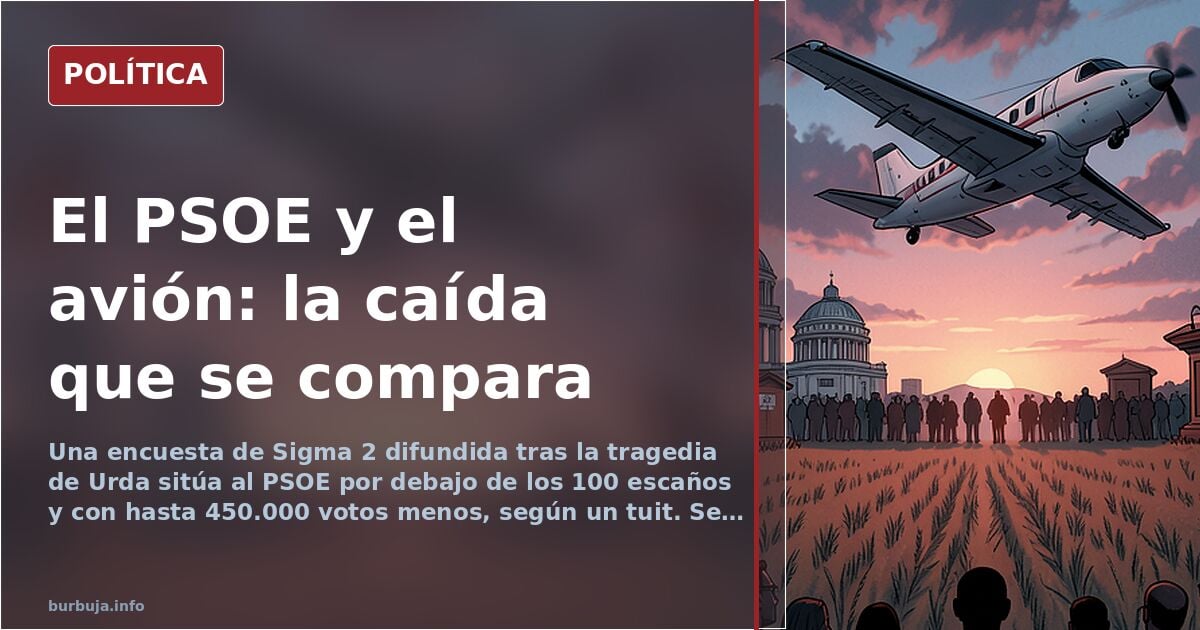
PSOE plunges in polls: up to 450,000 fewer votes
A Sigma 2 poll released after the Urda tragedy, during the pre-campaign for the November 29 elections, places the PSOE below 100 seats with a loss of up to 450,000 votes. This figure, circulating on social media and forums, would mark a historic low for Pedro Sánchez's party. No one in the Socialist camp has confirmed the technical details, but the shockwaves are already visible in comments: the narrative of resilience is cracking.
The poll no one denies
The survey, attributed to Sigma 2, has become the new mantra for digital opposition. It is not an isolated data point: the first poll after the Urda tragedy points to a drop of up to 450,000 votes, leaving the PSOE below 100 seats. According to the most widespread interpretation of the poll, this is the first time such a threshold has been crossed since Spain's democratic restoration. However, the fine print is conspicuously absent.
Meanwhile, friendly fire targets communication management. Critics highlight the use of a truck to promote the "national project" while high-estimulante ilegal rail (AVE), healthcare, and public education receive no similar deployment. The paradox is stark: institutional messaging travels by road while public services remain grounded.
Party pride and sectarianism
Statements by Amparo Rubiales—"If I am a patriot of anything, I am a patriot of my party"—have fueled the thesis of sectarianism. Some argue that the PSOE functions as a structure of blind loyalty, allowing it to withstand scandals like the ERE frauds, the power outage, incidents in Ceuta, Adamuz, and Urda, the Ferraz headquarters' controversies, or corruption. Activists, they say, vote PSOE regardless of what happens. That is the core problem for its critics.
Against this diagnosis, another current emphasizes that the PSOE does not need the traditional left because that left is broken. The disappearance of Podemos and Sumar from the electoral horizon would make the PSOE the only refuge for useful left-wing votes. The calculation is cold: with those parties at zero, Sánchez would capture the usual 12% of votes from habitual supporters. In that scenario, the decline would be less lethal for the brand.
Seat shuffle and defeat arithmetic
Not everyone buys the apocalyptic scenario. Some voices maintain that the seat count will not drop below 110-115, considering the Sigma 2 poll a pre-campaign artifact. The range makes sense: in politics, polls move based on headlines, and November 29 is still far off. The rush to bury the PSOE may be as premature as the rush to resurrect it.
The most optimistic calculation assumes the PP would govern with Bildu—the face Socialists will be left with, some joke—which opens a debate on governability. The question is not just how much the PSOE falls, but who picks up the pieces and at what price.
What lies behind Socialist voter demobilization?
The vote hemorrhage has no single explanation. Corruption is cited as a wear-and-tear factor, but also the impact of crisis management, such as in Urda. The feeling that the PSOE has become a power machine distributing nationalities and benefits among its electoral clientele feeds the narrative of demobilization. This widely shared diagnosis is not without nuances.
The system of 'apesebrados'—economic dependence on a power structure—has been described as one reason for loyal PSOE voting. Dismantling it gradually, they argue, would remove one incentive for captive votes. The other path would be tightening migration policy, but that is a different story.
The Florida plane and the sharpest fall
The metaphor titling this analysis compares the electoral fall to a plane crash in Florida. The image, taken from current events, summarizes the sensation of accelerated collapse. But so far, the data are just polls. And polls do not govern.
November 29 is the date everyone has marked. Until then, polls will continue to dance and narratives harden. Will the floor of 100 seats break, or will we witness another comeback by the party patriot?
Also available in: Deutsch
Summary of a discussion on Burbuja.info - Foro de economía, actualidad y política., translated from Spanish and reviewed before publication. Read the full discussion (17 replies).
More summaries
-
Polls give PP and Vox a majority but PSOE holds near 100 seats
Six polls give PP and Vox an absolute majority in Spain, but the PSOE holds above 100 seats. Some attribute its electoral floor to pensioner voters and…
-
Real estate holdings of Montse Mínguez's partner spark PSOE controversy
Sergi Vélez, partner of PSOE spokesperson Montse Mínguez, manages Nest Capital with 30 rental properties, according to Artículo14. The case reignites debate over...
-
Spain rail crash: 69 dead amid rising delays
The Urda train collision in Spain killed 69 people, sparking debate over safety warnings and Renfe's 40% delay increase.
-
Spain’s Transport Minister Puente resigns after parliamentary clash
Óscar Puente announces his resignation following a hearing at the Congress's Permanent Deputation, citing an incident he deems incompatible with holding office.
-
Italy's Viral Birth Rate Poster Error Sparks Debate
A viral poster attributed to Italy features a graphic error, highlighting real issues in housing and birth rates.
-
ABC criticized for focusing on goalkeeper over victim
A tweet criticizes ABC for centering the story on the goalkeeper rather than the 30-year-old man killed in the field.