
Italy's Viral Birth Rate Poster Error Sparks Debate
A viral poster attributed to Italy features a graphic error, highlighting real issues in housing and birth rates.
English · Original discussion in Spanish · Published
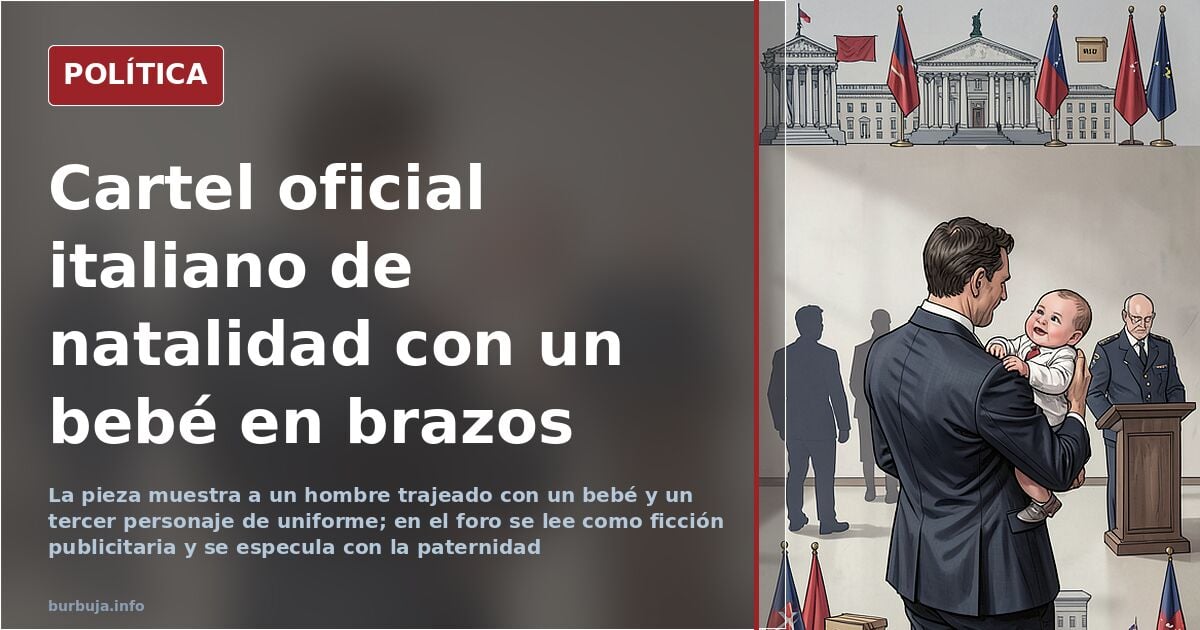
The Birth Rate Poster Nobody Signed
A baby, a woman, and two men. One in uniform, the other in a suit. And a third hand that shouldn't be there. The image circulates attributed to an Italian institutional campaign on birth rates and has become the perfect example of how a political message can die due to an execution detail. No one in the consulted material confirms the official authorship of the poster; what is clear is the effect: the piece reads as an involuntary joke about the family model it claims to defend.
The detail of the extra hand is minor. The major issue is that someone charged for the commission, another approved it, and a third paid for it. This is not a failure of the drawing tool: it is a quality control failure by people who don't look at what they sign. The anecdote serves a larger purpose: birth rate policy as a showcase.
Why Do Governments Talk About Birth Rates Instead of Housing?
Because housing is expensive to fix, while birth rates generate headlines. The diagnosis repeated in analyses is that the number one factor for low fertility is the price of shelter: late emancipation, rent consuming a huge part of the salary, and a mortgage lasting longer than the working life of the signer. Without stable housing, there are no cribs. That isn't solved with a poster.
Added to this is the pure cost: nursery, diapers, school when public options are far away. And the wage penalty for mothers, which in Spain is among the highest in Europe. Couples need two incomes to live, and the second is exactly the one that disappears when the child arrives. The real incentive has always been there, and it is not in a drawing.
The Argument of Those With Nothing to Lose
There is a current in the conversation defending the opposite of what seems apparent: if your emotional or economic situation is already bad, you ask for the maximum. Those with little to lose have every reason to be ambitious in their demands. Settling for little, they argue, guarantees lifelong frustration. It is a logic of personal redemption rather than public policy, and should be read as such: an opinion, not data.
In terms of genetics, the material also leaves statements that do not stand alone. That height or baldness are hereditary does not determine that a child will repeat the pattern: genetics is not linear, and cycles of beauty and ugliness repeat in each generation. The only thing definitely inherited are serious diseases, and that is another discussion.
Population Replacement as an Accounting Shortcut
The most uncomfortable part of the matter mixes birth rates with immigration. It is maintained that increasing the native population is a national priority and that the arrival of foreign workers covers the contribution hole. It is a debate existing throughout Europe, framed here as a dilemma: either raise birth rates or import labor. The accounting shows both have been done simultaneously, and neither has reversed the short-term trend.
The names in any province's delivery room are the thermometer of who lives there and who has children. It is not a conspiracy: it is textbook demography. And no OECD country has reversed its fertility decline solely with posters.
The poster will be forgotten. The question it leaves is more uncomfortable: if birth rates were truly a priority, the budget would be in rent, not in drawings. There the analysis stalls, because real estate remains a safe haven asset for half of Spain.
Also available in: Deutsch
Summary of a discussion on Burbuja.info - Foro de economía, actualidad y política., translated from Spanish and reviewed before publication. Read the full discussion (50 replies).
More summaries
-
Quechua tents and Soros accusation in a protest camp
Quechua tents at a protest camp and an unproven accusation of links to Soros are at the centre of the debate
-
PSOE polls crash: under 100 seats, losing 450k votes
Sigma 2 poll shows PSOE below 100 seats and down 450,000 votes ahead of Nov 29 elections.
-
Spain rail crash: 69 dead amid rising delays
The Urda train collision in Spain killed 69 people, sparking debate over safety warnings and Renfe's 40% delay increase.
-
Spain’s Transport Minister Puente resigns after parliamentary clash
Óscar Puente announces his resignation following a hearing at the Congress's Permanent Deputation, citing an incident he deems incompatible with holding office.
-
ABC criticized for focusing on goalkeeper over victim
A tweet criticizes ABC for centering the story on the goalkeeper rather than the 30-year-old man killed in the field.
-
Spain's Electoral Board Bans Sánchez Campaign Video
The Central Electoral Board removed a video of Pedro Sánchez at the Guernica. The clip cited his words on barbarism and coexistence. Here is what it implies.