
PSOE crisis: 535 million euros in suspicious public works contracts
Five projects in Murcia, Seville, La Rioja, and Barcelona involve 535 million euros in suspected kickbacks, increasing pressure on the Spanish Socialist Workers' Party.
English · Original discussion in Spanish · Published
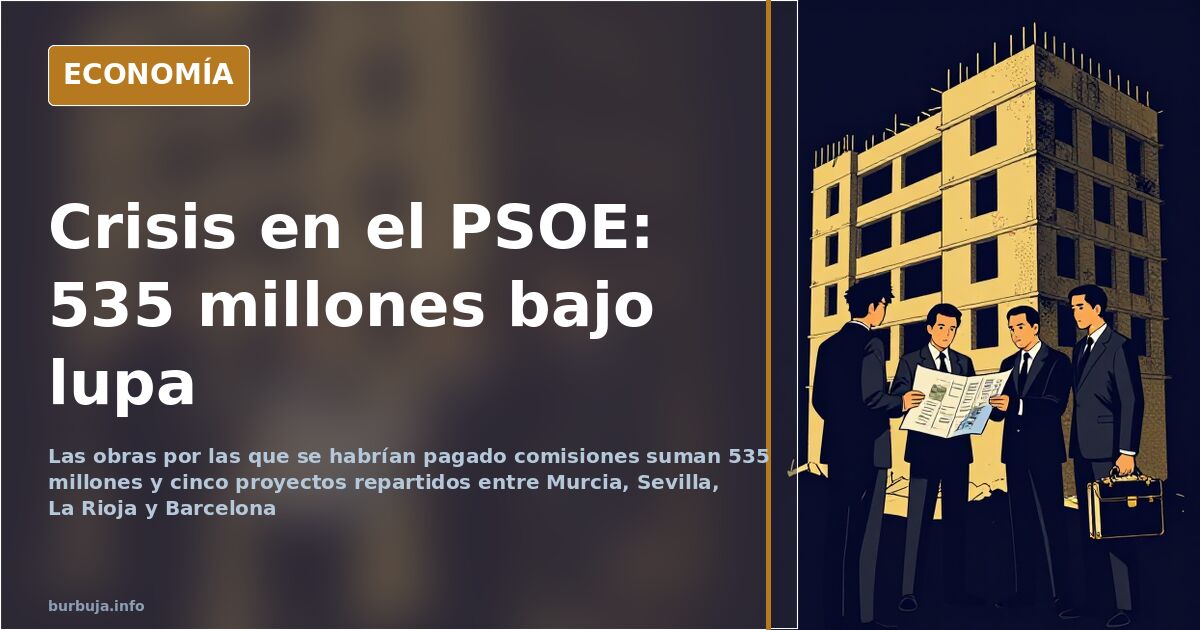
Suspicious public works total 535 million euros, tightening pressure on Ferraz
The Spanish Socialist Workers' Party (PSOE) is not imploding; it is bleeding out. The accumulation of reports on public contracts awarded under suspicion has placed the party in the most delicate phase of its recent history, with one figure clarifying the noise: the works involving suspected kickbacks total 535 million euros. This is not a campaign brochure number. It is the figure that has burst internal seams and explains why early elections are openly discussed.
The official narrative claims this is an adversary's smear campaign. Available accounting points elsewhere: five projects in Murcia, Seville, La Rioja, and Barcelona, with budgets inflated by 42 million euros over initial estimates and a trail of payments linked to Socialist leader José Luis Ábalos and Koldo. None of this is a final conviction. It must be repeated because public opinion has already passed judgment while the case remains under investigation.
Five works, four provinces, and 42 million in expansions
The administrative pattern repeats in the documents: public works tenders starting with one budget and ending with a much higher one. The documented cumulative expansion reaches 42 million euros, a significant figure in public contracting. According to published reports, the kickback circuit was built on this differential.
The geographic detail matters more than it seems. There is not a single focus, but several: Murcia, Seville, La Rioja, and Barcelona. This rules out the thesis of an isolated creative official and points, if confirmed, to a systematic structure. It also explains why the leak does not stop: each new work reopens the total figure.
The political aspect of the matter is sustained by the name of Santos Cerdán, mentioned in the reports. According to a comment in the thread, his presence in the party's graphic material has even been discussed, a communication detail in internal politics equivalent to removing someone from the family portrait without saying it aloud.
Why is resignation and August elections discussed?
The afternoon of the appearance became a countdown: a meeting over which an unstoppable rumor circulated about resignation and an electoral call for August. The detail that deflated most of the forecast was the scenario. The one who resigns calls the media from La Moncloa; the one managing an internal crisis does so from Ferraz. And the meeting was at Ferraz.
Nevertheless, the early election hypothesis has its arithmetic logic. A party that cannot pass budgets or sustain the legislative agenda reaches the end of the cycle without margin. The circulating dates pointed to August, an unusual month for general elections, which says much about the degree of desperation in the calculation.
The motion of censure no one plants
The most repeated analysis in recent weeks is that the Government does not fall due to parliamentary wear, but falls if it wants to. The partners supporting the majority have incentives to stay: outside the Executive, their seats are worth less. The exception would be Junts, which gains nothing by maintaining the block, and Podemos, which could capitalize the collapse with the flag of the fight against corruption.
The problem is who signs. A motion of censure requires an alternative candidate and a result, and the opposition's leading party does not seem willing to provide the votes. The other mechanisms to force an exit depend on the interested party itself: confidence issue, resignation, or dissolution of the Cortes. None is activated without their signature.
The voter who does not leave: 1996, Sumar, and the punishment vote
The comparison with the end of Felipe González's era appears as soon as the case rises in tone. Then, the socialist electorate responded with massive abstention, with no relevant shift to the right. The reading supported by some participants is that this scenario does not repeat: the left-wing voter would punish by diverting their vote to Sumar or Podemos, not staying home.
The most heard argument is from the manual: a left-wing government with corruption cases before a right-wing one. If this holds, the electoral drop would be much smaller than the volume of headlines suggests. It is not a reassuring calculation for the party, it is simply the calculation the party seems to be making.
What remains open: Segarro, primaries, and hands letting go
There are two black holes in this story that no one has closed. The first, an alleged rigging of the socialist primaries mentioned without proof and, for now, is only suspicion. The second, and more opaque: what has been agreed with Segarro and on what terms. Regarding this, there is simply no public information.
Meanwhile, the fight is fought internally. If Ábalos sees that the party has left Cerdán alone to save the rest of the building, the question is whether he pulls the blanket to drag more people down or stays still. It is the kind of doubt that decides cases, and it is not resolved in a news broadcast.
With this arithmetic and this leak, an early election in months would be reasonable. The party's history, however, says that it is also reasonable that absolutely nothing happens.
The Spanish Socialist Workers' Party (PSOE) is not imploding; it is bleeding out. The accumulation of reports on public contracts awarded under suspicion has placed the party in the most delicate phase of its recent history, with one figure clarifying the noise: the works involving suspected kickbacks total 535 million euros. This is not a campaign brochure number. It is the figure that has burst internal seams and explains why early elections are openly discussed.
The official narrative claims this is an adversary's smear campaign. Available accounting points elsewhere: five projects in Murcia, Seville, La Rioja, and Barcelona, with budgets inflated by 42 million euros over initial estimates and a trail of payments linked to Socialist leader José Luis Ábalos and Koldo. None of this is a final conviction. It must be repeated because public opinion has already passed judgment while the case remains under investigation.
Five works, four provinces, and 42 million in expansions
The administrative pattern repeats in the documents: public works tenders starting with one budget and ending with a much higher one. The documented cumulative expansion reaches 42 million euros, a significant figure in public contracting. According to published reports, the kickback circuit was built on this differential.
The geographic detail matters more than it seems. There is not a single focus, but several: Murcia, Seville, La Rioja, and Barcelona. This rules out the thesis of an isolated creative official and points, if confirmed, to a systematic structure. It also explains why the leak does not stop: each new work reopens the total figure.
The political aspect of the matter is sustained by the name of Santos Cerdán, mentioned in the reports. According to a comment in the thread, his presence in the party's graphic material has even been discussed, a communication detail in internal politics equivalent to removing someone from the family portrait without saying it aloud.
Why is resignation and August elections discussed?
The afternoon of the appearance became a countdown: a meeting over which an unstoppable rumor circulated about resignation and an electoral call for August. The detail that deflated most of the forecast was the scenario. The one who resigns calls the media from La Moncloa; the one managing an internal crisis does so from Ferraz. And the meeting was at Ferraz.
Nevertheless, the early election hypothesis has its arithmetic logic. A party that cannot pass budgets or sustain the legislative agenda reaches the end of the cycle without margin. The circulating dates pointed to August, an unusual month for general elections, which says much about the degree of desperation in the calculation.
The motion of censure no one plants
The most repeated analysis in recent weeks is that the Government does not fall due to parliamentary wear, but falls if it wants to. The partners supporting the majority have incentives to stay: outside the Executive, their seats are worth less. The exception would be Junts, which gains nothing by maintaining the block, and Podemos, which could capitalize the collapse with the flag of the fight against corruption.
The problem is who signs. A motion of censure requires an alternative candidate and a result, and the opposition's leading party does not seem willing to provide the votes. The other mechanisms to force an exit depend on the interested party itself: confidence issue, resignation, or dissolution of the Cortes. None is activated without their signature.
The voter who does not leave: 1996, Sumar, and the punishment vote
The comparison with the end of Felipe González's era appears as soon as the case rises in tone. Then, the socialist electorate responded with massive abstention, with no relevant shift to the right. The reading supported by some participants is that this scenario does not repeat: the left-wing voter would punish by diverting their vote to Sumar or Podemos, not staying home.
The most heard argument is from the manual: a left-wing government with corruption cases before a right-wing one. If this holds, the electoral drop would be much smaller than the volume of headlines suggests. It is not a reassuring calculation for the party, it is simply the calculation the party seems to be making.
What remains open: Segarro, primaries, and hands letting go
There are two black holes in this story that no one has closed. The first, an alleged rigging of the socialist primaries mentioned without proof and, for now, is only suspicion. The second, and more opaque: what has been agreed with Segarro and on what terms. Regarding this, there is simply no public information.
Meanwhile, the fight is fought internally. If Ábalos sees that the party has left Cerdán alone to save the rest of the building, the question is whether he pulls the blanket to drag more people down or stays still. It is the kind of doubt that decides cases, and it is not resolved in a news broadcast.
With this arithmetic and this leak, an early election in months would be reasonable. The party's history, however, says that it is also reasonable that absolutely nothing happens.
Also available in: Deutsch
Summary of a discussion on Burbuja.info - Foro de economía, actualidad y política., translated from Spanish and reviewed before publication. Read the full discussion (210 replies).
More summaries
-
Spain's PM Sánchez denies knowledge of Cerdán scandal
Spanish PM Pedro Sánchez claims ignorance of the alleged dirty tricks plot involving Santos Cerdán. We analyze competing views on whether this reflects incompetence or deceit.
-
Spain's Government Network: Ábalos, Cerdán, and Koldo in Corruption Scrutiny
Analysis of alleged ties between the Spanish Prime Minister and Ábalos or Cerdán amid ongoing political scandal and public skepticism.
-
PSOE's Ferraz Base: Sociatas and the Image of Party Loyalty
Analysis of the image at Ferraz: Ideological fanaticism or economic dependence? A breakdown of views on PSOE membership.
-
Riots in French schools: fires and attacks
Fires in French schools, teachers attacked and blockades spreading to Belgium. The unrest is attributed to the education strike and radical groups.
-
Greta Thunberg spotted on train to Vigo
Swedish activist Greta Thunberg photographed on a train bound for Vigo, sparking debate on climate consistency.
-
Spanish teen dies after stroke misdiagnosed as ear infection
Maria, 18, died two days after ER residents diagnosed vertigo and loss of consciousness as otitis. The case highlights supervision failures in Spain's public health system.