
PSOE and Podemos amend Spain's parity law to remove male cap
PSOE and Podemos agreed to modify Spain's Parity Law, allowing women to exceed the 60% quota while removing any minimum limit for men.
English · Original discussion in Spanish · Published
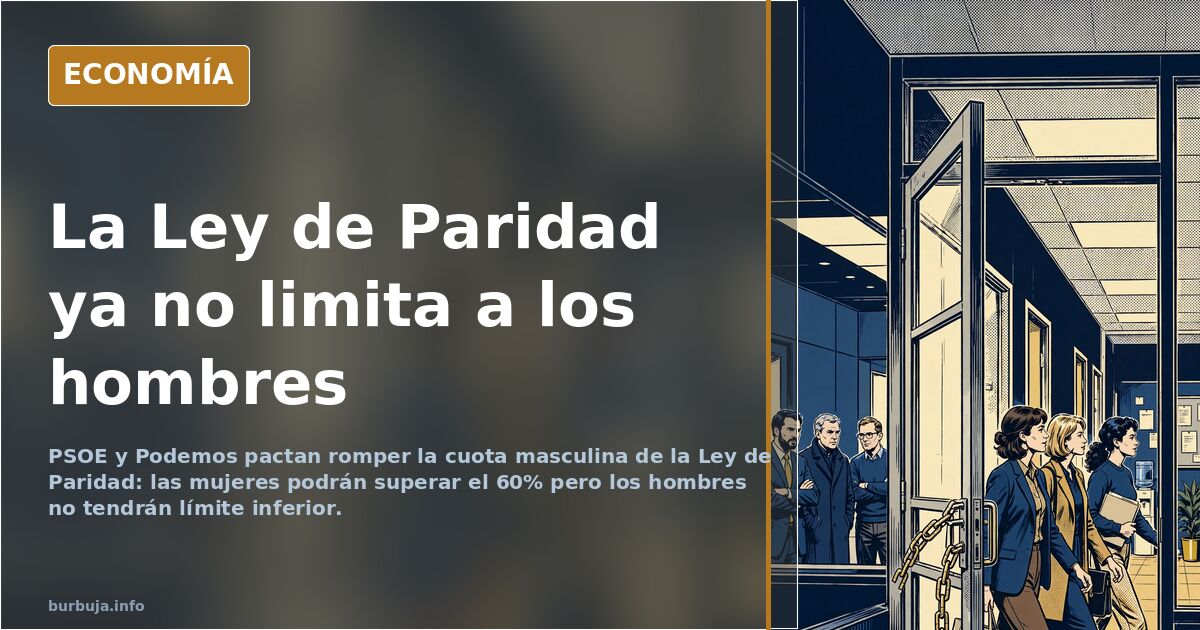
PSOE and Podemos agree to eliminate the 60% ceiling for men in Spain's Parity Law
The joint amendment by PSOE and Podemos breaks the balance of Spain's Parity Law: women may exceed 60% representation in public bodies and listed company boards, while men face no lower limit. The report passed the Congress Equality Committee with 20 votes in favor and 17 against, rejected by PP and Vox. The rule affects the Government, Constitutional Court, CGPJ, Council of State, and Court of Auditors.
What exactly changes in the Parity Law amendment
The original text required gender balance: neither sens could exceed 60% or fall below 40%. The new additional provision states that balanced representation criteria "may not apply... when there is a representation of women exceeding sixty percent," which must be justified. In practice, the law mandates at least 40% women but allows men to drop below that percentage without limit.
Podemos Secretary General Ione Belarra welcomed the change, citing Irene Montero’s ministerial cabinet as an example where they would have had to dismiss women to meet the 40% male minimum. Party sources argue that capping female representation at 60% would effectively end positive action and risk excluding women from leadership roles, similar to the 2019 Canary Islands Parliament board composition.
Why PSOE now accepts breaking its own quota
The agreement came late, during the final vote on the bill before it goes to the Plenary. It passed with the same 20-17 majority. PSOE needed Podemos’ votes to ensure the law’s approval in its last parliamentary step.
Critics argue this makes parity asymmetric: protecting a minimum for women but not men. Supporters counter that positive action only corrects historical disadvantages, and symmetric quotas perpetuate inequality. The core debate is whether parity means equal balance or a floor for underrepresented groups.
Who is affected by the Parity Law and when
Once in force, the norm applies to constitutional bodies—Government, Constitutional Court, CGPJ, Council of State, Court of Auditors—senior management of state public entities, directors of listed companies, professional associations, and award committees funded by the central administration.
Impact on the private sector remains uncertain. While the law sets the framework, enforcement in corporate boards depends on future verification mechanisms. In the public sector, appointments must justify any deviation from parity criteria.
Criticism: unconstitutionality and double standards
Some analysts argue the amendment introduces sens-based discrimination potentially conflicting with Article 14 of the Spanish Constitution, which prohibits discrimination based on sens among other grounds. This objection isn’t new; even the original law raised doubts about compatibility with formal equality principles.
The most common criticism is the double standard: if parity forbids any sens exceeding 60%, allowing women to do so while barring men from falling below 40% turns parity into a directional concept. The official defense maintains that positive action justifies correcting female underrepresentation, not maintaining symmetric balance.
With these provisions, the law will likely pass the Plenary. However, how actual composition evolves remains unclear, as does whether the Constitutional Court will address the asymmetry. Prudent prediction: the legal debate has only just begun.
The joint amendment by PSOE and Podemos breaks the balance of Spain's Parity Law: women may exceed 60% representation in public bodies and listed company boards, while men face no lower limit. The report passed the Congress Equality Committee with 20 votes in favor and 17 against, rejected by PP and Vox. The rule affects the Government, Constitutional Court, CGPJ, Council of State, and Court of Auditors.
What exactly changes in the Parity Law amendment
The original text required gender balance: neither sens could exceed 60% or fall below 40%. The new additional provision states that balanced representation criteria "may not apply... when there is a representation of women exceeding sixty percent," which must be justified. In practice, the law mandates at least 40% women but allows men to drop below that percentage without limit.
Podemos Secretary General Ione Belarra welcomed the change, citing Irene Montero’s ministerial cabinet as an example where they would have had to dismiss women to meet the 40% male minimum. Party sources argue that capping female representation at 60% would effectively end positive action and risk excluding women from leadership roles, similar to the 2019 Canary Islands Parliament board composition.
Why PSOE now accepts breaking its own quota
The agreement came late, during the final vote on the bill before it goes to the Plenary. It passed with the same 20-17 majority. PSOE needed Podemos’ votes to ensure the law’s approval in its last parliamentary step.
Critics argue this makes parity asymmetric: protecting a minimum for women but not men. Supporters counter that positive action only corrects historical disadvantages, and symmetric quotas perpetuate inequality. The core debate is whether parity means equal balance or a floor for underrepresented groups.
Who is affected by the Parity Law and when
Once in force, the norm applies to constitutional bodies—Government, Constitutional Court, CGPJ, Council of State, Court of Auditors—senior management of state public entities, directors of listed companies, professional associations, and award committees funded by the central administration.
Impact on the private sector remains uncertain. While the law sets the framework, enforcement in corporate boards depends on future verification mechanisms. In the public sector, appointments must justify any deviation from parity criteria.
Criticism: unconstitutionality and double standards
Some analysts argue the amendment introduces sens-based discrimination potentially conflicting with Article 14 of the Spanish Constitution, which prohibits discrimination based on sens among other grounds. This objection isn’t new; even the original law raised doubts about compatibility with formal equality principles.
The most common criticism is the double standard: if parity forbids any sens exceeding 60%, allowing women to do so while barring men from falling below 40% turns parity into a directional concept. The official defense maintains that positive action justifies correcting female underrepresentation, not maintaining symmetric balance.
With these provisions, the law will likely pass the Plenary. However, how actual composition evolves remains unclear, as does whether the Constitutional Court will address the asymmetry. Prudent prediction: the legal debate has only just begun.
Also available in: Deutsch
Summary of a discussion on Burbuja.info - Foro de economía, actualidad y política., translated from Spanish and reviewed before publication. Read the full discussion (114 replies).
More summaries
-
Cerezo Slams Montero and Belarra with Epithets: Podemos Walks Out
Patricia Cerezo hurled insults at Montero and Belarra; Pablo Fernández (Podemos) abandoned the set, and the collaborator retracted her comments after the commercial break.
-
Montero and Belarra bathroom photo sparks backlash
A photo of Spanish politicians Irene Montero and Ione Belarra in a bar restroom triggers criticism over perceived frivolity amid economic hardship.
-
Podemos demands Montero stay as Equality Minister for investiture
Podemos conditions its support on Irene Montero remaining in the Equality Ministry, while she blames Justice for sentence reviews.
-
AI-driven decompilation threatens proprietary software giants
Amateur groups use AI to decompile Adobe suites, cloning commercial apps in days and shaking the software industry.
-
Spain Divided Over Princess Leonor's Role as Europe Watches
Princess Leonor's military training and the Crown's cost reignite debate on Spain's monarchy utility amid European comparisons.
-
Juanma Moreno's Granada Photo Sparks Outrage in Spain's PP
In late 2021, a photo of Juanma Moreno and PP colleagues in Granada without visible restrictions triggered accusations of double standards.