
Protest at Ferraz 20:00: Desokupa link and riot fears
A 20:00 protest at Ferraz against the amnesty, attributed to Desokupa, raises fears of riots and potential fines up to 600,000 euros.
English · Original discussion in Spanish · Published
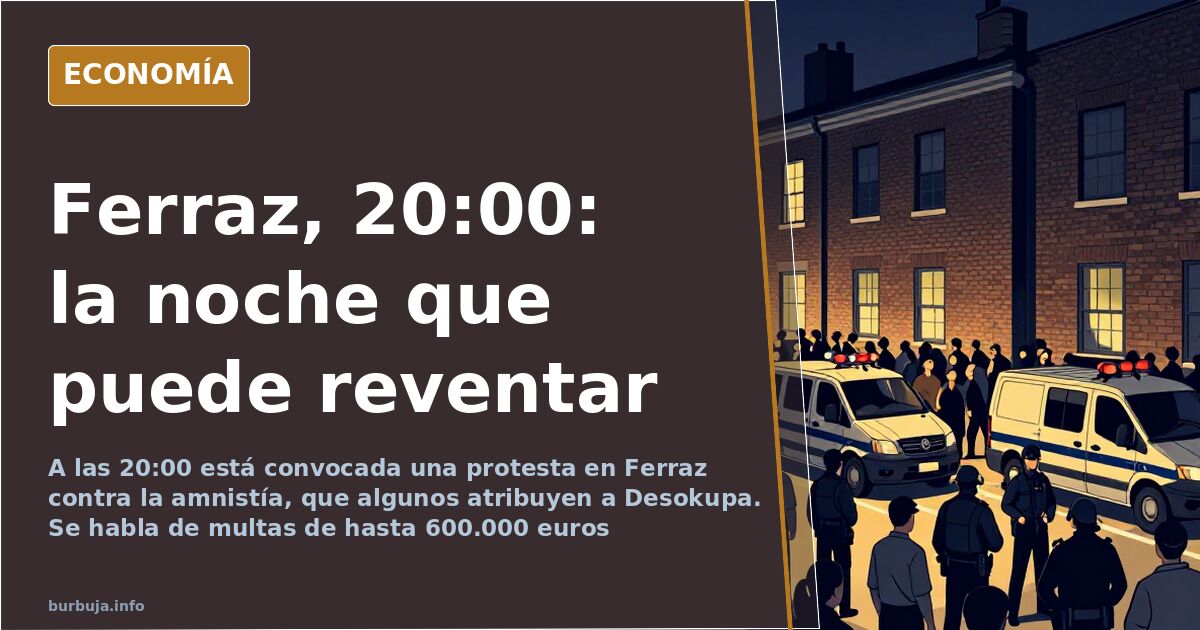
At 20:00 in Ferraz: the gamble linked to Desokupa
Hours before the streets fill up in Ferraz, the question is no longer how many will attend, but who wants the night to end badly. The call attributed to Desokupa for 20:00 in front of the socialist headquarters, during a protest against the amnesty, came with the promise to «accompany and defend the people» and a «TIC TAC, Pedrito» as a hook. On paper, popular support. In practice, the announcement set off all alarms.
Because if anything dominates the pre-event analysis, it is an uncomfortable suspicion: that the day will not be measured by attendees, but by what television stations report the next day. And there, several claim, the script is already written.
What has been called for in Ferraz and at what time
The message that sparked the controversy is brief: presence at Ferraz at 20:00, accompanying the «people» and the idea that «Spain has just awakened.» This is spread by a profile calling for mobilization that same afternoon, framed within protests against the amnesty law. The PSOE headquarters thus becomes the target of a protest presented as citizen defense.
Behind this provocation are names that reappear in every chronicle: that of Desokupa and that of Alvise Pérez, whom part of the analysis places as the organizer and describes as a professional agitator. This reading is an opinion, not a proven fact, but it explains why so many anticipate problems.
Antiestéticar that the night ends in riots
No one hides the forecast. Part of the messages assumes that, after 22:00, there will be incidents, and places the organizers at the center of the scene. The narrative that is already circulating before anything happens points to the first hours passing without incident and the clash arriving later, when the cameras of the prime-time news are already recording.
The police find themselves in the crossfire. Some wish them courage, while others reproach the use of force against elderly people while, according to this same version, they do not act in other fronts. Unproven accusations, attributed to others, shape the tone of a day charged with electricity.
Underlying this is a recurring thesis: on the street, whoever has the force has the reason, and any disorder ends up serving whoever controls the narrative. That is why many see the call as a poisoned gift that the Government could profit from if the night goes off track.
What is the fine for calling an uncommunicated protest?
The figure is repeated insistently: up to 600,000 euros in sanctions for calling without the prior notification required by the so-called gag law. The Police, they say, already have the organizers identified, which opens the door to a parallel file to the demonstration itself. The economic threat functions as a warning and an argument: whoever moves people to the street also assumes the legal cost.
Who benefits electorally from the Ferraz night?
Here the debate splits in two. Some maintain that the Vox party, with more than half a million votes lost in the last election, does not need more street noise but parliamentary battle. The street gives visibility, it is conceded, but narrows the electoral base and confines it to a minority role. Others defend the opposite: without tension on the street, the adversary continues to govern without a toll.
The shared risk by almost all is the contagion of the violent label. If the protest is confused with riots, they warn, the PP and Vox will end up in the same bag as the riot squads and pay the price at the polls. Hence the requests for preventive institutional condemnation: to distance themselves before it is too late.
The amnesty, the trigger no one deactivates
The thread that originated everything points to the amnesty as the issue that sparked the fuse. The underlying discussion is not about public order, but institutional architecture: a considerable part of the messages takes for granted that the separation of powers has ceased to exist and that protest is now the only remaining path. It is a debatable political statement, and as such it is posed, not as a fact.
The range of positions within this discontent is broad. In front of those who call for a tougher opposition, capable of standing up without complexes, others warn that this path erodes the moderate base and fuels the framework the adversary needs. Comparisons with institutional ruptures in other countries cross with the warning that forcing unity through imposition eventually takes a toll.
The circle closes with a scene identical to any tense night in Madrid: while Ferraz fills up, the news menu mixes the protest with a live TV broadcast and with the penultimate twist of a football judicial case. The news, as always, in chains.
And if the night ends without incident, will someone pay for having announced it?
Hours before the streets fill up in Ferraz, the question is no longer how many will attend, but who wants the night to end badly. The call attributed to Desokupa for 20:00 in front of the socialist headquarters, during a protest against the amnesty, came with the promise to «accompany and defend the people» and a «TIC TAC, Pedrito» as a hook. On paper, popular support. In practice, the announcement set off all alarms.
Because if anything dominates the pre-event analysis, it is an uncomfortable suspicion: that the day will not be measured by attendees, but by what television stations report the next day. And there, several claim, the script is already written.
What has been called for in Ferraz and at what time
The message that sparked the controversy is brief: presence at Ferraz at 20:00, accompanying the «people» and the idea that «Spain has just awakened.» This is spread by a profile calling for mobilization that same afternoon, framed within protests against the amnesty law. The PSOE headquarters thus becomes the target of a protest presented as citizen defense.
Behind this provocation are names that reappear in every chronicle: that of Desokupa and that of Alvise Pérez, whom part of the analysis places as the organizer and describes as a professional agitator. This reading is an opinion, not a proven fact, but it explains why so many anticipate problems.
Antiestéticar that the night ends in riots
No one hides the forecast. Part of the messages assumes that, after 22:00, there will be incidents, and places the organizers at the center of the scene. The narrative that is already circulating before anything happens points to the first hours passing without incident and the clash arriving later, when the cameras of the prime-time news are already recording.
The police find themselves in the crossfire. Some wish them courage, while others reproach the use of force against elderly people while, according to this same version, they do not act in other fronts. Unproven accusations, attributed to others, shape the tone of a day charged with electricity.
Underlying this is a recurring thesis: on the street, whoever has the force has the reason, and any disorder ends up serving whoever controls the narrative. That is why many see the call as a poisoned gift that the Government could profit from if the night goes off track.
What is the fine for calling an uncommunicated protest?
The figure is repeated insistently: up to 600,000 euros in sanctions for calling without the prior notification required by the so-called gag law. The Police, they say, already have the organizers identified, which opens the door to a parallel file to the demonstration itself. The economic threat functions as a warning and an argument: whoever moves people to the street also assumes the legal cost.
Who benefits electorally from the Ferraz night?
Here the debate splits in two. Some maintain that the Vox party, with more than half a million votes lost in the last election, does not need more street noise but parliamentary battle. The street gives visibility, it is conceded, but narrows the electoral base and confines it to a minority role. Others defend the opposite: without tension on the street, the adversary continues to govern without a toll.
The shared risk by almost all is the contagion of the violent label. If the protest is confused with riots, they warn, the PP and Vox will end up in the same bag as the riot squads and pay the price at the polls. Hence the requests for preventive institutional condemnation: to distance themselves before it is too late.
The amnesty, the trigger no one deactivates
The thread that originated everything points to the amnesty as the issue that sparked the fuse. The underlying discussion is not about public order, but institutional architecture: a considerable part of the messages takes for granted that the separation of powers has ceased to exist and that protest is now the only remaining path. It is a debatable political statement, and as such it is posed, not as a fact.
The range of positions within this discontent is broad. In front of those who call for a tougher opposition, capable of standing up without complexes, others warn that this path erodes the moderate base and fuels the framework the adversary needs. Comparisons with institutional ruptures in other countries cross with the warning that forcing unity through imposition eventually takes a toll.
The circle closes with a scene identical to any tense night in Madrid: while Ferraz fills up, the news menu mixes the protest with a live TV broadcast and with the penultimate twist of a football judicial case. The news, as always, in chains.
And if the night ends without incident, will someone pay for having announced it?
Also available in: Deutsch
Summary of a discussion on Burbuja.info - Foro de economía, actualidad y política., translated from Spanish and reviewed before publication. Read the full discussion (412 replies).
More summaries
-
Investiture Narrative Fractures as La Sexta Turns to PSOE
La Sexta moderates its support for the official story as the investiture and amnesty split the PSOE, while protests at Ferraz persist.
-
Spain's Police in Madrid: The Cost of System Loyalty
Police actions at Ferraz spark debate on institutional loyalty. Salary parity as a control tool and the precedent...
-
PSOE lawsuits against Alvise dismissed: a judicial victory?
The PSOE sees all its lawsuits against Alvise Pérez dismissed. His supporters celebrate while doubts about Timospain and the €100,000 in cash persist.
-
Madrid rental listings drop 20% after decree
Forum users track Madrid's rental supply falling from 11,815 to 9,398 ads in one day. They blame the new decree. Barcelona has only 680 long-term rentals.
-
Spain's Parasite Debate: Cultural Shock or Marketing?
Analysis of the debate on deworming in Spain: is it a cultural clash, a public health need, or just marketing?
-
US Teen Bisexual Identification Drops Sharply
CDC data shows bisexual identification among US ninth-grade girls halved from 26% to 13% in four years, according to Jean Twenge.