
Protest in Madrid: Fear of Riots at PSOE Headquarters
A protest against the amnesty law is planned for 8 PM at Ferraz Street, attributed to Desokupa. Fines up to €600,000 are threatened.
Deutsch · Ursprüngliche Diskussion auf Spanisch · Veröffentlicht
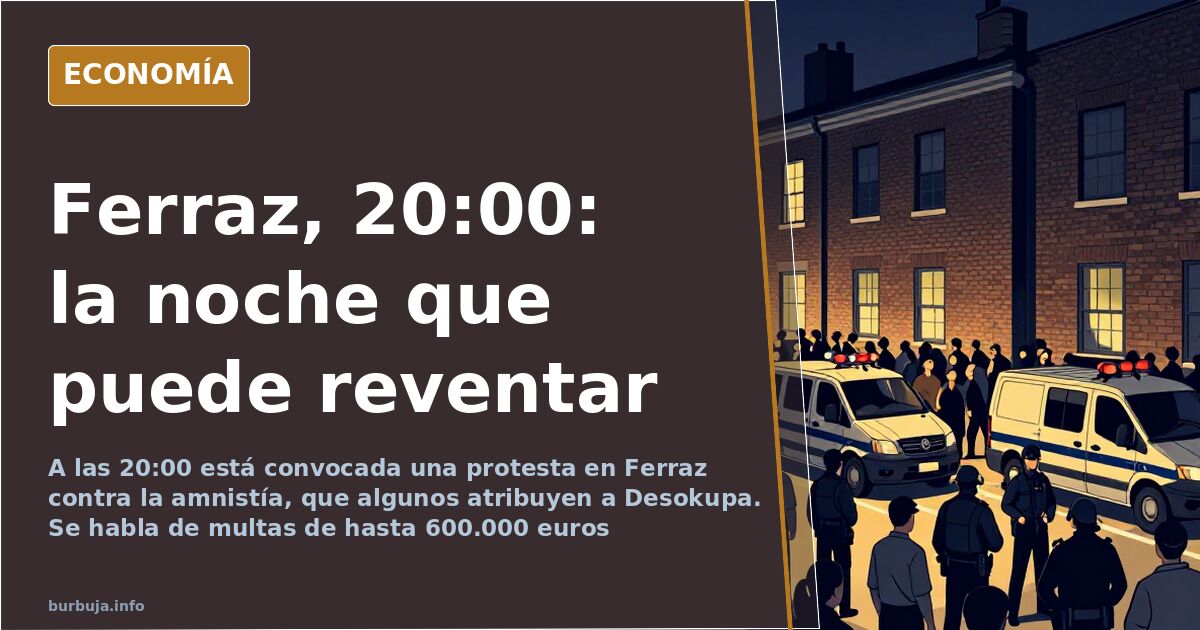
At 8 PM on Ferraz Street: The ultimatum attributed to Desokupa
Hours before the street fills up on Ferraz Street, the question is no longer how many people will attend, but who wants the night to end badly. The call attributed to Desokupa for 8 PM in front of the Socialist Party (PSOE) headquarters, amidst protests against the amnesty law, came with the promise to "accompany and defend the people" and a "TIC TAC, Pedrito" as a slogan. On paper, popular support. In practice, the announcement set off all alarms.
Because if anything dominates prior analyses, it is an uncomfortable suspicion: that the day will not be measured by attendees, but by what television stations report the next day. And there, several argue, the script is already written.
What was called for on Ferraz Street and at what time
The message that sparked the controversy is brief: presence on Ferraz Street at 8 PM, accompaniment to the "people," and the idea that "Spain has just awakened." It is spread by a profile calling for mobilization that same afternoon, framed within protests against the amnesty law. The PSOE headquarters thus becomes the target of a protest presented as civic defense.
Behind the challenge are names that reappear in every chronicle: Desokupa and Alvise Pérez, whom part of the analysis places as the organizer and describes as a professional agitator. That reading is an opinion, not a proven fact, but it explains why so many anticipate problems.
Antiestéticar that the night ends in riots
No one hides the forecast. Some messages assume that incidents will occur after 10 PM, placing the organizers at the center of the scene. The narrative circulating before it happens suggests that the first hours could pass without incident and that the clash would come later, when prime-time news cameras are already recording.
The police find themselves in the crossfire. Some wish them luck, while others criticize the use of force against elderly people while, according to the same version, they do not act on other fronts. Attributed criticisms, none proven, which outline the tone of a day charged with electricity.
In the background pulses a recurring thesis: in the street, whoever has the force has the reason, and any disorder ultimately serves those who control the narrative. That is why many see in the call a poisoned gift that the Government could profit from if the night goes off the rails.
What is the fine for calling an unnotified protest?
The figure is repeated insistently: up to €600,000 in sanctions for calling without the prior notification required by the so-called gag law. The Police, they say, have already identified those responsible for the call, opening the door to a parallel file to the demonstration itself. The economic threat works as a warning and as an argument: whoever moves people into the street also assumes the legal cost.
Who benefits electorally from the night on Ferraz Street?
Here the debate splits in two. Some argue that Vox, with more than half a million votes lost in the last election, does not need more street noise but parliamentary battle. The street gives visibility, they concede, but narrows the electoral base and locks you into a minority role. Others defend exactly the opposite: without tension in the street, the adversary continues governing without paying a price.
The risk shared by almost everyone is the contagion of the violent label. If the protest is confused with riots, they warn, the PP and Vox will end up in the same bag as shock groups and pay the bill at the polls. Hence the requests for preventive institutional condemnation: marking distance before it is too late.
The amnesty, the trigger no one deactivates
The thread that started everything points to the amnesty as the issue that lit the spark. The underlying discussion is not about public order, but about institutional architecture: a considerable part of the messages assume that the separation of powers has ceased to exist and that protest is now the only remaining path. It is a debatable political statement, and as such it is raised, not as data.
The range of positions within that discontent is broad. Facing those who ask for a harder opposition, capable of standing up without complexes, others warn that this path erodes the moderate base and feeds the framework that the adversary needs. Comparisons with institutional ruptures in other countries intersect with the warning that forcing unity through imposition ultimately takes its toll.
Closing the circle is a scene identical to any tense night in Madrid: while Ferraz Street fills up, the news menu mixes the protest with a live TV broadcast and the latest twist in a football judicial case. Current affairs, as always, in chain.
And if the night ends without incidents, will someone pay for having announced it?
Hours before the street fills up on Ferraz Street, the question is no longer how many people will attend, but who wants the night to end badly. The call attributed to Desokupa for 8 PM in front of the Socialist Party (PSOE) headquarters, amidst protests against the amnesty law, came with the promise to "accompany and defend the people" and a "TIC TAC, Pedrito" as a slogan. On paper, popular support. In practice, the announcement set off all alarms.
Because if anything dominates prior analyses, it is an uncomfortable suspicion: that the day will not be measured by attendees, but by what television stations report the next day. And there, several argue, the script is already written.
What was called for on Ferraz Street and at what time
The message that sparked the controversy is brief: presence on Ferraz Street at 8 PM, accompaniment to the "people," and the idea that "Spain has just awakened." It is spread by a profile calling for mobilization that same afternoon, framed within protests against the amnesty law. The PSOE headquarters thus becomes the target of a protest presented as civic defense.
Behind the challenge are names that reappear in every chronicle: Desokupa and Alvise Pérez, whom part of the analysis places as the organizer and describes as a professional agitator. That reading is an opinion, not a proven fact, but it explains why so many anticipate problems.
Antiestéticar that the night ends in riots
No one hides the forecast. Some messages assume that incidents will occur after 10 PM, placing the organizers at the center of the scene. The narrative circulating before it happens suggests that the first hours could pass without incident and that the clash would come later, when prime-time news cameras are already recording.
The police find themselves in the crossfire. Some wish them luck, while others criticize the use of force against elderly people while, according to the same version, they do not act on other fronts. Attributed criticisms, none proven, which outline the tone of a day charged with electricity.
In the background pulses a recurring thesis: in the street, whoever has the force has the reason, and any disorder ultimately serves those who control the narrative. That is why many see in the call a poisoned gift that the Government could profit from if the night goes off the rails.
What is the fine for calling an unnotified protest?
The figure is repeated insistently: up to €600,000 in sanctions for calling without the prior notification required by the so-called gag law. The Police, they say, have already identified those responsible for the call, opening the door to a parallel file to the demonstration itself. The economic threat works as a warning and as an argument: whoever moves people into the street also assumes the legal cost.
Who benefits electorally from the night on Ferraz Street?
Here the debate splits in two. Some argue that Vox, with more than half a million votes lost in the last election, does not need more street noise but parliamentary battle. The street gives visibility, they concede, but narrows the electoral base and locks you into a minority role. Others defend exactly the opposite: without tension in the street, the adversary continues governing without paying a price.
The risk shared by almost everyone is the contagion of the violent label. If the protest is confused with riots, they warn, the PP and Vox will end up in the same bag as shock groups and pay the bill at the polls. Hence the requests for preventive institutional condemnation: marking distance before it is too late.
The amnesty, the trigger no one deactivates
The thread that started everything points to the amnesty as the issue that lit the spark. The underlying discussion is not about public order, but about institutional architecture: a considerable part of the messages assume that the separation of powers has ceased to exist and that protest is now the only remaining path. It is a debatable political statement, and as such it is raised, not as data.
The range of positions within that discontent is broad. Facing those who ask for a harder opposition, capable of standing up without complexes, others warn that this path erodes the moderate base and feeds the framework that the adversary needs. Comparisons with institutional ruptures in other countries intersect with the warning that forcing unity through imposition ultimately takes its toll.
Closing the circle is a scene identical to any tense night in Madrid: while Ferraz Street fills up, the news menu mixes the protest with a live TV broadcast and the latest twist in a football judicial case. Current affairs, as always, in chain.
And if the night ends without incidents, will someone pay for having announced it?
Auch verfügbar auf: English
Zusammenfassung einer Diskussion auf Burbuja.info - Foro de economía, actualidad y política., aus dem Spanischen übersetzt und vor der Veröffentlichung geprüft. Die ganze Diskussion lesen (412 Antworten).
Weitere Zusammenfassungen
-
La Sexta distanziert sich von PSOE-Narrativ zur Investitur
La Sexta lockert die Unterstützung für das offizielle Narrativ, während Amnestie und Investitur die PSOE spalten und Proteste vor der Parteizentrale anhalten.
-
PSOE-Anzeigen gegen Alvise Pérez eingestellt
Alle Anzeigen des PSOE gegen Alvise Pérez wurden eingestellt. Seine Anhänger feiern dies, während Zweifel an Timospain und den 100.000 € Bargeld bestehen bleiben.
-
Mietangebote in Madrid fallen um 20 % nach Dekret
Forennutzer beobachten das Mietangebot in Madrid: von 11.815 auf 9.398 Inserate an einem Tag. Sie führen den Rückgang auf das Dekret zurück. Barcelona hat nur noch 680 Langzeitmietwohnungen.
-
15 Jahre Auto: 195 € monatlich ohne Sprit
Ein 17.500-€-Auto kostet über 15 Jahre 35.150 €. Das sind 195 € pro Monat ohne Kraftstoff bei 240.000 km. Leasing wird zur Alternative.
-
Zehn Jagdhunde: 1.000 Euro monatlich und zwei Pfleger
Ein Besitzer von zehn Jagdhunden schätzt die Unterhaltskosten auf über 1.000 Euro pro Monat und beschäftigt zwei Pflegekräfte, ohne jemals eine genaue Kalkulation erstellt zu haben.
-
93,8 % der Umfrage-Teilnehmer fühlen sich in Spanien nicht frei
Eine offene Umfrage zur Freiheit in Spanien endet mit 93,8 % negativen Antworten; nur 6,2 % fühlen sich frei.