
Promised Job, €200 a Month, and No Home: The Network That Helped
From €500 promised to €200 a month and a night at Barajas T4: citizen aid fills the gap left by social services.
English · Original discussion in Spanish · Published
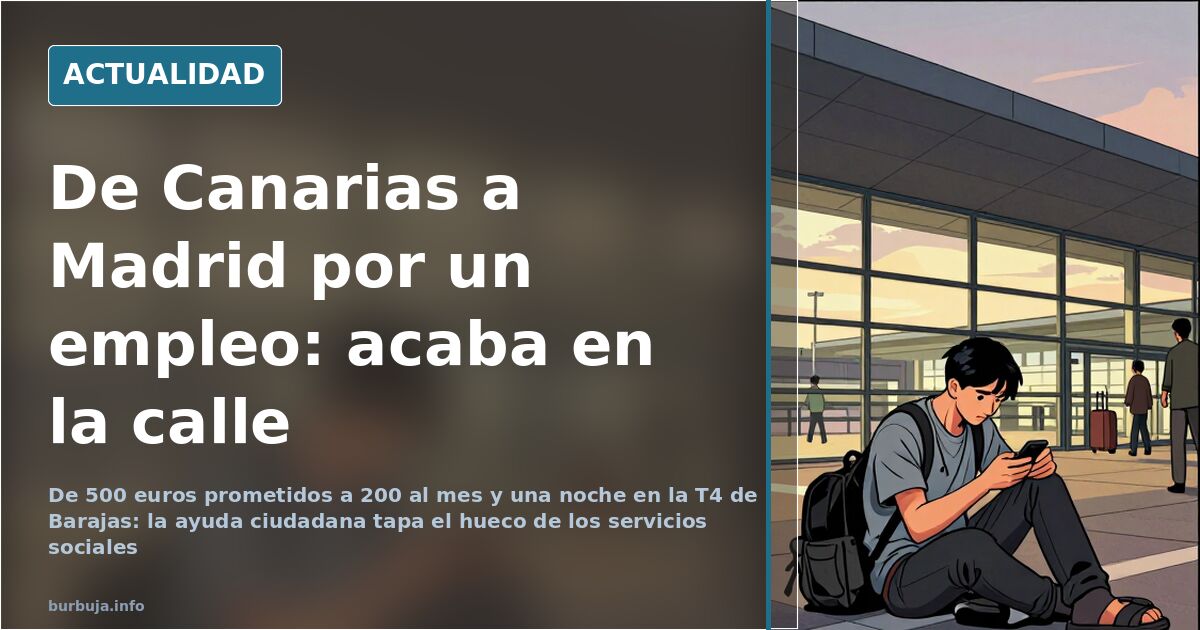
A Promised Job in Madrid Left a Person Homeless
Searching for work across Spain can be more expensive than not searching at all. A man traveled from the Canary Islands to Madrid with a job offer that, according to his own account, fell apart within hours: from the promised 500 euros, it dropped to 200 a month, full-time work, and accommodation in a town near Arganda del Rey. The episode ended with the person homeless at Barajas T4, and dozens of strangers organizing his departure. The events have not been independently verified.
What has been documented, and it's significant, is the chain of aid. Messages in the early morning, cross-country calls, and app contacts to get food, a location, and an exit plan within hours. The machinery worked. How aid is distributed in Spain is another matter.
What Peine with the Job Offer Near Arganda del Rey
The starting point, according to the account shared in the first person, was an online contact. Pick-up in Madrid, transfer to a town, and upon arrival, a change in conditions that no one had signed. The message sent past 11:30 PM on July 31st was explicit: "I've been scammed", wrote the affected person, who claimed to have ended up working every day for 200 euros a month. He stated he still had money in his account but no way to access it.
The geography of the case—a municipality in southeastern Madrid, near Arganda—comes from the affected person's own account. The conditions described—daily work, pay far below the agreed amount, and dependence on the employer—are part of his version, not independently verified.
Food, Winter Clothes, and a Bed: The Strangers' Operation
Once the whereabouts were confirmed, the aid was organized manually. A phone contact ruled out the worst, and another offered to cover the transfer north, to a town in Soria, with bed and food guaranteed. Winter clothes were also put on the table, the most telling detail of how little he had. Some offered food from Toledo, and others mentioned a job posting in Sabadell.
The itinerary changed several times in a few hours. First Madrid, with an overnight stay in the arrivals terminal of the airport. Then Soria. And finally, Valencia, with improvised accommodation for the night. All managed by phone, without most of the participants ever meeting in person. That's the anomaly: a logistical operation that no public agency coordinated.
Why Did the Help Come via WhatsApp and Not Through Official Channels?
Because doors open during office hours, and emergencies don't adhere to schedules. Among the alternatives mentioned were the social services of the Barajas district, the Teresa de Calcuta center at Plaza Navío 4 in Madrid (phone 913295920, open 09:00-13:00 and 15:00-19:00), the Cáritas network, and the classic parish resource. A food bank can solve two days' needs. It doesn't solve a month.
The gap isn't new but widens in August. Reception facilities operate by appointment, shelters are strained, and airport terminals become, by default, a refuge for those with nowhere to go. A resource that exists de facto and that no one counts as such.
Solidarity or Fraud: The Impossible Filter
The conversation quickly split. One side urged action without conditions: five euros is nothing, and the alternative for the affected person was the street. Another recalled that online help requests are a minefield and suggested, without any proof, that the story might hide addiction or deliberate fabrication. None of these hypotheses were supported by data.
The most uncomfortable detail isn't the doubt, which is reasonable, but its price. Demanding verification from someone sleeping rough is like demanding paperwork they cannot provide. The other side is equally true: those who help blindly assume a risk. No system has resolved the balance between these two, let alone a network of volunteers via messaging.
With the available resources, it's likely this case will fade without a trace—a person housed for a few days, a conversation that stops updating—and the next identical emergency will be resolved the same way: by phone, among strangers, without records or statistics. How many such episodes occur each month in Spain is, quite simply, a figure no one has.
Searching for work across Spain can be more expensive than not searching at all. A man traveled from the Canary Islands to Madrid with a job offer that, according to his own account, fell apart within hours: from the promised 500 euros, it dropped to 200 a month, full-time work, and accommodation in a town near Arganda del Rey. The episode ended with the person homeless at Barajas T4, and dozens of strangers organizing his departure. The events have not been independently verified.
What has been documented, and it's significant, is the chain of aid. Messages in the early morning, cross-country calls, and app contacts to get food, a location, and an exit plan within hours. The machinery worked. How aid is distributed in Spain is another matter.
What Peine with the Job Offer Near Arganda del Rey
The starting point, according to the account shared in the first person, was an online contact. Pick-up in Madrid, transfer to a town, and upon arrival, a change in conditions that no one had signed. The message sent past 11:30 PM on July 31st was explicit: "I've been scammed", wrote the affected person, who claimed to have ended up working every day for 200 euros a month. He stated he still had money in his account but no way to access it.
The geography of the case—a municipality in southeastern Madrid, near Arganda—comes from the affected person's own account. The conditions described—daily work, pay far below the agreed amount, and dependence on the employer—are part of his version, not independently verified.
Food, Winter Clothes, and a Bed: The Strangers' Operation
Once the whereabouts were confirmed, the aid was organized manually. A phone contact ruled out the worst, and another offered to cover the transfer north, to a town in Soria, with bed and food guaranteed. Winter clothes were also put on the table, the most telling detail of how little he had. Some offered food from Toledo, and others mentioned a job posting in Sabadell.
The itinerary changed several times in a few hours. First Madrid, with an overnight stay in the arrivals terminal of the airport. Then Soria. And finally, Valencia, with improvised accommodation for the night. All managed by phone, without most of the participants ever meeting in person. That's the anomaly: a logistical operation that no public agency coordinated.
Why Did the Help Come via WhatsApp and Not Through Official Channels?
Because doors open during office hours, and emergencies don't adhere to schedules. Among the alternatives mentioned were the social services of the Barajas district, the Teresa de Calcuta center at Plaza Navío 4 in Madrid (phone 913295920, open 09:00-13:00 and 15:00-19:00), the Cáritas network, and the classic parish resource. A food bank can solve two days' needs. It doesn't solve a month.
The gap isn't new but widens in August. Reception facilities operate by appointment, shelters are strained, and airport terminals become, by default, a refuge for those with nowhere to go. A resource that exists de facto and that no one counts as such.
Solidarity or Fraud: The Impossible Filter
The conversation quickly split. One side urged action without conditions: five euros is nothing, and the alternative for the affected person was the street. Another recalled that online help requests are a minefield and suggested, without any proof, that the story might hide addiction or deliberate fabrication. None of these hypotheses were supported by data.
The most uncomfortable detail isn't the doubt, which is reasonable, but its price. Demanding verification from someone sleeping rough is like demanding paperwork they cannot provide. The other side is equally true: those who help blindly assume a risk. No system has resolved the balance between these two, let alone a network of volunteers via messaging.
With the available resources, it's likely this case will fade without a trace—a person housed for a few days, a conversation that stops updating—and the next identical emergency will be resolved the same way: by phone, among strangers, without records or statistics. How many such episodes occur each month in Spain is, quite simply, a figure no one has.
Summary of a discussion on Burbuja.info - Foro de economía, actualidad y política., translated from Spanish and reviewed before publication. Read the full discussion (285 replies).
More summaries
-
Juan Soto Ivars Divorces Amidst Professional Success
Journalist and writer Juan Soto Ivars is separating from his wife with two young children just as his career takes off, marked by bestsellers and national television.
-
Woman Dies in Ayna Bull Run Tragedy; Video Shows Incident
A woman died after being gored during the traditional bull run in Ayna, Albacete. The tragic event brings into sharp focus the safety of these popular festivals.
-
Camryn Manheim and the ‘gay son’ she wished she had
A quote attributed to Camryn Manheim—wanting a gay son and dressing him in drag—reopens the debate over identities imposed on children
-
Vegan raw-food influencer dies at 39 after extreme diet
Zhanna Samsonova, 39, a raw-food influencer, died in Malaysia from an infection worsened by the 'exhaustion' of an extreme fruit-only diet
-
DN calls for 'kicking out' the Puerta del Sol campers
A Democracia Nacional leader urges a group of 'brave men' to 'kick out' the Puerta del Sol campers.
-
Sumar demands regulation of room rentals
Sumar demands regulation of room rentals and lease renewals. An investor warns that property maths no longer add up.