
Pro-Russian Argument Fails on 1991 Date
A 1991 USSR referendum saw Ukraine vote to stay, yet independence followed. This timeline undermines pro-Russian claims about Ukrainian sovereignty.
English · Original discussion in Spanish · Published
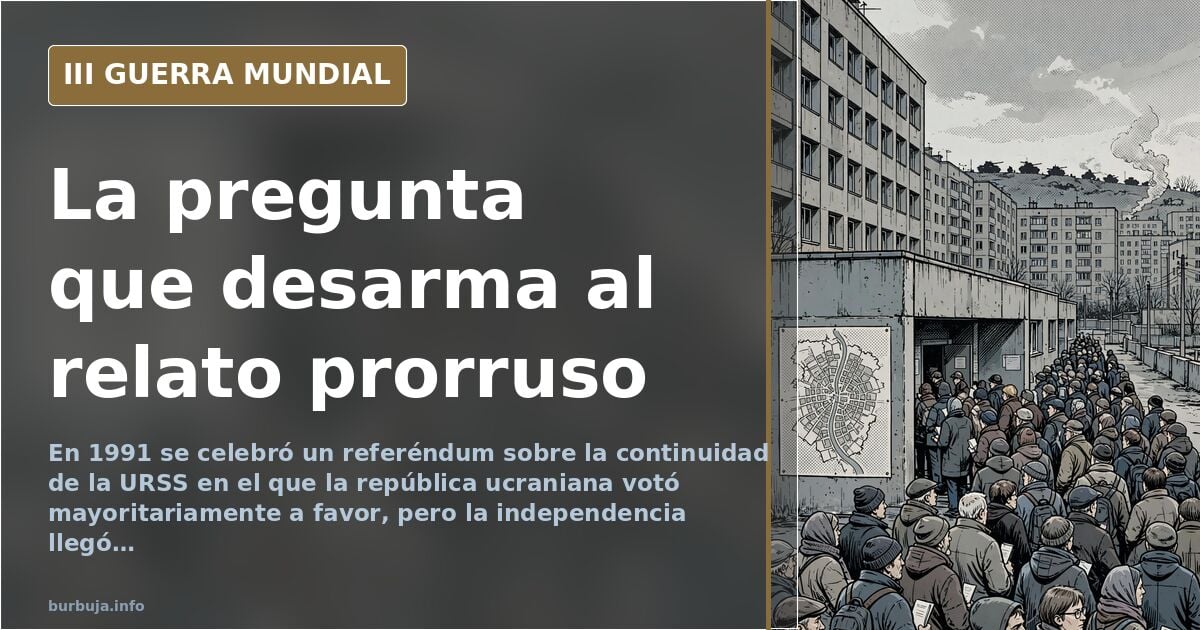
Ukraine: The Question That Dismantles the Pro-Russian Narrative
There is a recurring scene whenever Ukraine’s status is debated. Someone asks if its territorial integrity as an independent nation recognized since 1991 should be respected. For part of the audience, the answer comes quickly: that it is an invention, that Crimea was a gift, that NATO or Cuban missiles are to blame. The problem is that almost all these arguments clash with a chronology that, according to several participants, the Kremlin itself signed. It is not a matter of sympathy. It is a matter of dates.
What Is Debated When Asking About Ukraine
The starting question is simple: if Ukraine is an independent nation recognized since 1991, must its territorial integrity be respected? The affirmative answer relies, according to some interveners, on a chain of recognitions that does not begin in 1991, but much earlier. Ukraine was a distinct republic within the USSR since its founding in 1923, with its own separate seat at the UN since 1946, and with mutual recognition by Russia after the Soviet dissolution. The 1994 Budapest Memorandum closed the circle, according to this version: Russia recognized Ukraine’s territorial integrity within its 1991 borders in exchange for Ukraine surrendering its nuclear arsenal.
The negative response unfolds in three blocks. The first argues that Ukraine is not a real nation, but an amalgam of patches stitched together by the Tsars and later by Soviet leaders, with Crimea ceded by Khrushchev in 1954. The second block does not dispute history: it disputes force. If you cannot defend your territory, someone else will take it. The third is geopolitical: Ukraine allegedly breached a supposed neutrality pact and became a buffer state serving external interests.
The Non-Existent Pact and the Real Referendum
The broken-pact argument is the most repeated and the most fragile. It is claimed that all Warsaw Pact members had to commit to not joining NATO to gain independence. The objection, raised by another participant, is strong: East Germany joined NATO after reunification with Soviet approval, and the 1997 NATO-Russia treaty explicitly stated any country’s freedom to seek alliances. There is no document recording such a Ukrainian neutrality clause.
One datum often appears in these discussions and deserves scrutiny: in March 1991, a referendum was held in the USSR regarding its continuation. In the Ukrainian republic, 70.2% voted in favor and 29.8% against, according to figures cited by those who mention it. Those using this figure to question the legitimacy of subsequent independence omit that the referendum asked about maintaining the Union, not prohibiting secession, and that independence was proclaimed months later, when the USSR was already disintegrating. Comparisons with other territories —Kosovo, Catalonia, the Basque Country— appear in the exchange, but each analogy carries its own exceptions.
Crimea, Missiles, and the Force Argument
The transfer of Crimea is another loose thread. It is argued that Khrushchev gifted it in 1954 for personal reasons, adding a precision worth noting: what was transferred was administration, not sovereignty, and the handover mainly concerned postal services to facilitate management within the USSR. The distinction between administration and sovereignty is legally relevant and rarely developed in the media.
The force argument is formulated without adornment: political nations are not eternal, territorial integrity is nonsense if there is no army to sustain it, and an invaded nation can only surrender, submit, or fight. This is countered by the nuclear paradox: if the criterion is possessing warheads, the incentive is for all countries to acquire them, resulting in a less habitable planet. The comparison with the 1962 Cuban Missile Crisis —Russia promised to remove bases from Turkey and they remain, according to one participant— serves some to justify Russian presence in the Caribbean.
Who Controls the Narrative and Who Pays the Bill
The economic background emerges in several sections. Those demanding an end to the conflict because fuel prices rise are criticized, and the reply is that demanding Ukrainian surrender to cheapen fuel is a self-supporting position. The discussion drifts into cross-accusations of hypocrisy —Palestine, Kosovo, Ceuta and Melilla— and an exchange over which powers recognize whom and since when.
What remains at the end is not consensus, but asymmetry. Arguments questioning Ukrainian independence rely on disputed historical interpretations, pacts whose existence is undocumented, and a principle of force that, applied consistently, would leave half of Europe without defensible borders. Those defending recognition rely on dates, treaties, and seats in international bodies. The initial question, so simple, still lacks a pro-Russian answer that withstands the calendar.
The detail that is disorienting is not any of the big words. It is that Russia itself recognized Ukraine as a sovereign state multiple times, in various frameworks and with various signatures, and that the only clear treaty regarding its territorial integrity was signed for Ukraine to hand over its warheads. That bill remains unpaid.
There is a recurring scene whenever Ukraine’s status is debated. Someone asks if its territorial integrity as an independent nation recognized since 1991 should be respected. For part of the audience, the answer comes quickly: that it is an invention, that Crimea was a gift, that NATO or Cuban missiles are to blame. The problem is that almost all these arguments clash with a chronology that, according to several participants, the Kremlin itself signed. It is not a matter of sympathy. It is a matter of dates.
What Is Debated When Asking About Ukraine
The starting question is simple: if Ukraine is an independent nation recognized since 1991, must its territorial integrity be respected? The affirmative answer relies, according to some interveners, on a chain of recognitions that does not begin in 1991, but much earlier. Ukraine was a distinct republic within the USSR since its founding in 1923, with its own separate seat at the UN since 1946, and with mutual recognition by Russia after the Soviet dissolution. The 1994 Budapest Memorandum closed the circle, according to this version: Russia recognized Ukraine’s territorial integrity within its 1991 borders in exchange for Ukraine surrendering its nuclear arsenal.
The negative response unfolds in three blocks. The first argues that Ukraine is not a real nation, but an amalgam of patches stitched together by the Tsars and later by Soviet leaders, with Crimea ceded by Khrushchev in 1954. The second block does not dispute history: it disputes force. If you cannot defend your territory, someone else will take it. The third is geopolitical: Ukraine allegedly breached a supposed neutrality pact and became a buffer state serving external interests.
The Non-Existent Pact and the Real Referendum
The broken-pact argument is the most repeated and the most fragile. It is claimed that all Warsaw Pact members had to commit to not joining NATO to gain independence. The objection, raised by another participant, is strong: East Germany joined NATO after reunification with Soviet approval, and the 1997 NATO-Russia treaty explicitly stated any country’s freedom to seek alliances. There is no document recording such a Ukrainian neutrality clause.
One datum often appears in these discussions and deserves scrutiny: in March 1991, a referendum was held in the USSR regarding its continuation. In the Ukrainian republic, 70.2% voted in favor and 29.8% against, according to figures cited by those who mention it. Those using this figure to question the legitimacy of subsequent independence omit that the referendum asked about maintaining the Union, not prohibiting secession, and that independence was proclaimed months later, when the USSR was already disintegrating. Comparisons with other territories —Kosovo, Catalonia, the Basque Country— appear in the exchange, but each analogy carries its own exceptions.
Crimea, Missiles, and the Force Argument
The transfer of Crimea is another loose thread. It is argued that Khrushchev gifted it in 1954 for personal reasons, adding a precision worth noting: what was transferred was administration, not sovereignty, and the handover mainly concerned postal services to facilitate management within the USSR. The distinction between administration and sovereignty is legally relevant and rarely developed in the media.
The force argument is formulated without adornment: political nations are not eternal, territorial integrity is nonsense if there is no army to sustain it, and an invaded nation can only surrender, submit, or fight. This is countered by the nuclear paradox: if the criterion is possessing warheads, the incentive is for all countries to acquire them, resulting in a less habitable planet. The comparison with the 1962 Cuban Missile Crisis —Russia promised to remove bases from Turkey and they remain, according to one participant— serves some to justify Russian presence in the Caribbean.
Who Controls the Narrative and Who Pays the Bill
The economic background emerges in several sections. Those demanding an end to the conflict because fuel prices rise are criticized, and the reply is that demanding Ukrainian surrender to cheapen fuel is a self-supporting position. The discussion drifts into cross-accusations of hypocrisy —Palestine, Kosovo, Ceuta and Melilla— and an exchange over which powers recognize whom and since when.
What remains at the end is not consensus, but asymmetry. Arguments questioning Ukrainian independence rely on disputed historical interpretations, pacts whose existence is undocumented, and a principle of force that, applied consistently, would leave half of Europe without defensible borders. Those defending recognition rely on dates, treaties, and seats in international bodies. The initial question, so simple, still lacks a pro-Russian answer that withstands the calendar.
The detail that is disorienting is not any of the big words. It is that Russia itself recognized Ukraine as a sovereign state multiple times, in various frameworks and with various signatures, and that the only clear treaty regarding its territorial integrity was signed for Ukraine to hand over its warheads. That bill remains unpaid.
Also available in: Deutsch
Summary of a discussion on Burbuja.info - Foro de economía, actualidad y política., translated from Spanish and reviewed before publication. Read the full discussion (130 replies).
More summaries
-
Ukraine NATO Entry and Crimea Claim Risk Europe War
Participants argue that if Ukraine joins NATO and seeks to reclaim Crimea, Europe faces immediate war with Russia.
-
Ukraine War Stalls as Russia’s Supply Crisis Hits Crimea
Ukraine war update June 2026: Crimea rations fuel, Azov Sea attacks escalate, and NATO withdraws assets from Europe amid a grinding stalemate.
-
Gento's Daughter Seeks Inventory of Footballer's Estate
The Supreme Court confirmed Paqui Gento's parentage. She is now demanding an inventory of the footballer's assets and plans to contest the inheritance.
-
Nuclear Warhead Lifespan: Tritium, Plutonium, and Lithium
Tritium has a 12-year half-life; plutonium-239 lasts 24,000 years. Key factors explaining why 40-year-old bombs remain operational.
-
Azovstal: Unconfirmed Rumors of Foreign Officers
264 Ukrainian soldiers left Azovstal, including 53 severely wounded. Over 700 remain inside amid unverified reports of foreign officers.
-
Who is the invader? The cultural erasure thesis
Erasing history and identity defines the invader: a controversial thesis dividing analyses of the Ukraine-Russia conflict.