
Pro-Palestine protest in Barcelona sparks tension with police
Pro-Palestine demonstration in Barcelona begins with tension with Mossos; call for general strike on October 15.
English · Original discussion in Spanish · Published
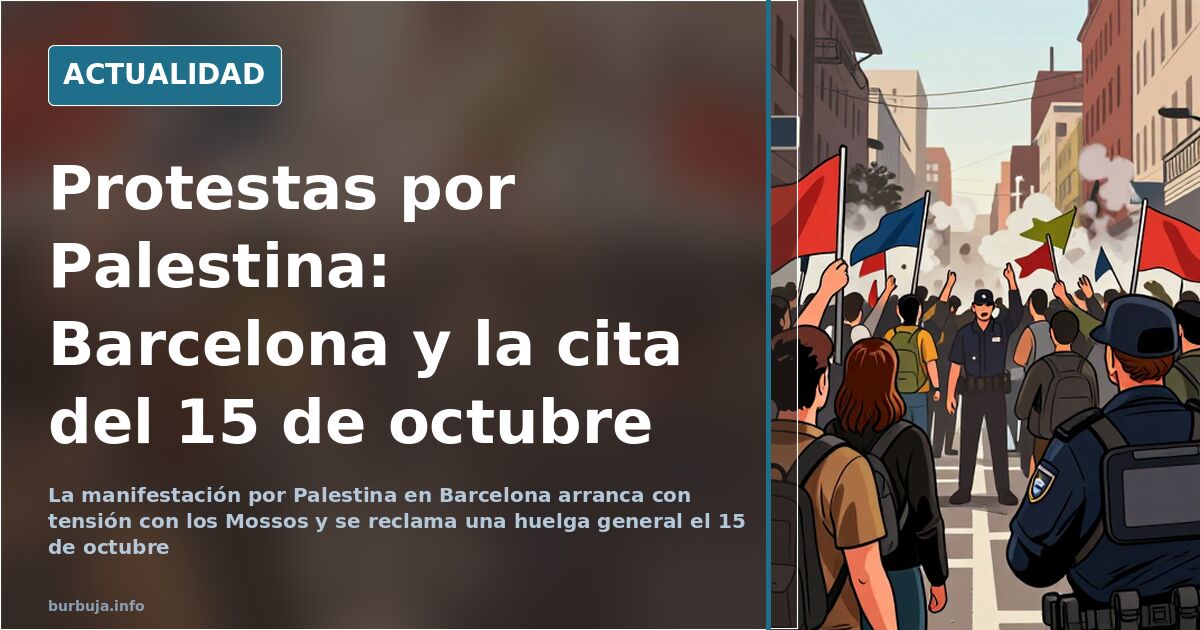
Barcelona rallies for Palestine, general strike called
The streets have once again mobilized for a cause outside Spain, and that's where the controversy begins. The pro-Palestine demonstration in Barcelona, supporting the Global Sumud Flotilla, started with tension with the Mossos (Catalan police), according to live coverage of the march. This wasn't an isolated incident: in parallel, a message in a thread indicated a student strike in Madrid for the same cause on the same day. Within hours, the focus shifted from the march to the general strike planned for October 15 announced by some participants.
The issue divided opinions. For some, it's a legitimate citizen reaction to an ongoing international conflict. For others, a smokescreen distracting from urgent domestic issues. A third, more vocal group, directly suspects who is funding the protests.
Barcelona protest and flotilla face tension
The march was called in support of the Global Sumud Flotilla, the maritime expedition intercepted while attempting to reach Gaza. Live reporting captured moments of tension between protesters and Mossos at the start of the route, though no major incidents were detailed. The event was echoed in other cities, notably Madrid, where, according to a message in a thread, the protest coincided with a student strike.
For the organizers, the goal was to highlight the situation in Gaza and institutional complicity with Israel. One statement disseminated on social media summarized this perspective: the idea that there has been an "authentic demolition of international law as we knew it".
The push for a general strike on October 15
The transition from demonstration to general strike was immediate in the debate. The call was set for October 15 under the slogan "stop everything to stop the genocide." Shortly after, the fine print emerged: it was shaping up to be partial strikes of two hours per shift. This detail marks the difference between a symbolic mobilization and a real paralysis of activity, and it didn't go unnoticed, even among supporters.
This highlights the perennial divide. Two hours per shift barely affect production; a full-day strike strains it. Those defending the call saw it as a gesture of pressure; critics viewed it as a cost-free gesture. The detail about shifts reveals the difficulty of organizing a classic general strike in today's fragmented labor market.
I have more urgent problems than Palestine
The most frequent argument against the protest wasn't geopolitical but domestic. Many reactions pointed out that a forty-year-old struggling with precarious wages and housing access has much closer urgencies than a conflict thousands of miles away. The recurring list included: housing, wages, security, corruption.
There were two versions of this criticism. The moderate one emphasized the paradox that young people—precisely those who cannot afford a home—dedicate their free time to an external cause. The more acidic version directly dismissed the mobilization. In the middle lies an uncomfortable fact: if housing prices mobilized as many people as Palestine does, the country's political map would be different.
How many people took to the streets?
The dispute over numbers was another battleground. Some reactions claimed the images showed very few people and that the march's real size didn't justify the media coverage; others argued that media attention amplified a call that would have gone unnoticed without cameras. No independent count was provided.
This is the old struggle between perception and counting. When there are no official attendance figures—and there almost never are—the only number circulating is the one that suits each side. Whether a mobilization is massive or marginal often depends on whom you ask.
Conspiratorial narratives circulating without proof
No mobilization today escapes the theory of a hidden plan. Around the pro-Palestine marches, the thesis of an orchestrated operation from abroad circulated, mentioning international actors and a supposed global technocratic design. These are claims made without any evidence, similar to those attributing funding of Spanish parties to foreign governments.
It's important to separate these from serious analysis. It's one thing to discuss who finances a flotilla—a verifiable fact—and another to construct an architecture with English acronyms and interchangeable enemies. The insistence on these explanations says less about the facts and more about the accumulated distrust towards the official narrative.
Who has the right to occupy the street
Another line compared the Spanish response to that of other countries. It was noted that similar mobilization wasn't seen for other conflicts, with ironic commentary on the selectivity of indignation. Some also focused on universities, describing an atmosphere where, based on their experience, certain topics cannot be discussed.
The underlying issue is a fight over the narrative: which causes are genuine and which are posturing. The pro-Palestine demonstration thus became a thermometer for something larger: the fatigue of a segment of the population with the priorities of the public agenda.
October 15 will tell if the call materializes into something more than two hours per shift. If the pattern repeats, mobilization will likely remain a gesture, and the debate will return to its starting point: why the streets fill for Gaza and not for rent. It remains to be seen if the initial tension with the Mossos was an anecdote or a preview of a hotter autumn.
The streets have once again mobilized for a cause outside Spain, and that's where the controversy begins. The pro-Palestine demonstration in Barcelona, supporting the Global Sumud Flotilla, started with tension with the Mossos (Catalan police), according to live coverage of the march. This wasn't an isolated incident: in parallel, a message in a thread indicated a student strike in Madrid for the same cause on the same day. Within hours, the focus shifted from the march to the general strike planned for October 15 announced by some participants.
The issue divided opinions. For some, it's a legitimate citizen reaction to an ongoing international conflict. For others, a smokescreen distracting from urgent domestic issues. A third, more vocal group, directly suspects who is funding the protests.
Barcelona protest and flotilla face tension
The march was called in support of the Global Sumud Flotilla, the maritime expedition intercepted while attempting to reach Gaza. Live reporting captured moments of tension between protesters and Mossos at the start of the route, though no major incidents were detailed. The event was echoed in other cities, notably Madrid, where, according to a message in a thread, the protest coincided with a student strike.
For the organizers, the goal was to highlight the situation in Gaza and institutional complicity with Israel. One statement disseminated on social media summarized this perspective: the idea that there has been an "authentic demolition of international law as we knew it".
The push for a general strike on October 15
The transition from demonstration to general strike was immediate in the debate. The call was set for October 15 under the slogan "stop everything to stop the genocide." Shortly after, the fine print emerged: it was shaping up to be partial strikes of two hours per shift. This detail marks the difference between a symbolic mobilization and a real paralysis of activity, and it didn't go unnoticed, even among supporters.
This highlights the perennial divide. Two hours per shift barely affect production; a full-day strike strains it. Those defending the call saw it as a gesture of pressure; critics viewed it as a cost-free gesture. The detail about shifts reveals the difficulty of organizing a classic general strike in today's fragmented labor market.
I have more urgent problems than Palestine
The most frequent argument against the protest wasn't geopolitical but domestic. Many reactions pointed out that a forty-year-old struggling with precarious wages and housing access has much closer urgencies than a conflict thousands of miles away. The recurring list included: housing, wages, security, corruption.
There were two versions of this criticism. The moderate one emphasized the paradox that young people—precisely those who cannot afford a home—dedicate their free time to an external cause. The more acidic version directly dismissed the mobilization. In the middle lies an uncomfortable fact: if housing prices mobilized as many people as Palestine does, the country's political map would be different.
How many people took to the streets?
The dispute over numbers was another battleground. Some reactions claimed the images showed very few people and that the march's real size didn't justify the media coverage; others argued that media attention amplified a call that would have gone unnoticed without cameras. No independent count was provided.
This is the old struggle between perception and counting. When there are no official attendance figures—and there almost never are—the only number circulating is the one that suits each side. Whether a mobilization is massive or marginal often depends on whom you ask.
Conspiratorial narratives circulating without proof
No mobilization today escapes the theory of a hidden plan. Around the pro-Palestine marches, the thesis of an orchestrated operation from abroad circulated, mentioning international actors and a supposed global technocratic design. These are claims made without any evidence, similar to those attributing funding of Spanish parties to foreign governments.
It's important to separate these from serious analysis. It's one thing to discuss who finances a flotilla—a verifiable fact—and another to construct an architecture with English acronyms and interchangeable enemies. The insistence on these explanations says less about the facts and more about the accumulated distrust towards the official narrative.
Who has the right to occupy the street
Another line compared the Spanish response to that of other countries. It was noted that similar mobilization wasn't seen for other conflicts, with ironic commentary on the selectivity of indignation. Some also focused on universities, describing an atmosphere where, based on their experience, certain topics cannot be discussed.
The underlying issue is a fight over the narrative: which causes are genuine and which are posturing. The pro-Palestine demonstration thus became a thermometer for something larger: the fatigue of a segment of the population with the priorities of the public agenda.
October 15 will tell if the call materializes into something more than two hours per shift. If the pattern repeats, mobilization will likely remain a gesture, and the debate will return to its starting point: why the streets fill for Gaza and not for rent. It remains to be seen if the initial tension with the Mossos was an anecdote or a preview of a hotter autumn.
Summary of a discussion on Burbuja.info - Foro de economía, actualidad y política., translated from Spanish and reviewed before publication. Read the full discussion (227 replies).
More summaries
-
Marlaska and the Ideological Dossier on Journalists
The Ministry of the Interior allegedly compiled a secret file on journalists classified by ideology. Details and reactions.
-
Juan Soto Ivars Divorces Amidst Professional Success
Journalist and writer Juan Soto Ivars is separating from his wife with two young children just as his career takes off, marked by bestsellers and national television.
-
Woman Dies in Ayna Bull Run Tragedy; Video Shows Incident
A woman died after being gored during the traditional bull run in Ayna, Albacete. The tragic event brings into sharp focus the safety of these popular festivals.
-
Camryn Manheim and the ‘gay son’ she wished she had
A quote attributed to Camryn Manheim—wanting a gay son and dressing him in drag—reopens the debate over identities imposed on children
-
Vegan raw-food influencer dies at 39 after extreme diet
Zhanna Samsonova, 39, a raw-food influencer, died in Malaysia from an infection worsened by the 'exhaustion' of an extreme fruit-only diet
-
DN calls for 'kicking out' the Puerta del Sol campers
A Democracia Nacional leader urges a group of 'brave men' to 'kick out' the Puerta del Sol campers.