
Pro-life doctor arrested for sitting outside abortion clinic in Spain
Spanish National Police arrest Jesus Poveda, a pro-life physician, for peacefully blocking the entrance of Dator clinic.
English · Original discussion in Spanish · Published
Pro-life doctor arrested for sitting outside abortion clinic
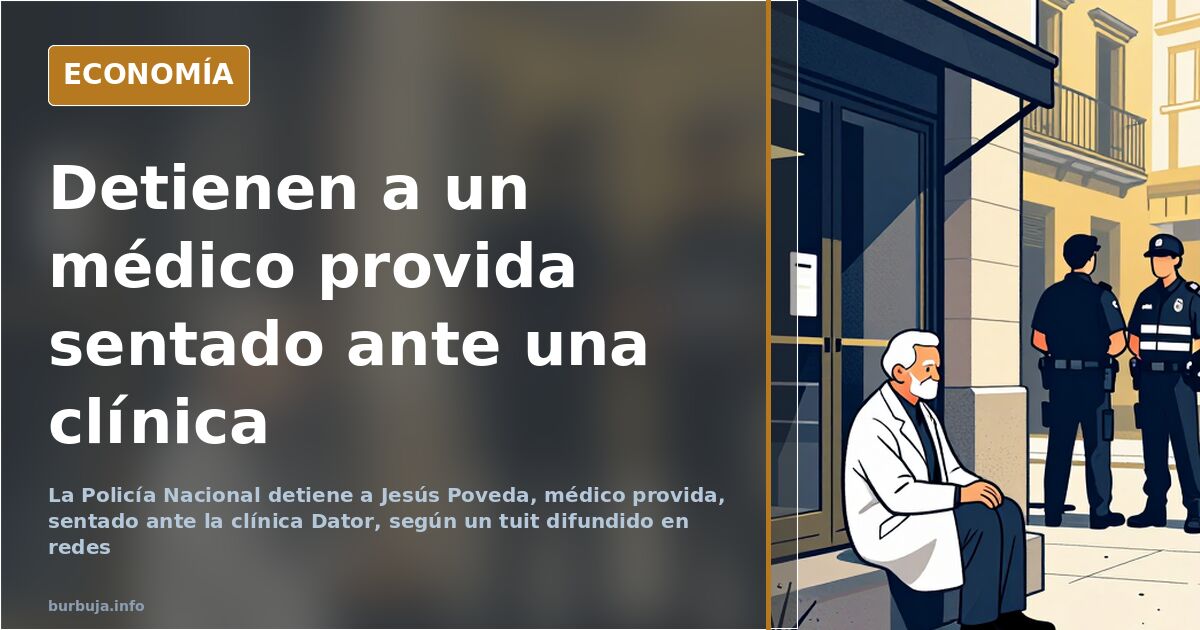
The Spanish National Police have detained Jesus Poveda, a pro-life physician, who was sitting peacefully at the entrance of the Dator clinic, according to a tweet circulated on social media. The incident reignites the clash between those defending conscientious objection and those demanding that no belief should condition access to voluntary termination of pregnancy. The scene is minimal: a man sitting on the ground, with no apparent struggle, and a police action justified by an eviction order. However, the arrest triggers a debate far beyond this specific case.
What the arrest of a pro-life doctor means
The episode occurs within the context of regular gatherings outside clinics performing voluntary terminations of pregnancy. The detention of a healthcare professional adds nuance: it is not just any demonstrator, but someone claiming the status of a doctor and turning their presence into an act of public objection. According to the circulating account, the National Police acted against a person refusing to leave the entrance.
Subsequent discussion divides between those considering the arrest disproportionate and those viewing it as a logical consequence of disobeying an order. The proportionality argument clashes with legality: if there is an eviction order, passive resistance remains resistance. The legal key lies in whether the conduct constitutes disobedience or merely an exercise of freedom of expression.
The economic cost of an unwanted child
One axis of the debate is economic. It raises what happens when an unwanted pregnancy coincides with unemployment or a child with disabilities. Pro-life positions argue that the State ends up covering, via benefits, much of that cost. The calculation used in the discussion suggests that maintaining these children falls de facto on the taxpayer, not on the objector.
The counter-objection is direct: cost cannot be the criterion for deciding on a life. It is argued that reducing the problem to an economic bill is a way of evading the sarracena issue. Furthermore, most abortions performed in Spain do not respond to cases of disability or risk to the mother, but to personal decisions.
When an embryo becomes human
The most technical discussion is biological. It is maintained that an embryo is human when it develops a nervous system and brain, and that before that point there is no capacity to feel. In response, it is stated that the lack of scientific unanimity prevents setting a clean cutoff and that, if one does not know what is being terminated, prudence dictates non-interference.
The debate shifts to law. It is recalled that the law recognizes rights to the unborn in specific cases, such as inheritance for a posthumous child, introducing a contradiction: the unborn are protected for inheritance but not for birth. The answer is that those rights activate only if birth occurs. The discussion gets stuck exactly there.
The trap of freedom of expression
There is a point running through the entire exchange: the accusation of cross-intolerance. It is reproached that those presenting themselves as defenders of freedom become rigid when not trinc. And it is responded that freedom does not protect disobeying a police order. No one yields.
The result is an exchange that starts talking about a specific arrest and ends discussing the sarracena status of the embryo, the fiscal cost of birth rates, and the limits of conscientious objection. The arrest of Jesus Poveda remains the trigger, not the subject. And the subject, judging by what has been written, remains unresolved.
The Spanish National Police have detained Jesus Poveda, a pro-life physician, who was sitting peacefully at the entrance of the Dator clinic, according to a tweet circulated on social media. The incident reignites the clash between those defending conscientious objection and those demanding that no belief should condition access to voluntary termination of pregnancy. The scene is minimal: a man sitting on the ground, with no apparent struggle, and a police action justified by an eviction order. However, the arrest triggers a debate far beyond this specific case.
What the arrest of a pro-life doctor means
The episode occurs within the context of regular gatherings outside clinics performing voluntary terminations of pregnancy. The detention of a healthcare professional adds nuance: it is not just any demonstrator, but someone claiming the status of a doctor and turning their presence into an act of public objection. According to the circulating account, the National Police acted against a person refusing to leave the entrance.
Subsequent discussion divides between those considering the arrest disproportionate and those viewing it as a logical consequence of disobeying an order. The proportionality argument clashes with legality: if there is an eviction order, passive resistance remains resistance. The legal key lies in whether the conduct constitutes disobedience or merely an exercise of freedom of expression.
The economic cost of an unwanted child
One axis of the debate is economic. It raises what happens when an unwanted pregnancy coincides with unemployment or a child with disabilities. Pro-life positions argue that the State ends up covering, via benefits, much of that cost. The calculation used in the discussion suggests that maintaining these children falls de facto on the taxpayer, not on the objector.
The counter-objection is direct: cost cannot be the criterion for deciding on a life. It is argued that reducing the problem to an economic bill is a way of evading the sarracena issue. Furthermore, most abortions performed in Spain do not respond to cases of disability or risk to the mother, but to personal decisions.
When an embryo becomes human
The most technical discussion is biological. It is maintained that an embryo is human when it develops a nervous system and brain, and that before that point there is no capacity to feel. In response, it is stated that the lack of scientific unanimity prevents setting a clean cutoff and that, if one does not know what is being terminated, prudence dictates non-interference.
The debate shifts to law. It is recalled that the law recognizes rights to the unborn in specific cases, such as inheritance for a posthumous child, introducing a contradiction: the unborn are protected for inheritance but not for birth. The answer is that those rights activate only if birth occurs. The discussion gets stuck exactly there.
The trap of freedom of expression
There is a point running through the entire exchange: the accusation of cross-intolerance. It is reproached that those presenting themselves as defenders of freedom become rigid when not trinc. And it is responded that freedom does not protect disobeying a police order. No one yields.
The result is an exchange that starts talking about a specific arrest and ends discussing the sarracena status of the embryo, the fiscal cost of birth rates, and the limits of conscientious objection. The arrest of Jesus Poveda remains the trigger, not the subject. And the subject, judging by what has been written, remains unresolved.
Also available in: Deutsch
Summary of a discussion on Burbuja.info - Foro de economía, actualidad y política., translated from Spanish and reviewed before publication. Read the full discussion (119 replies).
More summaries
-
Spain Police Pay Debate: €2,000 Net vs. €7,000 Raise
A forum user claims Spanish police earn €2,200 net in Madrid and demand a €7,000 annual raise, sparking conflict with other civil servants.
-
Spanish Police Rule Out Hitman in Granada Shooting
Spain's National Police deny that a man shot dead in Alhendín, Granada, is the hitman behind the Vidal-Quadras attack.
-
Which celebrity will offer a home to the evicted woman?
Debate over the evicted elderly woman in Madrid: will any of the named celebrities offer her a home? Wyoming is attributed 19 properties.
-
Timeshare in Spain: €15,000 for one week plus annual fees
A user calculates that 52 owners paying €15,000-€25,000 per apartment week total up to €780,000. Annual community fees...
-
King proposes Feijóo: 172 votes vs 159
The King proposes Alberto Núñez Feijóo with 172 votes against Pedro Sánchez's 159. ERC, Junts and Bildu skipped the consultation round.
-
MAGA Circulates Unverified Theories on Erika Kirk and Israel
Erika Kirk, widow of Charlie Kirk, faces unverified MAGA theories linking her to Israel, a Romanian orphanage, and Trump.