
Prison costs more than unemployment, but freedom is priceless
Spain’s prison system is criticized as a luxury hotel, but inmates face strict routines and loss of liberty, explaining why no one queues to enter.
English · Original discussion in Spanish · Published
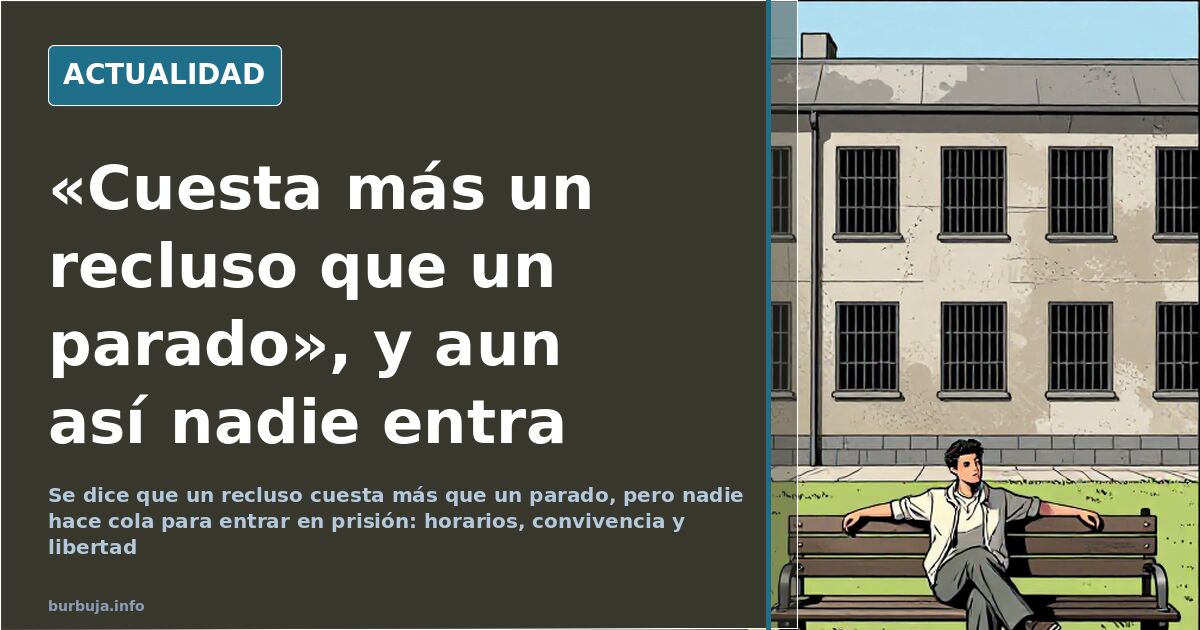
Prison costs more than unemployment, but freedom is priceless
The same old refrain persists: in Spain, prison is a five-star hotel with a pool, gym, and hot meals. This paradox is easy to state but hard to resolve. If incarceration is such a good deal, why do homeless people still sleep rough, why does nobody fight to get in, and why do defendants not request maximum sentences? The answer lies in a word absent from any budget: freedom.
Cost of maintaining an inmate versus an unemployed person
The economic argument supports the "hotel" theory. One forum user claims the state’s cost per inmate exceeds the average unemployment benefit. In other words, taxpayers pay more to keep someone behind bars than to support them on welfare. This data is used to prove the system is too lenient.
The fine print tells a different story: cost does not measure confinement or loss of liberty. It is not a restaurant menu. The thread describes a subsistence diet: tough meat, bland vegetables, and basic coffee, with three options—standard, Muslim, and vegetarian—that barely change the meal. Some inmates may eat better inside than outside. Still, it is the same routine every day, at the same time, with no choice.
Why a homeless person prefers the street to prison
The real question is not why the rich avoid prison, but why the destitute do not seek it. The most common answer is not material but regulatory. According to one participant, the shelter network provides housing and food without crime, provided rules are accepted: no drinking, strict hours, and respect for others. Many fail to comply.
There are exceptions. Some homeless individuals commit minor crimes to spend winter indoors. These cases are very rare. Most calculate that while the street is cold, they decide when and where to sleep. Inside, they do not. Prison allows no improvisation, drunkenness, or unscheduled naps, nor does it permit leaving when the body needs air.
Freedom, the asset missing from the balance sheet
Cervantes is cited without shame: “freedom is one of the most precious gifts heaven has given men.” Added to this, without attribution, is the saying “even if the cage is gold, it remains a prison.” This argument holds strong. Rigid schedules, individual cells on paper but shared in practice, full-body searches, and prohibitions on travel, choosing companions, or maintaining normal sensual relations.
The pandemic served as a dress rehearsal. Remembering the collective anger during lockdowns helps understand the weight of having someone else organize your life. The difference is that lockdown lasted weeks, while prison can last years: the feeling of confinement, according to testimonies, sets in by the third day, even if the pool is full.
Third degree, open regime, and Article 100.2
The discussion inevitably turned to technical details. The Spanish system has levels: the third degree is an open regime with exits and lax control; Article 100.2 of the prison regulations allows intermediate levels, practically called semi-liberty. The debate over terminology took as much space as the core issue, leaving a clear idea: prison is not a uniform block.
There is also politics. According to a prison official involved in the thread, since 2022 the state transferred penitentiary powers to the Basque Country, and ETA prisoners are in Basque centers, in the third degree or semi-liberty. Those defending the privilege thesis cite this as proof; opponents argue that privilege, if it exists, applies to a few, and the majority of inmates do not experience it.
Mixed prisons and coexistence: the unmeasured cost
The most cited factor is not luxury but neighbors. Prison forces 24/7 coexistence with difficult people, and sharing a cell with a stranger allows no room change due to personal dislike. In mixed centers, men and women share corridors, sports facilities, and social spaces, generating friction, according to the same official.
Spain has two women-only prisons—Ávila and Alcalá de Henares—after Alcalá de Guadaira ceased to be one in late 2023. These are described as quieter centers. This distinction dismantles the uniform hotel idea: comfort depends less on the star rating and more on who is your neighbor.
With these factors, economic logic suggests queues for prison should be kilometers long. They are not. No one queues to sleep in a cell with a hot shower in exchange for losing freedom. There, precisely there, the analysis stalls: there is no line item for freedom in any budget, and without that figure, the five-star hotel thesis does not fit.
The same old refrain persists: in Spain, prison is a five-star hotel with a pool, gym, and hot meals. This paradox is easy to state but hard to resolve. If incarceration is such a good deal, why do homeless people still sleep rough, why does nobody fight to get in, and why do defendants not request maximum sentences? The answer lies in a word absent from any budget: freedom.
Cost of maintaining an inmate versus an unemployed person
The economic argument supports the "hotel" theory. One forum user claims the state’s cost per inmate exceeds the average unemployment benefit. In other words, taxpayers pay more to keep someone behind bars than to support them on welfare. This data is used to prove the system is too lenient.
The fine print tells a different story: cost does not measure confinement or loss of liberty. It is not a restaurant menu. The thread describes a subsistence diet: tough meat, bland vegetables, and basic coffee, with three options—standard, Muslim, and vegetarian—that barely change the meal. Some inmates may eat better inside than outside. Still, it is the same routine every day, at the same time, with no choice.
Why a homeless person prefers the street to prison
The real question is not why the rich avoid prison, but why the destitute do not seek it. The most common answer is not material but regulatory. According to one participant, the shelter network provides housing and food without crime, provided rules are accepted: no drinking, strict hours, and respect for others. Many fail to comply.
There are exceptions. Some homeless individuals commit minor crimes to spend winter indoors. These cases are very rare. Most calculate that while the street is cold, they decide when and where to sleep. Inside, they do not. Prison allows no improvisation, drunkenness, or unscheduled naps, nor does it permit leaving when the body needs air.
Freedom, the asset missing from the balance sheet
Cervantes is cited without shame: “freedom is one of the most precious gifts heaven has given men.” Added to this, without attribution, is the saying “even if the cage is gold, it remains a prison.” This argument holds strong. Rigid schedules, individual cells on paper but shared in practice, full-body searches, and prohibitions on travel, choosing companions, or maintaining normal sensual relations.
The pandemic served as a dress rehearsal. Remembering the collective anger during lockdowns helps understand the weight of having someone else organize your life. The difference is that lockdown lasted weeks, while prison can last years: the feeling of confinement, according to testimonies, sets in by the third day, even if the pool is full.
Third degree, open regime, and Article 100.2
The discussion inevitably turned to technical details. The Spanish system has levels: the third degree is an open regime with exits and lax control; Article 100.2 of the prison regulations allows intermediate levels, practically called semi-liberty. The debate over terminology took as much space as the core issue, leaving a clear idea: prison is not a uniform block.
There is also politics. According to a prison official involved in the thread, since 2022 the state transferred penitentiary powers to the Basque Country, and ETA prisoners are in Basque centers, in the third degree or semi-liberty. Those defending the privilege thesis cite this as proof; opponents argue that privilege, if it exists, applies to a few, and the majority of inmates do not experience it.
Mixed prisons and coexistence: the unmeasured cost
The most cited factor is not luxury but neighbors. Prison forces 24/7 coexistence with difficult people, and sharing a cell with a stranger allows no room change due to personal dislike. In mixed centers, men and women share corridors, sports facilities, and social spaces, generating friction, according to the same official.
Spain has two women-only prisons—Ávila and Alcalá de Henares—after Alcalá de Guadaira ceased to be one in late 2023. These are described as quieter centers. This distinction dismantles the uniform hotel idea: comfort depends less on the star rating and more on who is your neighbor.
With these factors, economic logic suggests queues for prison should be kilometers long. They are not. No one queues to sleep in a cell with a hot shower in exchange for losing freedom. There, precisely there, the analysis stalls: there is no line item for freedom in any budget, and without that figure, the five-star hotel thesis does not fit.
Summary of a discussion on Burbuja.info - Foro de economía, actualidad y política., translated from Spanish and reviewed before publication. Read the full discussion (234 replies).
More summaries
-
Henri Parot, responsible for 82 murders and sentenced to 4,800 years, gains release without remorse
Henri Parot, convicted of 82 murders and sentenced to 4,800 years, is released from prison. The Basque Government granted him the third regime status.
-
Is the System Deliberately Making Spaniards Dumber?
A recent controversy suggests the system has intentionally dulled the Spanish population, but lacks evidence or data.
-
Ramón Campayo: Spain's self-styled memory guru faces mounting fraud claims
Ramón Campayo has spent 30 years selling memory courses without proof. Failed demonstrations, an unrecorded competition and suspicions of fraud with a terminal illness.
-
Ceuta empties as migration pressure sparks unrest
Migration pressure empties shops and threatens Ceuta's school year. Residents denounce collapse and political debate radicalizes.
-
Metro Assault: Physical Self-Defense and Legal Consequences in Spain
Analysis of a viral subway altercation involving a Russian national, examining self-defense limits and legal risks in Spain.
-
AI mimics Reverte and Gala: creative jobs shake
ChatGPT imitates Reverte, Gala, and Larra; some in the sector say voice actors, illustrators, and screenwriters are losing commissions.