
AI mimics Reverte and Gala: creative jobs shake
ChatGPT imitates Reverte, Gala, and Larra; some in the sector say voice actors, illustrators, and screenwriters are losing commissions.
English · Original discussion in Spanish · Published
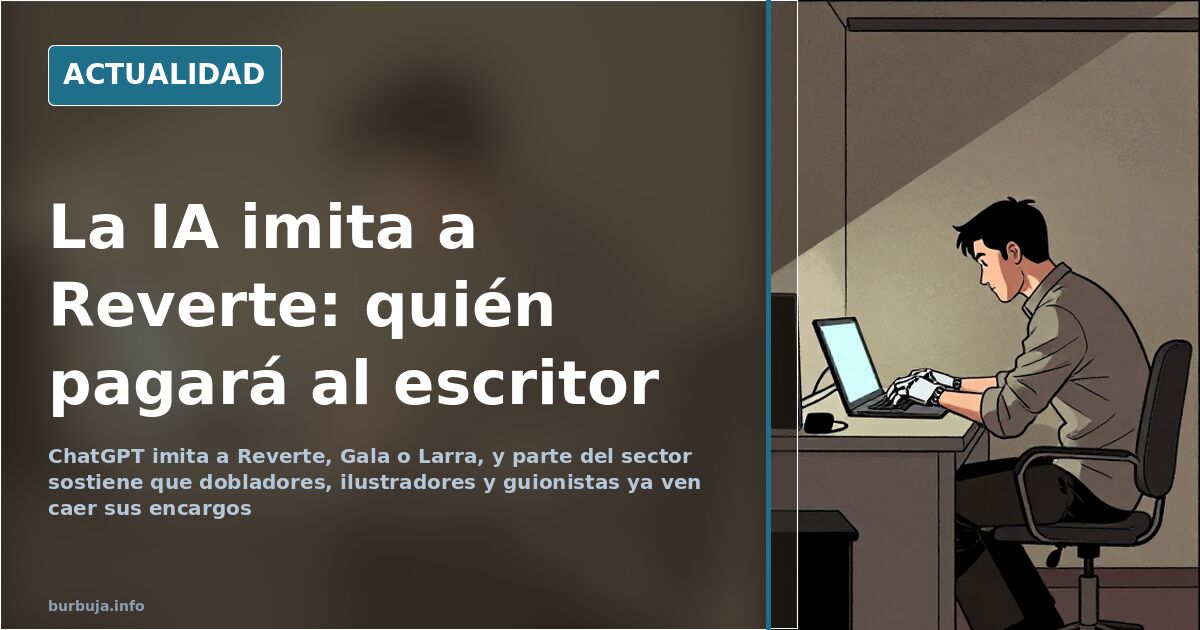
ChatGPT mimics Reverte, Gala, and Larra: creative jobs shake
A popular science book rewritten in the style of Mariano José de Larra. According to one forum user, it holds up for two chapters, but in the third, the machine stops writing. The scene circulates among those who make a living with words and summarizes the mood of much of the creative sector. Generative AI mimics in seconds styles that once took years of craftsmanship, but also stumbles in a disconcerting way. It is no longer debated whether ChatGPT can write like Arturo Pérez-Reverte or Antonio Gala. The question is who pays a human to do it.
ChatGPT now mimics Reverte, Gala, and Paulo Coelho
The machine's ability to mimic other voices is the discovery that sparked the conversation. A text about current Spanish affairs, passed through ChatGPT, emerges transformed into Reverte-style prose with a simple prompt, and the same operation, repeated in a chain, produces versions in the style of Antonio Gala, James Cameron, Paul Verhoeven, Quentin Tarantino, or Plato. The result can sound convincing for entire paragraphs. Until you read it slowly. Then the seams show: repeated turns, an impersonal voice, the feeling of facing an industrial boll that is brilliant on the outside and empty on the inside.
Voice actors, illustrators, and screenwriters: the unemployment that is already coming
The blow is not theoretical. Part of the analysis suggests that voice generators are leaving many voice actors without commissions, with the case of voice actor Fabián C. Barrio as a recurring reference. In illustration, some point out that small towns are now creating their festival posters with AI, bypassing public contests, and some see comics as a gold mine: almost unlimited content without paying rights. Translators have been in decline for years; now, they are being sidelined directly. In Hollywood, according to this thesis, screenwriters are fired because one is enough where ten were previously needed. The result, it is argued, is underpaid technicians and connected family members.
Did photography really kill painting?
The historical counterpoint underpins half the discussion. One side repeats that the camera did not eliminate painters, that the printing press did not end scribes, and that CGI did not bury traditional effects: everything adapts and nothing dies. The other side responds that photography did indeed erase the bulk of portrait painters' work, and from there, painting took refuge in the avant-gardes and design. It is the only known case where a machine exposed artists, it is argued. And now the pace is different: it is not measured in decades, but in months.
Literature as an act of will that no machine signs
Against the pessimism stands a defense that does not rely on nostalgia. Literature, they say, was born outside the industry and has never depended on it: it is the materialization of an individual will, and no machine can take that away as long as someone has something to say. Authors who write for money may become scarce, but not those who write because they need to tell it. This is added to a colder argument: the public consumes the work, not its authorship. Those who cannot distinguish an article by Umbral from one signed by a machine will not demand a certificate of humanity.
99% did not write well before AI
Perhaps the most uncomfortable conclusion is the least epic. Some argue that not even 1% of the population is capable of writing a text correctly, and no machine has changed that. Reading laziness and comprehension deficits come from before. If anything, AI has accelerated what was already written: good books are scarce today and were equally scarce before. What has shifted is standard work, the kind done by pattern and without signature. There, the replacement will not be decided by quality, but by cost.
With these threads, the question is no longer whether a machine can write better than a human. It is whether someone is willing to pay the difference.
A popular science book rewritten in the style of Mariano José de Larra. According to one forum user, it holds up for two chapters, but in the third, the machine stops writing. The scene circulates among those who make a living with words and summarizes the mood of much of the creative sector. Generative AI mimics in seconds styles that once took years of craftsmanship, but also stumbles in a disconcerting way. It is no longer debated whether ChatGPT can write like Arturo Pérez-Reverte or Antonio Gala. The question is who pays a human to do it.
ChatGPT now mimics Reverte, Gala, and Paulo Coelho
The machine's ability to mimic other voices is the discovery that sparked the conversation. A text about current Spanish affairs, passed through ChatGPT, emerges transformed into Reverte-style prose with a simple prompt, and the same operation, repeated in a chain, produces versions in the style of Antonio Gala, James Cameron, Paul Verhoeven, Quentin Tarantino, or Plato. The result can sound convincing for entire paragraphs. Until you read it slowly. Then the seams show: repeated turns, an impersonal voice, the feeling of facing an industrial boll that is brilliant on the outside and empty on the inside.
Voice actors, illustrators, and screenwriters: the unemployment that is already coming
The blow is not theoretical. Part of the analysis suggests that voice generators are leaving many voice actors without commissions, with the case of voice actor Fabián C. Barrio as a recurring reference. In illustration, some point out that small towns are now creating their festival posters with AI, bypassing public contests, and some see comics as a gold mine: almost unlimited content without paying rights. Translators have been in decline for years; now, they are being sidelined directly. In Hollywood, according to this thesis, screenwriters are fired because one is enough where ten were previously needed. The result, it is argued, is underpaid technicians and connected family members.
Did photography really kill painting?
The historical counterpoint underpins half the discussion. One side repeats that the camera did not eliminate painters, that the printing press did not end scribes, and that CGI did not bury traditional effects: everything adapts and nothing dies. The other side responds that photography did indeed erase the bulk of portrait painters' work, and from there, painting took refuge in the avant-gardes and design. It is the only known case where a machine exposed artists, it is argued. And now the pace is different: it is not measured in decades, but in months.
Literature as an act of will that no machine signs
Against the pessimism stands a defense that does not rely on nostalgia. Literature, they say, was born outside the industry and has never depended on it: it is the materialization of an individual will, and no machine can take that away as long as someone has something to say. Authors who write for money may become scarce, but not those who write because they need to tell it. This is added to a colder argument: the public consumes the work, not its authorship. Those who cannot distinguish an article by Umbral from one signed by a machine will not demand a certificate of humanity.
99% did not write well before AI
Perhaps the most uncomfortable conclusion is the least epic. Some argue that not even 1% of the population is capable of writing a text correctly, and no machine has changed that. Reading laziness and comprehension deficits come from before. If anything, AI has accelerated what was already written: good books are scarce today and were equally scarce before. What has shifted is standard work, the kind done by pattern and without signature. There, the replacement will not be decided by quality, but by cost.
With these threads, the question is no longer whether a machine can write better than a human. It is whether someone is willing to pay the difference.
Summary of a discussion on Burbuja.info - Foro de economía, actualidad y política., translated from Spanish and reviewed before publication. Read the full discussion (229 replies).
More summaries
-
Belarra, a Loaned Red Ferrari and the Remark: «China Is Not This Country»
A thread concerning Belarra mentions a loaned red Ferrari and obtaining a certificate in one week, prompting a user to reply: «China is not this country»
-
ChatGPT hallucinates 48% on PersonQA test: AGI promise fades
OpenAI internal data: o4-mini fails 48% on PersonQA, o3 fails 33%. Hallucinations triple, undermining the AGI promise.
-
OpenAI Claims AGI with Astra: Hype or Revolution?
OpenAI presents GPT-6 Astra as artificial general intelligence. Demos are impressive, but skepticism is mounting: is it genuine progress or just smoke for the next...
-
Spain's 'La bola negra' sparks culture war with €4.7M opening
'La bola negra' grosses €4.7 million in its first weekend and divides Spain between critical praise and accusations of propaganda and historical sectarianism.
-
Yolanda Díaz's Decline: From Political Narrative to Reality
Yolanda Díaz's influence wanes amid labor reform failure and record fiscal pressure. Is her political relevance ending?
-
Women's Feet: From Summer Heat to the Fetish Driving Thousands of Photos
Open footwear lets feet breathe and avoids fungus, but exposes painted nails and bunions. The foot fetish drives thousands of free photos online.