
Prison as shelter: debate on trading freedom for stability
Debate on whether prison solves precariousness and housing costs, offering basics in exchange for liberty.
English · Original discussion in Spanish · Published
Prison as shelter: debate on trading freedom for stability
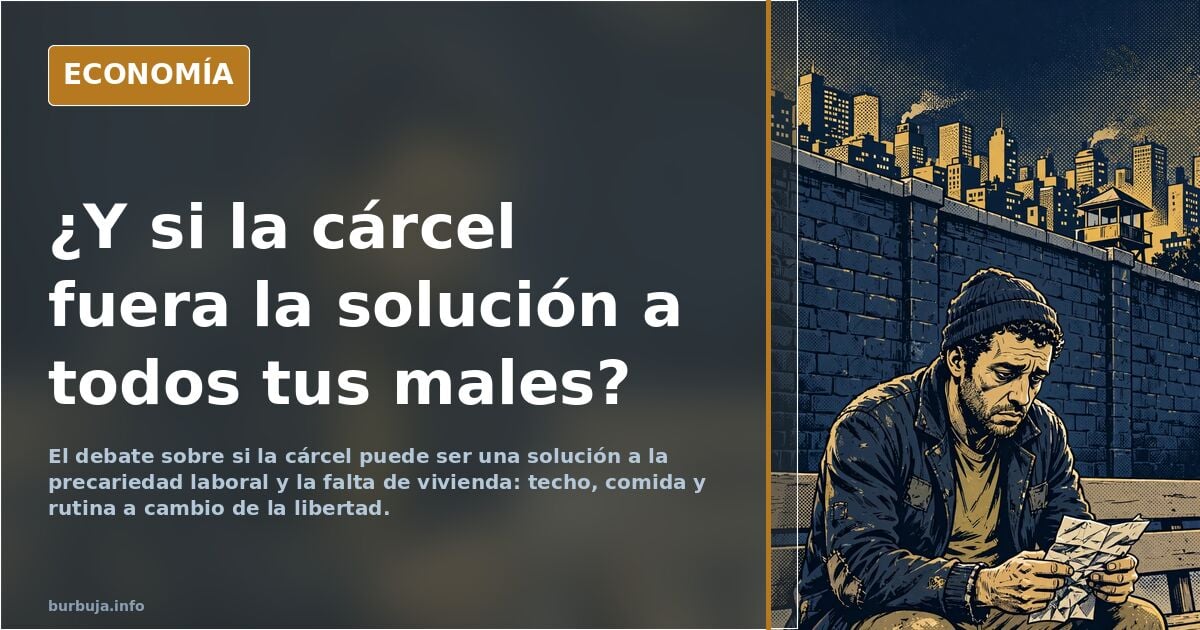
What if the solution to unaffordable rent, job insecurity, and lack of future was simply committing a crime to get imprisoned? This idea, expressed with equal parts irony and desperation, opens a discussion in Spain that has an uncomfortable answer: the temptation to trade freedom for roof, food, and routine is not so far-fetched when the labor market and housing prices exclude part of the population from normal adult life.
The starting point is a list of problems that, according to this reasoning, would disappear instantly: inability to access housing, self-employment precariousness, unemployment, low wages, loss of purchasing power, family and emotional conflicts. In return, this approach suggests prison offers shelter, food, social life, gym, pool, and free university education. The peace of mind of not having to fight daily to survive.
The majority response arrives quickly: prison is not a hotel, and freedom is not negotiable. Against penitentiary romanticism, the most upvoted messages describe an environment of constant noise, lack of privacy, risk of assault, and forced cohabitation with people you wouldn't choose. The idea that life inside is better than outside is debunked by personal experiences and data on how the Spanish prison system works.
What is lost upon entering prison
The first objection is the most obvious and repeated: freedom. But the analysis goes further. In prison, others decide which cell you live in and who you share it with. Privacy disappears, even for basic needs. Food is, in most cases, poor quality. The gym is basic and always crowded. From 21:00 to 08:00 you remain in your cell. And without internet, informational isolation is total.
Some recall that intimate visits require being married or in a registered partnership, excluding a significant part of the inmate population. And the profile of module companions is hardly that of a social club: people with addiction issues, convicted of serious crimes, and a prison culture that does not forgive weakness. The toughest person you know outside is a sweetie in there, summarizes a particularly upvoted message.
The myth of modern prison and shared showers
The image of prison as a place with sports facilities and educational opportunities has some truth but is heavily qualified. In older prisons, like Madrid II or Alcalá, communal showers still exist. In newer centers, each cell has its own shower. The difference between modules can be abyssal, and the experience depends largely on the assigned center.
A message with specific knowledge of the Spanish prison system debunks several myths: sentence reduction for working no longer applies, as it did under the 1981 regulations; since the 1996 regulations, the system is different. Also, computers are not allowed in cells, and the PlayStation 2 previously permitted is now banned. The reality of Spanish prisons is harsher than TV fiction suggests.
Inmate profile and forced cohabitation
Who you share the module with is one of the most repeated points. Prisons concentrate people with addiction issues, untreated mental disorders, and histories of social exclusion. Cohabitation is not optional and you cannot choose your peers. In the most conflictive modules, arguments are frequent and tension constant.
Some note that most inmates are drug users, creating an internal economy based on tobacco and commissary cards instead of cash. Those who don't smoke and aren't in a "respect" module find it especially hard to integrate. Social life exists, but it doesn't resemble life outside.
The alternative: freedom without money before confinement with shelter
Against the initial premise, a counter-proposal emerges that also gathers consensus: if the problem is lack of housing and resources, better to renounce conventional life without losing freedom. The idea of traveling the world by bike, asking for food, and sleeping in a tent appears as a less dramatic option than prison. Ask all prisoners what they would do to spend ten years cycling, suggests a message.
The discussion shifts to the Spanish prison system and its differences with other countries. Norwegian prisons are mentioned as examples of a rehabilitative model, with cells resembling hotel rooms. But it is also recalled that in Spain, prisons are generally safe, and extreme violence cases are rare if one keeps a low profile. The image of El Salvador or Latin American prisons does not match Spanish reality.
The economic calculation of confinement
Beyond personal experience, the debate has an economic dimension that cannot be ignored. Prisoner maintenance is paid by public funds. If the issue is that the labor market doesn't allow paying rent, prison shifts that cost to the taxpayer. It's an individual solution generating a collective cost, and that is perhaps the strongest argument against the idea that prison is a rational escape.
The discussion also hints at criticism of the welfare system and labor market. The impossibility of becoming independent, having children, or maintaining a stable partner appears as a structural problem not solved by an extreme individual decision. Prison fixes nothing: it just swaps one set of problems for another.
In the end, the most repeated conclusion is that freedom, even precarious, remains preferable to confinement. The temptation to trade uncertainty for penitentiary routine is understandable, but the price is too high. Better to lose your life than your freedom, concludes a message. And although the phrase sounds grandiose, it summarizes the consensus running through the entire discussion.
What if the solution to unaffordable rent, job insecurity, and lack of future was simply committing a crime to get imprisoned? This idea, expressed with equal parts irony and desperation, opens a discussion in Spain that has an uncomfortable answer: the temptation to trade freedom for roof, food, and routine is not so far-fetched when the labor market and housing prices exclude part of the population from normal adult life.
The starting point is a list of problems that, according to this reasoning, would disappear instantly: inability to access housing, self-employment precariousness, unemployment, low wages, loss of purchasing power, family and emotional conflicts. In return, this approach suggests prison offers shelter, food, social life, gym, pool, and free university education. The peace of mind of not having to fight daily to survive.
The majority response arrives quickly: prison is not a hotel, and freedom is not negotiable. Against penitentiary romanticism, the most upvoted messages describe an environment of constant noise, lack of privacy, risk of assault, and forced cohabitation with people you wouldn't choose. The idea that life inside is better than outside is debunked by personal experiences and data on how the Spanish prison system works.
What is lost upon entering prison
The first objection is the most obvious and repeated: freedom. But the analysis goes further. In prison, others decide which cell you live in and who you share it with. Privacy disappears, even for basic needs. Food is, in most cases, poor quality. The gym is basic and always crowded. From 21:00 to 08:00 you remain in your cell. And without internet, informational isolation is total.
Some recall that intimate visits require being married or in a registered partnership, excluding a significant part of the inmate population. And the profile of module companions is hardly that of a social club: people with addiction issues, convicted of serious crimes, and a prison culture that does not forgive weakness. The toughest person you know outside is a sweetie in there, summarizes a particularly upvoted message.
The myth of modern prison and shared showers
The image of prison as a place with sports facilities and educational opportunities has some truth but is heavily qualified. In older prisons, like Madrid II or Alcalá, communal showers still exist. In newer centers, each cell has its own shower. The difference between modules can be abyssal, and the experience depends largely on the assigned center.
A message with specific knowledge of the Spanish prison system debunks several myths: sentence reduction for working no longer applies, as it did under the 1981 regulations; since the 1996 regulations, the system is different. Also, computers are not allowed in cells, and the PlayStation 2 previously permitted is now banned. The reality of Spanish prisons is harsher than TV fiction suggests.
Inmate profile and forced cohabitation
Who you share the module with is one of the most repeated points. Prisons concentrate people with addiction issues, untreated mental disorders, and histories of social exclusion. Cohabitation is not optional and you cannot choose your peers. In the most conflictive modules, arguments are frequent and tension constant.
Some note that most inmates are drug users, creating an internal economy based on tobacco and commissary cards instead of cash. Those who don't smoke and aren't in a "respect" module find it especially hard to integrate. Social life exists, but it doesn't resemble life outside.
The alternative: freedom without money before confinement with shelter
Against the initial premise, a counter-proposal emerges that also gathers consensus: if the problem is lack of housing and resources, better to renounce conventional life without losing freedom. The idea of traveling the world by bike, asking for food, and sleeping in a tent appears as a less dramatic option than prison. Ask all prisoners what they would do to spend ten years cycling, suggests a message.
The discussion shifts to the Spanish prison system and its differences with other countries. Norwegian prisons are mentioned as examples of a rehabilitative model, with cells resembling hotel rooms. But it is also recalled that in Spain, prisons are generally safe, and extreme violence cases are rare if one keeps a low profile. The image of El Salvador or Latin American prisons does not match Spanish reality.
The economic calculation of confinement
Beyond personal experience, the debate has an economic dimension that cannot be ignored. Prisoner maintenance is paid by public funds. If the issue is that the labor market doesn't allow paying rent, prison shifts that cost to the taxpayer. It's an individual solution generating a collective cost, and that is perhaps the strongest argument against the idea that prison is a rational escape.
The discussion also hints at criticism of the welfare system and labor market. The impossibility of becoming independent, having children, or maintaining a stable partner appears as a structural problem not solved by an extreme individual decision. Prison fixes nothing: it just swaps one set of problems for another.
In the end, the most repeated conclusion is that freedom, even precarious, remains preferable to confinement. The temptation to trade uncertainty for penitentiary routine is understandable, but the price is too high. Better to lose your life than your freedom, concludes a message. And although the phrase sounds grandiose, it summarizes the consensus running through the entire discussion.
Also available in: Deutsch
Summary of a discussion on Burbuja.info - Foro de economía, actualidad y política., translated from Spanish and reviewed before publication. Read the full discussion (114 replies).
More summaries
-
Madrid's impossible reality: soaring prices, tourism and migration pressure
Rents skyrocketing, tourist pressure and a capital that pushes out its residents: why Madrid has become unaffordable for those who live there.
-
Bukele reshapes El Salvador amid re-election legal battle
Bukele’s security model makes El Salvador a global reference, while his potential re-election—banned by critics—sparks legal controversy.
-
Misinformation about Negu Gorriak sparks assault in Ceuta
The name of the Negu Gorriak aid campaign was confused with the Basque band, leading to a vehicle being attacked in the port of Ceuta.
-
Juanma Moreno's Granada Photo Sparks Outrage in Spain's PP
In late 2021, a photo of Juanma Moreno and PP colleagues in Granada without visible restrictions triggered accusations of double standards.
-
Live TV groping claim sparks debate over hand position
A live broadcast incident involving a Cuatro reporter turns into a national dispute over whether the contact was sexual assault or accidental.
-
LIBERUM releases templates to block EU health data sharing
LIBERUM publishes forms to refuse transferring Spanish health data to the EU, citing opposition rights and data protection agencies.