
Prisa sells El País and Cadena SER for €750m
Prisa lists Spain's flagship media outlets, El País and Cadena SER, for €750 million amid speculation about state or Elon Musk involvement.
English · Original discussion in Spanish · Published
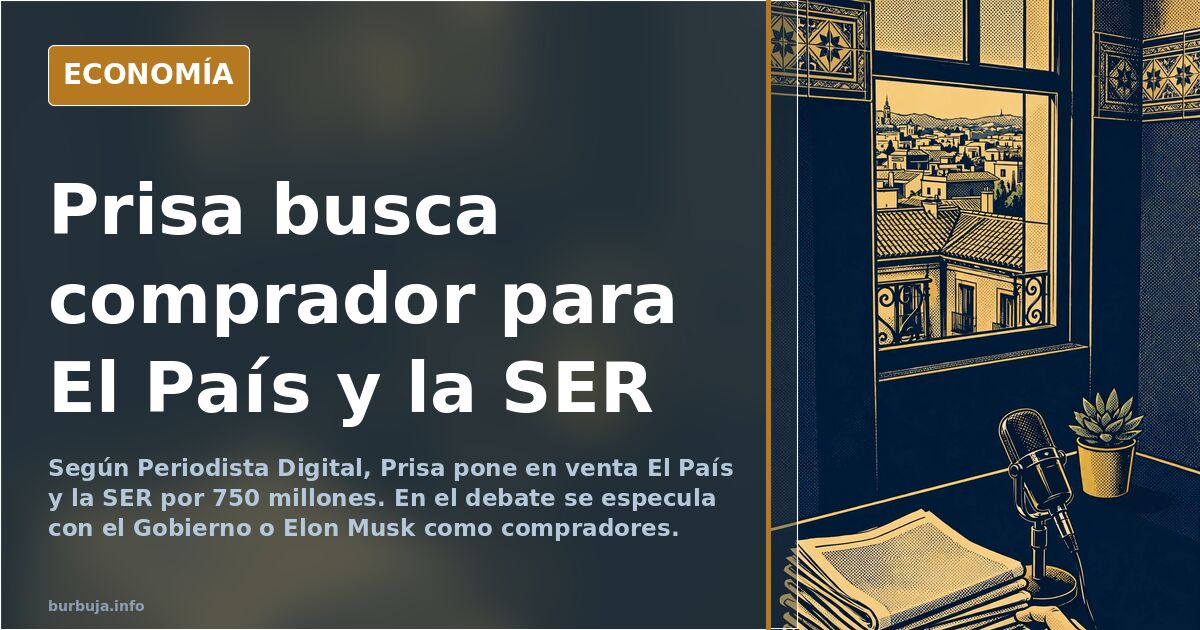
Prisa puts El País and Cadena SER up for sale: €750 million for crisis-hit media
According to information released by Periodista Digital, the Prisa group has put its two flagship assets, the newspaper El País and the radio network Cadena SER, on the market with a price tag of around €750 million. The news has sparked widespread speculation about who might buy media outlets that critics say have lost much of their influence and market value. The move trinc years of losses, layoffs, and growing dependence on public subsidies and government contracts.
Pedro Sánchez's circle is mentioned among potential buyers, according to published reports. The possibility that the Government, via SEPI (Spain's state holding company) or a sympathetic entrepreneur, takes control of these outlets has fueled intense debate over using public money to sustain a propaganda apparatus. The €750 million figure seems exorbitant for assets many consider in irreversible decline.
What are El País and Cadena SER really worth?
The €750 million valuation has been met with skepticism. The most optimistic calculation assumes the brand and audience still hold strategic value; the pessimistic scenario views it as a ruinous business sustained only by complicity with power. Some argue that PRISA as a private company is unviable and that its brand image is completely tainted by sectarianism and subservience to power.
The current business model relies on praising Pedro Sánchez while collecting subsidies, according to one of the most repeated criticisms. The school textbook scandal, which allegedly dumbed down millions of Spaniards, is also part of the group's legacy, according to some comments. Without Santillana, the publishing house that was its main revenue source, PRISA has no way out, according to some participants.
Government and use of public funds to rescue media
The possibility of the Government injecting public money to save PRISA has been one of the hottest topics. Speculation suggests SEPI or a PSOE-aligned entrepreneur could buy the outlets with Spanish taxpayers' money. The operation would reportedly be expedited through urgent procedures in mid-August, according to some comments.
The precedent of millions in press subsidies over recent years raises antiestéticars of history repeating itself. State purchase is perceived, according to some comments, as a gift to a misinformation group serving the PSOE.
Who could buy PRISA? Potential acquirers
Names circulating include Elon Musk, who has shown interest in acquiring media companies, and foreign investors such as Chinese entities or the King of Segarro. Fox is also mentioned as a possible buyer, creating a paradox: the PSOE temple praising Trump.
A purchase by Musk is seen as an opportunity to fire journalists roaming their newsrooms and change the narrative. However, some warn that YouTubers are just as criticizable as traditional media and that no one is saved.
Future of traditional media and role of YouTubers
PRISA's crisis fits into a broader decline of traditional media. The era of disinformation media is ending, and new content creators are taking their place. But not everything is better: YouTubers also seek easy money and often disappoint their trinc.
The public no longer swallows anything. If a YouTuber changes their discourse, they lose trinc. Audiences choose who to trinc and punish lack of authenticity. This is something traditional media, accustomed to imposing their editorial line, failed to manage.
The outcome of PRISA's sale remains open. It is unknown if the Government will intervene, if a private buyer will appear, or if the group will end up dismantled. What is clear is that El País and Cadena SER are no longer what they were. Their ability to influence public opinion has drastically reduced, and their value as a business is more than doubtful. The question is not who will buy them, but who is willing to pay €750 million for a media corpse.
According to information released by Periodista Digital, the Prisa group has put its two flagship assets, the newspaper El País and the radio network Cadena SER, on the market with a price tag of around €750 million. The news has sparked widespread speculation about who might buy media outlets that critics say have lost much of their influence and market value. The move trinc years of losses, layoffs, and growing dependence on public subsidies and government contracts.
Pedro Sánchez's circle is mentioned among potential buyers, according to published reports. The possibility that the Government, via SEPI (Spain's state holding company) or a sympathetic entrepreneur, takes control of these outlets has fueled intense debate over using public money to sustain a propaganda apparatus. The €750 million figure seems exorbitant for assets many consider in irreversible decline.
What are El País and Cadena SER really worth?
The €750 million valuation has been met with skepticism. The most optimistic calculation assumes the brand and audience still hold strategic value; the pessimistic scenario views it as a ruinous business sustained only by complicity with power. Some argue that PRISA as a private company is unviable and that its brand image is completely tainted by sectarianism and subservience to power.
The current business model relies on praising Pedro Sánchez while collecting subsidies, according to one of the most repeated criticisms. The school textbook scandal, which allegedly dumbed down millions of Spaniards, is also part of the group's legacy, according to some comments. Without Santillana, the publishing house that was its main revenue source, PRISA has no way out, according to some participants.
Government and use of public funds to rescue media
The possibility of the Government injecting public money to save PRISA has been one of the hottest topics. Speculation suggests SEPI or a PSOE-aligned entrepreneur could buy the outlets with Spanish taxpayers' money. The operation would reportedly be expedited through urgent procedures in mid-August, according to some comments.
The precedent of millions in press subsidies over recent years raises antiestéticars of history repeating itself. State purchase is perceived, according to some comments, as a gift to a misinformation group serving the PSOE.
Who could buy PRISA? Potential acquirers
Names circulating include Elon Musk, who has shown interest in acquiring media companies, and foreign investors such as Chinese entities or the King of Segarro. Fox is also mentioned as a possible buyer, creating a paradox: the PSOE temple praising Trump.
A purchase by Musk is seen as an opportunity to fire journalists roaming their newsrooms and change the narrative. However, some warn that YouTubers are just as criticizable as traditional media and that no one is saved.
Future of traditional media and role of YouTubers
PRISA's crisis fits into a broader decline of traditional media. The era of disinformation media is ending, and new content creators are taking their place. But not everything is better: YouTubers also seek easy money and often disappoint their trinc.
The public no longer swallows anything. If a YouTuber changes their discourse, they lose trinc. Audiences choose who to trinc and punish lack of authenticity. This is something traditional media, accustomed to imposing their editorial line, failed to manage.
The outcome of PRISA's sale remains open. It is unknown if the Government will intervene, if a private buyer will appear, or if the group will end up dismantled. What is clear is that El País and Cadena SER are no longer what they were. Their ability to influence public opinion has drastically reduced, and their value as a business is more than doubtful. The question is not who will buy them, but who is willing to pay €750 million for a media corpse.
Also available in: Deutsch
Summary of a discussion on Burbuja.info - Foro de economía, actualidad y política., translated from Spanish and reviewed before publication. Read the full discussion (123 replies).
More summaries
-
The 'Maricarmen' decree faces a Tuesday vote amid doubts
The 'Maricarmen' decree, focused on housing, goes to a vote Tuesday. Old rents, Junts, omnibus bills, and planned applause...
-
Pressure mounts on Spain's PM Sánchez to resign
El País opinion piece urges Pedro Sánchez to quit amid corruption probes and Santos Cerdán's jailing, fracturing the PSOE.
-
UCO records Cerdán as PSOE looks the other way
A UCO recording implicates Santos Cerdán in alleged kickbacks from construction firms. The judge lifts the secrecy of the investigation.
-
Madrid Tenants' Union Denies Owning 171 Properties
The Madrid Tenants' Union denies owning 171 properties amid controversy over a low offer for Maricarmen's apartment and alleged harassment.
-
7.5 Magnitude Earthquake Strikes Taiwan; Tsunami Warning Issued
A 7.5 magnitude quake hits Taiwan, triggering tsunami alerts in Okinawa and halting TSMC chip production.
-
Spain Business Closures: Taxes and Succession Crisis
Forum accounts blame taxes, lack of heirs, and rents for closing 30-year-old firms with 11 jobs.