
7.5 Magnitude Earthquake Strikes Taiwan; Tsunami Warning Issued
A 7.5 magnitude quake hits Taiwan, triggering tsunami alerts in Okinawa and halting TSMC chip production.
English · Original discussion in Spanish · Published
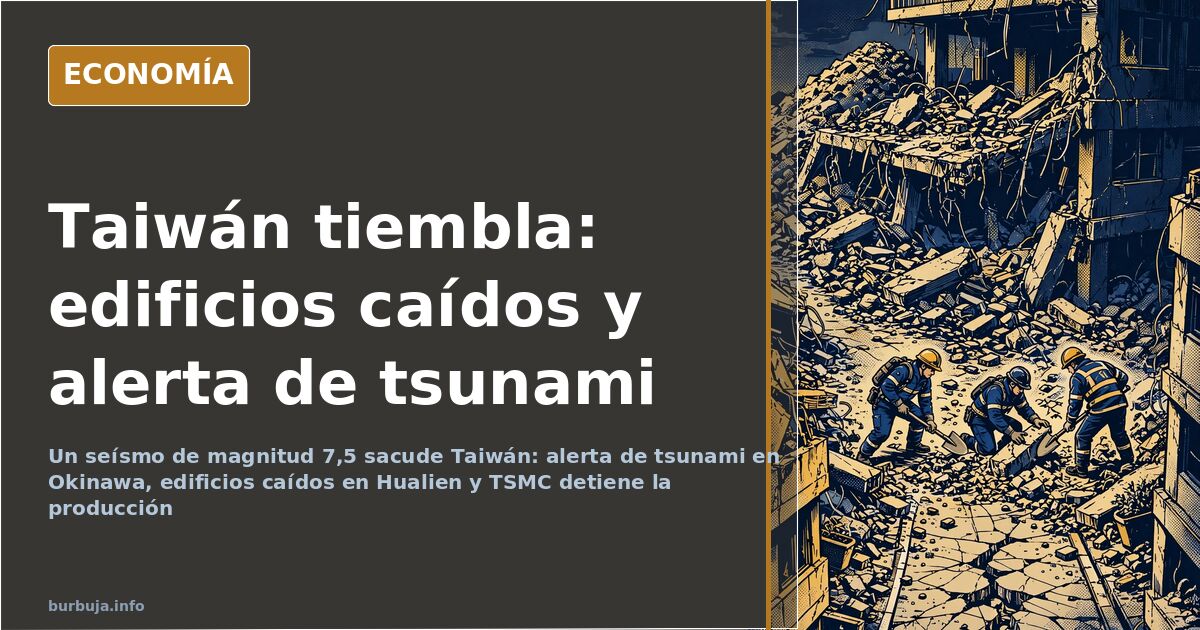
Taiwan shaken by 7.5 magnitude quake; tsunami warning issued for Okinawa
A 7.5 magnitude tremor — recorded as 7.3 by the Japan Meteorological Agency — struck the coast of Taiwan at 8:58 local time (23:58 GMT Tuesday). Within minutes, tsunami warnings extended to Taiwan, Okinawa, and the Philippines. Images showed collapsed buildings in Hualien, destruction on Guishan Island, and the evacuation of Naha Airport. As always, disaster shadows trinc: suspicions that nature was not solely responsible.
What is known about the Taiwan earthquake
The epicenter was located offshore with very shallow depth, according to the Japanese agency. Figures vary. 7.3 degrees in the official Japanese report; 7.5 in social media reports; 7.4 in tech press covering the blow to the chip industry. The fluctuation in magnitude is not cosmetic when debating if the quake belongs to the major league: Turkey’s was 7.8, a message noted.
Sources cited it as the strongest movement in 25 years on the island. Building collapses were reported in Hualien, and severe destruction images circulated from Guishan Island — turtle-shaped, off Yilan. The tsunami alert was issued for Taiwan, Okinawa, Japan, and the Philippines, and was not merely theoretical.
Tsunami warning empties Naha Airport
In Okinawa, protocols activated immediately. At Naha Airport, passengers were evacuated to the third floor due to the risk of water reaching low levels. Japan issued a tsunami advisory for the archipelago trinc the quake registered off the Taiwanese coast.
It is worth remembering that a tsunami warning is not a decorative headline: it depends on the epicenter's depth and how much water mass shifts. It is the same reason the alert jumped to the Philippines and Taiwan itself. The open question was not whether there was an alert, but how long it would take to arrive and with what force.
Why does Taiwan withstand quakes better than other countries?
Here appears one of the most interesting analyses made during the day. Against catastrophic readings, some argue that the notable aspect is precisely how well Taiwanese construction resisted. With 29,484 earthquakes per month — someone exaggerated — the country has spent decades calculating foundations to move with the ground instead of breaking.
The argument relies on concrete details: buildings tilted at almost impossible angles that did not break and from which people could exit via stairs; a monorail that, poorly designed, would have fallen. The conclusion drawn is uncomfortable and unheroic: engineering, when done right, does not make headlines, it only prevents burials. The anecdote told was that of a Murcian architect who said that before a degree 6 quake, all buildings in his city would fall; and if any remained standing, it would be because it was miscalculated.
TSMC and chips: the earthquake that moves prices
As the issue has economic derivatives, focus shifted quickly to the chip factory. TSMC halted production after the quake, specialized press reported. And the detail matters because much of what you carry is manufactured on the island: AMD and NVIDIA produce much of their output there, and even hotel rooms or hams — a message exaggerated — pass through trade with Taiwan.
Another message warned that if destruction proved greater than it seemed, stock markets exposed to TSMC and NVIDIA would feel it. Is it worth upgrading your PC before everything costs triple? That was, literally, the question many asked.
HAARP, geological devices, and other hoaxes
And rumors arrived. A version circulated that the Chinese government provoked the earthquake using "geological impact devices" before a hypothetical military operation on the island. Another current pointed to the classic HAARP and underground weapons detonations. None of these hypotheses are backed by evidence; they are speculations that reappear with each catastrophe.
The terrain where they land does not help debunk them: during the day, Taiwanese defense officials reported 30 Chinese combat planes and 9 ships approaching the island. Coincidence fuels conspiratorial reading, although coincidence is exactly what it is. What bothered others was the aesthetic of the disaster itself.
Chongqing Boulevard and the video that looks like Hollywood
Because there was an image that some messages flagged as iconic: a collapsing building, which a forum user placed on Chongqing Boulevard. And to part of the public it looked directly like CGI, too theatrical, too cinematic. From there, fine threads were spun: if it was Tuesday, if the date was April 3, if the declared magnitude mirrored the publication date of some unknown message.
It is the old mechanic: throwing stones that fit anything and seeing how many connections hold. The problem is that, adding arbitrary points, a conspiracy always emerges. And if the video looked fictional, perhaps it is because a real building collapsing resembles too much how we had been told in cinema.
How much of what was seen was real disaster and how much simple narrative with good technical quality? With chip production halted, the answer will take longer than the next earthquake.
A 7.5 magnitude tremor — recorded as 7.3 by the Japan Meteorological Agency — struck the coast of Taiwan at 8:58 local time (23:58 GMT Tuesday). Within minutes, tsunami warnings extended to Taiwan, Okinawa, and the Philippines. Images showed collapsed buildings in Hualien, destruction on Guishan Island, and the evacuation of Naha Airport. As always, disaster shadows trinc: suspicions that nature was not solely responsible.
What is known about the Taiwan earthquake
The epicenter was located offshore with very shallow depth, according to the Japanese agency. Figures vary. 7.3 degrees in the official Japanese report; 7.5 in social media reports; 7.4 in tech press covering the blow to the chip industry. The fluctuation in magnitude is not cosmetic when debating if the quake belongs to the major league: Turkey’s was 7.8, a message noted.
Sources cited it as the strongest movement in 25 years on the island. Building collapses were reported in Hualien, and severe destruction images circulated from Guishan Island — turtle-shaped, off Yilan. The tsunami alert was issued for Taiwan, Okinawa, Japan, and the Philippines, and was not merely theoretical.
Tsunami warning empties Naha Airport
In Okinawa, protocols activated immediately. At Naha Airport, passengers were evacuated to the third floor due to the risk of water reaching low levels. Japan issued a tsunami advisory for the archipelago trinc the quake registered off the Taiwanese coast.
It is worth remembering that a tsunami warning is not a decorative headline: it depends on the epicenter's depth and how much water mass shifts. It is the same reason the alert jumped to the Philippines and Taiwan itself. The open question was not whether there was an alert, but how long it would take to arrive and with what force.
Why does Taiwan withstand quakes better than other countries?
Here appears one of the most interesting analyses made during the day. Against catastrophic readings, some argue that the notable aspect is precisely how well Taiwanese construction resisted. With 29,484 earthquakes per month — someone exaggerated — the country has spent decades calculating foundations to move with the ground instead of breaking.
The argument relies on concrete details: buildings tilted at almost impossible angles that did not break and from which people could exit via stairs; a monorail that, poorly designed, would have fallen. The conclusion drawn is uncomfortable and unheroic: engineering, when done right, does not make headlines, it only prevents burials. The anecdote told was that of a Murcian architect who said that before a degree 6 quake, all buildings in his city would fall; and if any remained standing, it would be because it was miscalculated.
TSMC and chips: the earthquake that moves prices
As the issue has economic derivatives, focus shifted quickly to the chip factory. TSMC halted production after the quake, specialized press reported. And the detail matters because much of what you carry is manufactured on the island: AMD and NVIDIA produce much of their output there, and even hotel rooms or hams — a message exaggerated — pass through trade with Taiwan.
Another message warned that if destruction proved greater than it seemed, stock markets exposed to TSMC and NVIDIA would feel it. Is it worth upgrading your PC before everything costs triple? That was, literally, the question many asked.
HAARP, geological devices, and other hoaxes
And rumors arrived. A version circulated that the Chinese government provoked the earthquake using "geological impact devices" before a hypothetical military operation on the island. Another current pointed to the classic HAARP and underground weapons detonations. None of these hypotheses are backed by evidence; they are speculations that reappear with each catastrophe.
The terrain where they land does not help debunk them: during the day, Taiwanese defense officials reported 30 Chinese combat planes and 9 ships approaching the island. Coincidence fuels conspiratorial reading, although coincidence is exactly what it is. What bothered others was the aesthetic of the disaster itself.
Chongqing Boulevard and the video that looks like Hollywood
Because there was an image that some messages flagged as iconic: a collapsing building, which a forum user placed on Chongqing Boulevard. And to part of the public it looked directly like CGI, too theatrical, too cinematic. From there, fine threads were spun: if it was Tuesday, if the date was April 3, if the declared magnitude mirrored the publication date of some unknown message.
It is the old mechanic: throwing stones that fit anything and seeing how many connections hold. The problem is that, adding arbitrary points, a conspiracy always emerges. And if the video looked fictional, perhaps it is because a real building collapsing resembles too much how we had been told in cinema.
How much of what was seen was real disaster and how much simple narrative with good technical quality? With chip production halted, the answer will take longer than the next earthquake.
Also available in: Deutsch
Summary of a discussion on Burbuja.info - Foro de economía, actualidad y política., translated from Spanish and reviewed before publication. Read the full discussion (123 replies).
More summaries
-
Russia 8.7 Earthquake: Tsunami Alert Fails, Conspiracy Theories Emerge
A magnitude 8.7 earthquake in Russia triggered tsunami warnings in Hawaii and Japan, but the expected disaster never arrived, sparking conspiracy theories about its origins.
-
Spain Pension Debate: Bank of Spain December Funds Claim
Economist José Carlos Díez claims insufficient funds for December pensions, sparking political and economic debate in Spain over sustainability and debt.
-
Spain's PSOE rivals PP in polls despite corruption
In Spain, the PSOE maintains vote intention near the PP despite scandals. Analysts cite clientelist networks and fear of the far-right.
-
Mataró video reignites Catalonia demographic debate
A viral video from Mataró revives the discussion on demographics and voting in Catalonia, highlighting data gaps and political reluctance to quantify trends.
-
Spain Reservoirs Hit Record High as Contrail Debate Fades
Spanish reservoirs reach ~72% capacity amid claims that persistent contrails have vanished, reigniting debates on cloud seeding and USAID funding cuts.
-
Podemos demands rent cuts and residency rules for budget support
Spain's Podemos party proposes banning non-resident home purchases and cutting rents by 40% as conditions for backing the national budget.