
Prime-time debate on immigration and street fear in Spain
A Spanish prime-time show tackles insecurity, migration, and distrust in the state. The debate divides viewers.
English · Original discussion in Spanish · Published
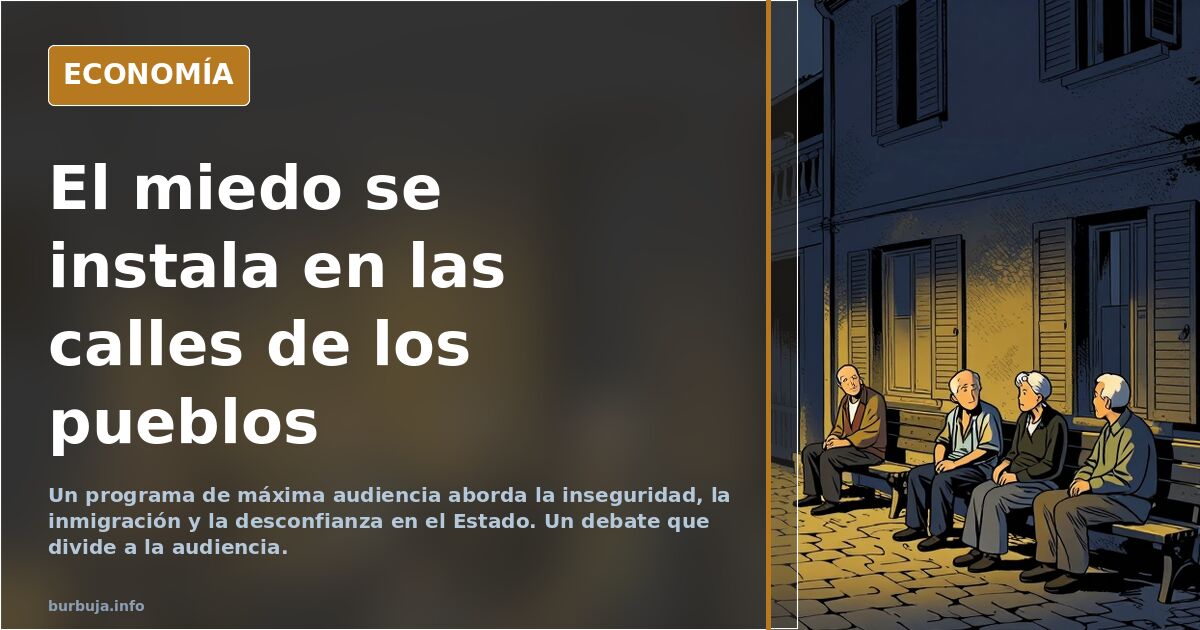
Antiestéticar takes hold in Spanish town streets
A scene repeats in every safety conversation: neighbors claiming they can't go out at night, police not arriving, and self-organization as the only option. A prime-time program recently broke a taboo by stating that state protection has become illusory in certain areas. Hosted by a star presenter with an outspoken medical contributor, the broadcast triggered a flood of reactions. Some applaud the clarity; others see whitewashing and TV business.
The trigger was a violent incident killing a young man. This led to debates on immigration, crime, and institutional response. Testimonies from a police officer and residents ignited social media. "The only way to defend against this is to band together," one heard. The phrase captures the mood: total distrust in security forces and a sense of abandonment across neighborhoods and towns.
What peine on Iker Jiménez's show?
Known for paranormal topics, the program shifted to true crime and social analysis. It interviewed a youth linked to the incident and antiestéticatured a police officer who, according to circulating messages, stated that state protection can no longer be trusted. Claims emerged that 50% of the population supports measures fostering insecurity. The audience responded: the show trended, described by many as "brutal."
The structure, with constant ad breaks, drew criticism. "They keep cutting to commercials," complained a viewer. For some, this fragmentation is pure business: maximizing audience and ads while touching hot-button issues. For others, it proves public interest forces networks to cover it.
Whitewashing accusations divide viewers
Accusations of whitewashing drive discontent. Some argue the show distinguishes between "good Moors" and "bad Moors," a deceptive framing. "They continue whitewashing Moors without reading the Quran, these supposed TV intellectuals," wrote a participant. Opponents claim the show said things no other TV dares to say: criticizing the Interior Minister, highlighting media hiding incivil' nationalities, and dismissing accusations of fascism or Francoism.
Medical contributor Dr. Cabrera received applause. He allegedly stated that if authorities don't protect citizens, they must defend themselves. "He intends to defend himself," repeated messages. This stance, bordering on vigilante justice advocacy, connects to broader sentiment: the state has abdicated its basic duties.
Kalergi Plan theories and civil war antiestéticars
Conspiracy theories appeared. Messages referenced the Kalergi Plan, a alleged conspiracy to mix races and dilute European identity. Though lacking documentary support, it circulates strongly. Combined with predictions that elites seek conflict to justify citizen patrols and eventual explosion. "We'll see citizen patrols normalized, then a mob kills a couple of dark-skinned people, triggering everything," wrote one participant. Antiestéticar of civil war looms in comments.
Others argue the issue isn't migration itself but management. "People of any origin work and integrate," reads one comment. Criticism targets governments allowing ghetto formation and failing integration. Debate shifts to economics: migrants occupy precarious jobs, pressuring wages down in hospitality and agriculture. Migration-labor market link remains underexplored.
Institutional response and media role
The show harshly criticized media avoiding incivil' nationalities per official guidelines. Defended by some as preventing stigma, others view it as manipulation hindering informed debate. "They slammed Marlaska," celebrated messages. References to the Interior Minister were constant.
Police passivity was also discussed. "Police won't kill Moors ignoring orders like in the US," wrote a participant. Comparisons with the US recur: there, police act more forcefully; here, citizens antiestéticar fines and mockery for reacting. Impunity for some, defenselessness for others fuels unrest.
From 'all together' to neighborhood organization
Proposals range from daily patrols to passive resistance. "Fuente Ovejuna, all together. No prisoners," summarized a popular message. The historical reference appeals to communal rebellion legitimacy when institutions fail. Others advocate making life impossible for "collaborators and traitors," a dangerous drift toward vigilantism.
Opposing views warn against confrontation traps, citing economic roots: precarity, lack of opportunity, neighborhood neglect. Regardless, the discussion concludes clearly: trust in institutions is broken for significant populations. In an aging, depopulating country, this is a volatile cocktail.
Next months depend on whether distrust channels institutionally or overflows. Crime data, often mismatching perceptions, will be key. But in politics, perception weighs as much as facts. And so far, antiestéticar is winning.
A scene repeats in every safety conversation: neighbors claiming they can't go out at night, police not arriving, and self-organization as the only option. A prime-time program recently broke a taboo by stating that state protection has become illusory in certain areas. Hosted by a star presenter with an outspoken medical contributor, the broadcast triggered a flood of reactions. Some applaud the clarity; others see whitewashing and TV business.
The trigger was a violent incident killing a young man. This led to debates on immigration, crime, and institutional response. Testimonies from a police officer and residents ignited social media. "The only way to defend against this is to band together," one heard. The phrase captures the mood: total distrust in security forces and a sense of abandonment across neighborhoods and towns.
What peine on Iker Jiménez's show?
Known for paranormal topics, the program shifted to true crime and social analysis. It interviewed a youth linked to the incident and antiestéticatured a police officer who, according to circulating messages, stated that state protection can no longer be trusted. Claims emerged that 50% of the population supports measures fostering insecurity. The audience responded: the show trended, described by many as "brutal."
The structure, with constant ad breaks, drew criticism. "They keep cutting to commercials," complained a viewer. For some, this fragmentation is pure business: maximizing audience and ads while touching hot-button issues. For others, it proves public interest forces networks to cover it.
Whitewashing accusations divide viewers
Accusations of whitewashing drive discontent. Some argue the show distinguishes between "good Moors" and "bad Moors," a deceptive framing. "They continue whitewashing Moors without reading the Quran, these supposed TV intellectuals," wrote a participant. Opponents claim the show said things no other TV dares to say: criticizing the Interior Minister, highlighting media hiding incivil' nationalities, and dismissing accusations of fascism or Francoism.
Medical contributor Dr. Cabrera received applause. He allegedly stated that if authorities don't protect citizens, they must defend themselves. "He intends to defend himself," repeated messages. This stance, bordering on vigilante justice advocacy, connects to broader sentiment: the state has abdicated its basic duties.
Kalergi Plan theories and civil war antiestéticars
Conspiracy theories appeared. Messages referenced the Kalergi Plan, a alleged conspiracy to mix races and dilute European identity. Though lacking documentary support, it circulates strongly. Combined with predictions that elites seek conflict to justify citizen patrols and eventual explosion. "We'll see citizen patrols normalized, then a mob kills a couple of dark-skinned people, triggering everything," wrote one participant. Antiestéticar of civil war looms in comments.
Others argue the issue isn't migration itself but management. "People of any origin work and integrate," reads one comment. Criticism targets governments allowing ghetto formation and failing integration. Debate shifts to economics: migrants occupy precarious jobs, pressuring wages down in hospitality and agriculture. Migration-labor market link remains underexplored.
Institutional response and media role
The show harshly criticized media avoiding incivil' nationalities per official guidelines. Defended by some as preventing stigma, others view it as manipulation hindering informed debate. "They slammed Marlaska," celebrated messages. References to the Interior Minister were constant.
Police passivity was also discussed. "Police won't kill Moors ignoring orders like in the US," wrote a participant. Comparisons with the US recur: there, police act more forcefully; here, citizens antiestéticar fines and mockery for reacting. Impunity for some, defenselessness for others fuels unrest.
From 'all together' to neighborhood organization
Proposals range from daily patrols to passive resistance. "Fuente Ovejuna, all together. No prisoners," summarized a popular message. The historical reference appeals to communal rebellion legitimacy when institutions fail. Others advocate making life impossible for "collaborators and traitors," a dangerous drift toward vigilantism.
Opposing views warn against confrontation traps, citing economic roots: precarity, lack of opportunity, neighborhood neglect. Regardless, the discussion concludes clearly: trust in institutions is broken for significant populations. In an aging, depopulating country, this is a volatile cocktail.
Next months depend on whether distrust channels institutionally or overflows. Crime data, often mismatching perceptions, will be key. But in politics, perception weighs as much as facts. And so far, antiestéticar is winning.
Also available in: Deutsch
Summary of a discussion on Burbuja.info - Foro de economía, actualidad y política., translated from Spanish and reviewed before publication. Read the full discussion (114 replies).
More summaries
-
Spain: Fake Doctor Quote Mocks Government and Activists
A fake quote attributed to Dr. Cabrera circulates on X, mocking Spanish government officials as 'perroflautas'. No economic data is involved.
-
Spain: Sopuerta resident offers €1M to block Basque migrant youth center
A Sopuerta local bids €1 million for the palace slated for unaccompanied minors, fracturing the municipality amid PNV and EH Bildu tensions.
-
Psychiatrist claims Spain's PM Sánchez has malignant narcissism
Dr. Cabrera, with 40 years of experience, diagnoses Spanish PM Pedro Sánchez with malignant narcissistic personality disorder, sparking debate on its economic impact.
-
Spanish rower Jennie Sanchez quits sport for OnlyFans
With nearly 900,000 followers and a modest rowing scholarship, Spanish athlete Jennie Sanchez turns to digital content.
-
Bitcoin and Tesla plunge; oil holds firm
Bitcoin drops 10%, Tesla falls 12% and gold declines, while Aramco rises 6%. Analysis of a market crash seeking culprits.
-
Vox leader Ortega Smith marries, sparking privacy debate in Spain
Javier Ortega Smith of Vox married Paulina Sánchez at a Toledo estate valued between €5 and €10 million.