
Bitcoin and Tesla plunge; oil holds firm
Bitcoin drops 10%, Tesla falls 12% and gold declines, while Aramco rises 6%. Analysis of a market crash seeking culprits.
English · Original discussion in Spanish · Published
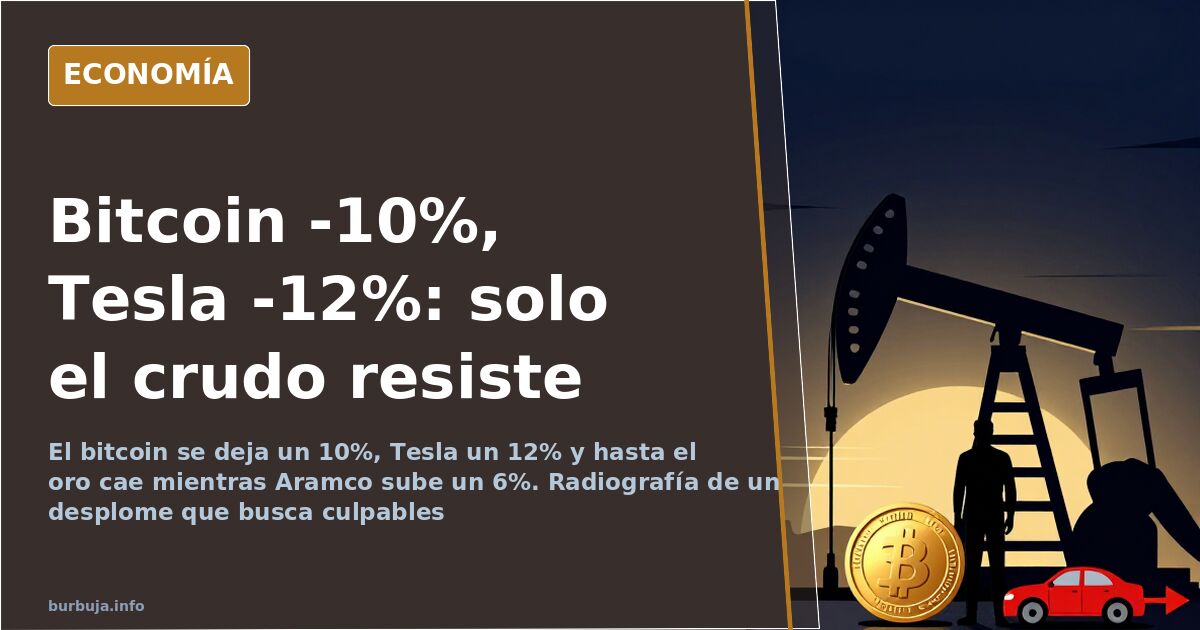
Bitcoin loses 10%, Tesla drops 12% and gold also retreats
There are sessions where money isn't looking for returns, but hiding places. The latest one left an uncomfortable map: bitcoin shed 10%, Tesla fell 12%, Meta dropped 8%, and even gold, the traditional safe haven, ended in the red. The only asset that rose significantly was oil, with Saudi Aramco gaining 6%. When crude, not precious metals, withstands the blow, it's time to review the playbook.
The question opening this matter has brutal honesty: "Evergrande, Bitcoin… Everything is falling apart. What do we do?" Behind the joke lie serious fronts: China's property crisis, tech stocks, bitcoin, and markets that have been running on patches for months.
What peine to bitcoin and tech stocks?
Bitcoin fell around 10% coinciding with the movement of 1,000 ancient coins from the network's first stage. The quick read was that someone had reactivated a historic wallet. The calm read is that 1,000 BTC are worth about 26 million, a trivial figure in daily market volume. Both narratives circulate simultaneously, explaining why price moved before reason did.
Tech stocks trinc suit: Tesla down 12%, Meta down 8%. And gold, which theoretically should absorb antiestéticar, also retreated. Only energy producers resisted: oil companies rose, led by Saudi Aramco. On such a day, the safe-haven narrative breaks at its most vulnerable point, precisely where protection was expected.
US credit card defaults hit highest levels since 1991
The data causing the least noise is likely the most serious. According to shared charts, credit card default rates among small US banks reach highs not seen since 1991. These aren't the giants; they are mid-sized and small entities, the first to feel customer distress. Rising plastic defaults to three-decade highs point to consumers who stopped covering minimum payments, not just a market bump.
One shouldn't exaggerate. It's a signal, not a verdict. But it fits the thesis that the real economy has been holding on by pins for some time, and the feeling that the cycle should have burst much earlier than it did.
1,000 bitcoins don't move the market, far from it
The soberest calculation dismantles the scare theory: 1,000 BTC are only 26 million, and vastly more is traded daily. With that figure in hand, attributing the crash to a historic wallet gives too much weight to a small move, however symbolic its origin.
Another current points to a summer pattern, with similar episodes in previous years. A third suspicion is that the coins don't come from the million historically attributed to Satoshi, which would completely change the interpretation of the gesture. Correlation isn't causation, but the market reacted before having the explanation.
What if AMC and GME are the safe havens?
Amid the red, a minority thesis argues the opposite: that money will end up in the assets remaining when conventional financial systems break, with AMC and GameStop as candidates and references of $100,000 per share. It's a bet with lots of faith and few fundamentals, but it illustrates how far the conversation has shifted from valuations to hiding spots.
Some argue the system has been broken for a long time and that even precious metals won't protect. Against this weighs a simple argument: that diagnosis has been announced for years without an expiration date, and repetition has stripped it of surprise value.
China, Musk and the theory of induced collapse
Explanations are lacking, so culprits are sought. One hypothesis dismisses the old wallet and points elsewhere: Evergrande, some operation by Elon Musk, and who knows what else. Another current directly blames election results in Spain. Without supporting data, these function more as symptoms of antiestéticar than analysis.
The systemic diagnosis is the most repeated: central banks rescuing every mismatch, chained bubbles, and the impression that this is sustained by borrowed time. With each rescue, the patch covers more bone and less flesh.
The bunker can wait until November
Deep down, the discussion isn't economic, it's existential, and it shows in the details. Some ask collapse forces to respect the agenda and delay the "apocalypse" until November, as there are pending reforms in the bunker. Others declare themselves immune to antiestéticar because they already feel dead inside. Dark humor is the last hedge available when gold fails.
With oil up, gold down, and middle-class credit tightening, the question is no longer whether this holds. It's how much longer the same patch can be asked to stick.
There are sessions where money isn't looking for returns, but hiding places. The latest one left an uncomfortable map: bitcoin shed 10%, Tesla fell 12%, Meta dropped 8%, and even gold, the traditional safe haven, ended in the red. The only asset that rose significantly was oil, with Saudi Aramco gaining 6%. When crude, not precious metals, withstands the blow, it's time to review the playbook.
The question opening this matter has brutal honesty: "Evergrande, Bitcoin… Everything is falling apart. What do we do?" Behind the joke lie serious fronts: China's property crisis, tech stocks, bitcoin, and markets that have been running on patches for months.
What peine to bitcoin and tech stocks?
Bitcoin fell around 10% coinciding with the movement of 1,000 ancient coins from the network's first stage. The quick read was that someone had reactivated a historic wallet. The calm read is that 1,000 BTC are worth about 26 million, a trivial figure in daily market volume. Both narratives circulate simultaneously, explaining why price moved before reason did.
Tech stocks trinc suit: Tesla down 12%, Meta down 8%. And gold, which theoretically should absorb antiestéticar, also retreated. Only energy producers resisted: oil companies rose, led by Saudi Aramco. On such a day, the safe-haven narrative breaks at its most vulnerable point, precisely where protection was expected.
US credit card defaults hit highest levels since 1991
The data causing the least noise is likely the most serious. According to shared charts, credit card default rates among small US banks reach highs not seen since 1991. These aren't the giants; they are mid-sized and small entities, the first to feel customer distress. Rising plastic defaults to three-decade highs point to consumers who stopped covering minimum payments, not just a market bump.
One shouldn't exaggerate. It's a signal, not a verdict. But it fits the thesis that the real economy has been holding on by pins for some time, and the feeling that the cycle should have burst much earlier than it did.
1,000 bitcoins don't move the market, far from it
The soberest calculation dismantles the scare theory: 1,000 BTC are only 26 million, and vastly more is traded daily. With that figure in hand, attributing the crash to a historic wallet gives too much weight to a small move, however symbolic its origin.
Another current points to a summer pattern, with similar episodes in previous years. A third suspicion is that the coins don't come from the million historically attributed to Satoshi, which would completely change the interpretation of the gesture. Correlation isn't causation, but the market reacted before having the explanation.
What if AMC and GME are the safe havens?
Amid the red, a minority thesis argues the opposite: that money will end up in the assets remaining when conventional financial systems break, with AMC and GameStop as candidates and references of $100,000 per share. It's a bet with lots of faith and few fundamentals, but it illustrates how far the conversation has shifted from valuations to hiding spots.
Some argue the system has been broken for a long time and that even precious metals won't protect. Against this weighs a simple argument: that diagnosis has been announced for years without an expiration date, and repetition has stripped it of surprise value.
China, Musk and the theory of induced collapse
Explanations are lacking, so culprits are sought. One hypothesis dismisses the old wallet and points elsewhere: Evergrande, some operation by Elon Musk, and who knows what else. Another current directly blames election results in Spain. Without supporting data, these function more as symptoms of antiestéticar than analysis.
The systemic diagnosis is the most repeated: central banks rescuing every mismatch, chained bubbles, and the impression that this is sustained by borrowed time. With each rescue, the patch covers more bone and less flesh.
The bunker can wait until November
Deep down, the discussion isn't economic, it's existential, and it shows in the details. Some ask collapse forces to respect the agenda and delay the "apocalypse" until November, as there are pending reforms in the bunker. Others declare themselves immune to antiestéticar because they already feel dead inside. Dark humor is the last hedge available when gold fails.
With oil up, gold down, and middle-class credit tightening, the question is no longer whether this holds. It's how much longer the same patch can be asked to stick.
Also available in: Deutsch
Summary of a discussion on Burbuja.info - Foro de economía, actualidad y política., translated from Spanish and reviewed before publication. Read the full discussion (114 replies).
More summaries
-
Bitcoin Plunge: Bottom or New Correction Cycle?
Analysis of Bitcoin's drop: collapse or cyclical correction? We examine technical supports and the flight to precious metals.
-
Saudi Arabia cuts off crude supply to European refineries in October
Saudi Aramco informs European refineries that no Saudi crude will be available in October following a drone attack on the pipeline. The pumps already sensed this issue.
-
Tesla vs Ruiz-Mateos: 2,840 days of a bankruptcy that never comes
Tesla went from $22 to $479 and sold over 1.2 million cars while bankruptcy was predicted since 2017.
-
Spain to 30 Million: The Proposal and Its Achilles Heel
A proposal to reduce Spain’s population to 30-35 million clashes with an aging demographic and persistently low birth rates.
-
Spanish engineer gets €150k, seeks investment advice
A Spanish software engineer receives a €150,000 project payment with no debts and asks the community for investment ideas.
-
Spain's President Car Incident: Two Plates, One Broken Window
Confusion surrounds the damage to official vehicles in Paiporta, Spain, involving two distinct license plates and questions about armored protection.