
Pressure tank and pump: air pressure caps, not adds
The air in a pressure tank does not add to the pump's pressure: it limits it. With a 2.5 bar pump and 1 bar pre-charge, the system runs at about 1.8 bar.
English · Original discussion in Spanish · Published
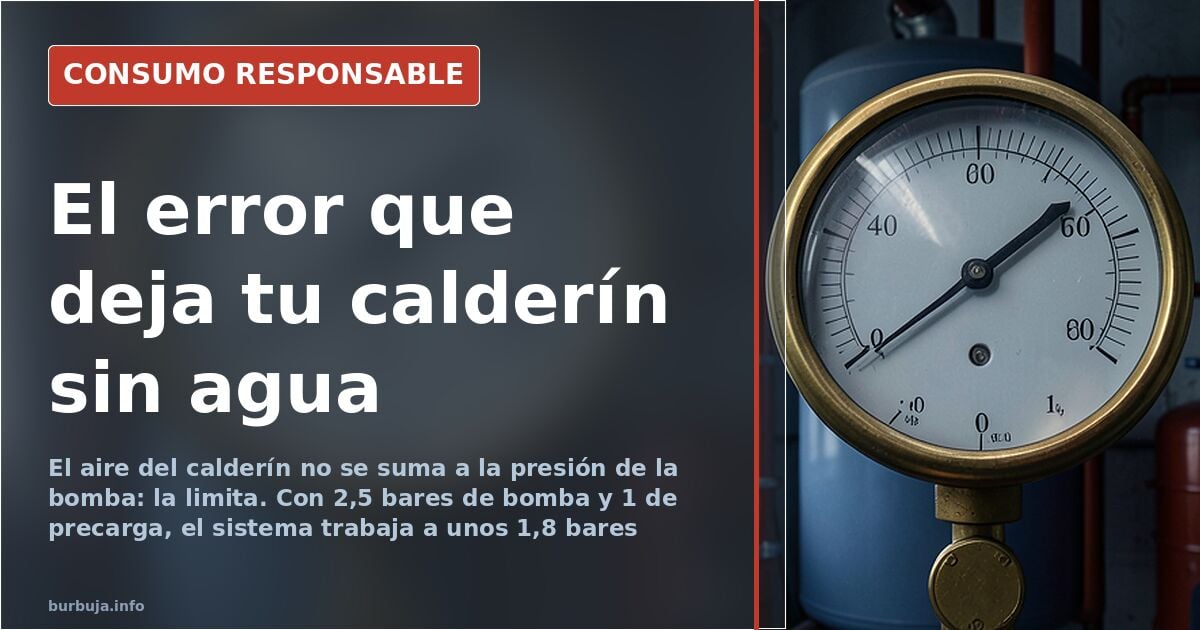
Pressure tank and pump: the air pressure calls the shots
A pressure booster system delivering 2.5 bar and 4.5 litres per minute, installed in a house with a low-output solar array, forces a rethink of what almost nobody explains when buying a diaphragm tank: the air the pressure tank is inflated with does not add to the pump's pressure, it limits it. There are two starting questions. Is pressure cumulative? Can a 1 bar pump push water into a tank inflated to 3? The short answer to the second is no. And the first hides the mistake that ruins more domestic installations than any other.
Do air pressure and pump pressure add up?
They do not. The tank is inflated empty, before any water goes in, and that pre-charge pressure becomes the system's floor: water does not start entering until the pump exceeds that value. If the bladder is at 1 bar and the pump delivers 6, the tank does not reach 7 bar; it settles around 6. What does happen is that the greater the difference between pre-charge and pump pressure, the more water fits in the diaphragm and the more stable the supply. With a 2.5 bar pump and a tank at 1 bar, the average working pressure is around 1.8 bar. Low by usual standards, enough for a house without major elevation changes.
A 6 bar pump for an ordinary home: is it too much?
The reasoning that prevails in practice is different: a pump capable of delivering around 6 bar and a tank set to 2.5, which is the pressure most households are used to. The pump does not always run at its maximum; the tank and the pressure switch set the actual range. The obvious objection arises on its own: if the system cuts in at 3 bar and out at 6, the swing is noticeable. That margin is adjusted with the pressure switch, not left to chance.
How to adjust a pressure tank's pre-charge
Almost all tanks leave the factory with a 3 bar pre-charge, which puzzles anyone who needs 1 or 1.5. It can be lowered without any problem: most have a tyre-type valve and are adjusted with an air pump. The condition is doing it with the tank empty, no water inside. If you inflate it with water in, the reading is false and the adjustment useless.
Does the tank fill with the tap open?
Yes, and that is the key to its intermittent operation. With the tap open, the pump delivers more flow than the outlet is drawing at times of low demand, and that surplus enters the diaphragm until the cut-out pressure is reached. The pump then stops, the tank pushes the water out, and once the pressure drops to the minimum it starts again. For the equipment, that cycle is better than continuous running.
The point where the analysis gets stuck: nobody has measured, with this specific setup, how much usable water there really is between 1.8 and 2.5 bar. Theory says only part of the volume is used. The exact figure still awaits a pressure gauge.
Also available in: Deutsch
Summary of a discussion on Burbuja.info - Foro de economía, actualidad y política., translated from Spanish and reviewed before publication. Read the full discussion (7 replies).
More summaries
-
Installing Solar Panels at Home Costs Between €4,000 and €5,000
Domestic photovoltaic installations cost between €4,000 and €5,000, with batteries at €0.063/kWh. The issue isn't price, it's December.
-
Broken pressure cooker: fix the handle or buy a new one
A broken bakelite handle forces a decision between repairing a 20-year-old pressure cooker or buying a new one with triple safety valve.
-
Replacing a well pump: pressure tank, switch or press control
Well pump won't start: pressure tank, pressure switch or electronic press control. Why it fails, when to replace it, and the mistake of skipping a check valve.
-
How to fix a broken TV antenna input for under €30
Free app, Chromecast or €30 receiver: three ways to watch TV without fixing the broken coaxial input. The cheapest costs zero euros.
-
Removing rust from tiles: vinegar works, muriatic acid with care
Vinegar removes rust stains from tiles without damaging them; muriatic acid is stronger but eats into limestone. Which product to use depending on the material.
-
Running a chest freezer costs just €24 to €30 a year in electricity
A chest freezer uses between €24 and €30 of electricity a year, according to a calculation circulating in the debate, which reopens the question of whether freezing food is worth it.