
Prepping: the six-month pantry you rotate like a supermarket
Lentils at €1/kg and rice at €0.70: the six-month pantry as a savings strategy. Water and rotation are the weak points.
English · Original discussion in Spanish · Published
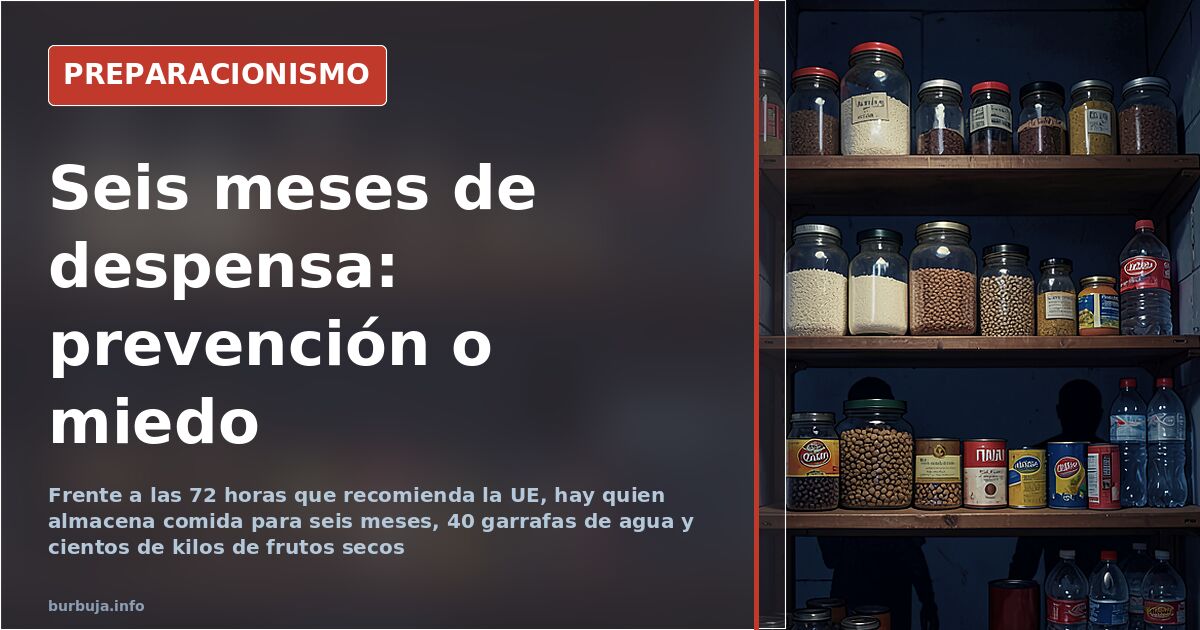
Buying six months of food and rotating it like a supermarket: the savings trend among preppers
How much food do you need at home to sleep soundly? The answer circulating in certain circles is no longer three days of canned goods, but six months of rice, legumes, bottled water and nuts. The EU recommends supplies for 72 hours; some people have multiplied that figure by sixty. And not out of some mystical premonition, but out of savings logic: buy cheap today what you'll eat two years from now.
The starting thesis is simple: if the system fails — a prolonged blackout, a supply crisis, a war — whoever has a full pantry doesn't queue. If it doesn't fail, you eat what you've stored and replace it. In either scenario, the money isn't lost. The problem arises when the stockpile becomes an end in itself rather than an extension of the family shopping.
What to store and how much it costs
The figures thrown around in these conversations are pure household economics. Lentils at 1 euro a kilo, chickpeas and white beans at 1.45, rice at 0.70, macaroni and spaghetti at 0.20. At those prices, a family can stockpile calories for months without going broke. The underlying calculation is simple: protein and fat are the expensive part; carbs, the cheap part. That's why olive oil and fatty foods emerge as the real insurance policy, not rice.
Some go further and reduce the pantry to a single product: instant mashed potato powder, sold in packets ready to store, which can be eaten prepared with water or even dry. It's the modern version of military rations: cheap calories, long shelf life and zero culinary pretensions. The problem, as the veterans point out, is that storing what you don't normally eat is throwing money away. The golden rule is to rotate: what goes in, comes out; what comes out, gets replaced.
Water, the weak point of any pantry
No stockpile of food is any use without water. And this is where the debate turns technical. Eight-litre jerry cans keep well, but must be stored in the dark, away from concrete floors and chemicals. To obtain water from a river or spring, the methods complement each other: a 0.1-0.2 micron membrane filter removes bacteria and parasites, but not all bicho; boiling for one to three minutes or adding a few drops of food-grade bleach covers that gap. Ultraviolet light inactivates pathogens, but only works with clear water and needs power.
Turbidity is the silent enemy. If the water carries mud, the membrane clogs and UV radiation can't peine. That's why it's recommended to let the water settle and pass it first through a cloth or prefilter. It's a three-step process — settle, filter, disinfect — that many ignore and that turns expensive equipment into a paperweight.
Ash lye: the mistake that keeps repeating
A homemade recipe circulates in these circles that mixes wood ash with water to obtain a disinfectant. The result is an alkaline solution of potassium carbonate and hydroxide, the so-called old-fashioned lye, once used for washing clothes and making soap. It is not hypochlorite. Ash contains no chlorine. It's caustic, can burn skin and eyes, and is useless for making water safe to drink. If added to drinking water, it makes it corrosive.
The sodium hypochlorite in commercial bleach is made by electrolysis of water with salt, and its usual concentration is 3-5%. The confusion between the two terms is dangerous and happens often. For disinfecting water, the reference is food-grade bleach, not an ash concoction.
The garden, the henhouse and the remote plot of land
The pantry is only the first phase. The ultimate goal for many is a plot of land with natural water, solar panels, a gas stove and tools to work the soil. The idea is that the stored food provides the margin needed to get a vegetable garden and a henhouse going. Rabbits and chickens are the minimum-effort protein; duckweed and azolla are fast-growing crops in warm climates.
The problem is scale. A well-stocked henhouse provides eggs and chickens, but if you only eat chicken, the chickens run out in a month. Real self-sufficiency requires variety and, above all, knowledge. That's why books on edible wild plants and survival manuals come up in these conversations as the most valuable resource. Knowledge doesn't expire and can't be stolen.
The debate that never closes
The most repeated criticism is that no pantry cures appendicitis. Total self-sufficiency doesn't exist; humanity survives because of the division of labour. Having six months of food doesn't replace a surgeon, a pharmacist or a power grid. And in a prolonged crisis, a house with visible supplies becomes a target.
The answer from the most experienced is that the goal isn't to isolate yourself, but to buy time. Time for the system to recover, or to organise with your neighbours. In real emergencies, what has worked isn't weapons, but mutual aid. The pantry buys you margin; social relationships, survival. And coffee, chocolate and olive oil, according to the most practical, are the currency of the future.
In the end, the question isn't whether collapse will come, but how much of your weekly shopping you're willing to turn into a rotating stockpile. The answer, like almost everything in household economics, depends on how much space you have and how much patience for labelling cans.
Also available in: Deutsch
Summary of a discussion on Burbuja.info - Foro de economía, actualidad y política., translated from Spanish and reviewed before publication. Read the full discussion (111 replies).
More summaries
-
Prepper pre-buying: months of normal food without spending extra
The prepper pre-buying strategy suggests stockpiling months of regular food without extra spending. Data, debate, and lockdown lessons in a no-holds-barred analysis.
-
Kubotans and tactical pens: legality in Spain
Spain's Weapons Regulation does not explicitly mention kubotans. Possession of a tactical pen depends on police discretion and intended use.
-
Heat pumps lose efficiency in cold weather, users report
Forum users report heat pump performance drops below 5°C, suggesting alternatives like €20 electric blankets or wood.
-
Edible Oil Selection Becomes Strategic for Indian Food Makers
Vyansa Intelligence predicts palm oil will account for 27% of India's edible oil consumption in 2026. Oil choice impacts frying, packaging, and supply.
-
Portable Heat Pump: The 39-Euro Annual Cost That Doesn't Add Up
A user claims €39/year heating with a portable heat pump. COP of 3.2 and constant outlet temperature fail to prove this.
-
Emergency Radio: Frequencies to Save When Internet and TV Fail
No secret government frequency exists, but specific bands and protocols work when networks fail. A guide to essential emergency radio equipment.