
Premium diesel: the cleaner EGR that doesn't pay off at the pump
A driver notices his diesel knocks with cheap fuel and starts better with premium. The shared origin at CLH and the price of additives are up for debate.
English · Original discussion in Spanish · Published
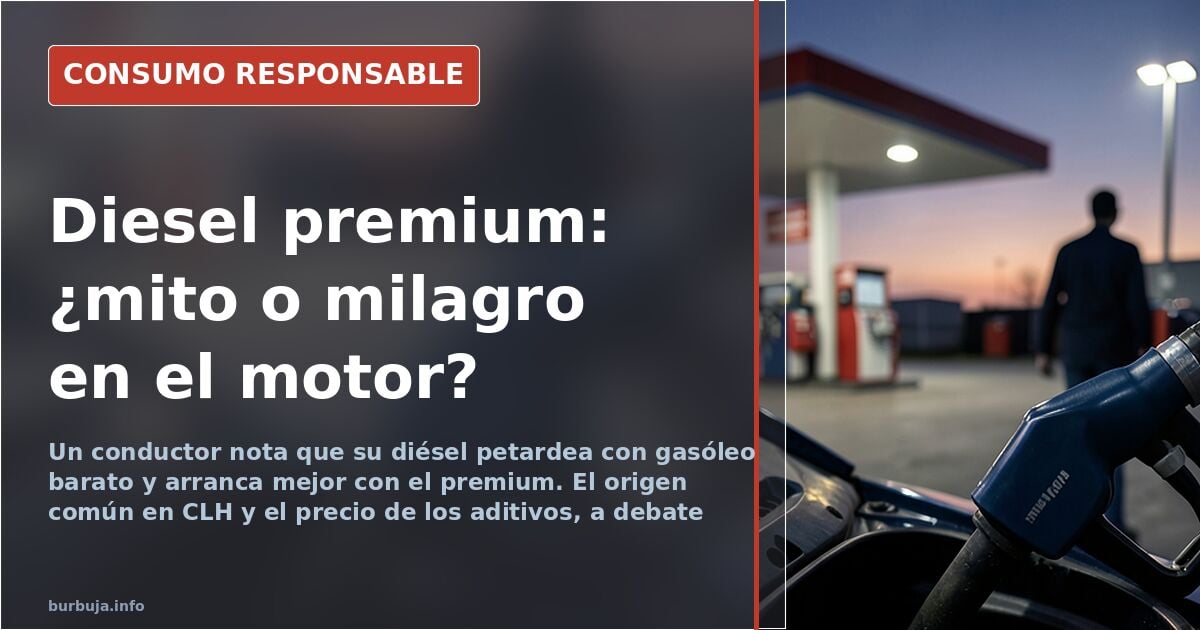
Branded diesel isn't worth it, even if it keeps the EGR clean
A driver switches from BP Ultimate to the cheap fuel from a taxi cooperative and, according to his account, the car stops starting on the first try. Halfway through the tank, when revving past 4,000 rpm, it starts to knock. He goes back to the additive-enhanced fuel and the engine regains its punch. The conclusion seems obvious: expensive diesel works better. The problem is that this conclusion doesn't hold up with a single test, a single car and zero repetitions. The experience, told in detail, opens a debate that has lasted for years and touches the pocket of anyone who fills up every week.
The initial account is thorough. With premium diesel, the engine runs smoother, uses slightly less fuel, makes less noise when cold and starts on the first try. With the regular fuel from the cooperative, halfway through the tank and with the engine warm, a slight knocking fault appears above 4,000 rpm. The EGR valve, moreover, was much cleaner with the branded fuel, according to the author. These are subjective impressions, but the author insists that ambient temperatures were similar in both cases.
The price per litre and the calculation nobody makes
The difference between regular and premium diesel moves in cents per litre. From regular to branded there's about **10 cents**; from branded to premium, another **7 cents**, according to the prices the author cites. On an average tank, the annual extra cost can exceed a hundred euros. The question hanging in the air is whether that money translates into fewer breakdowns or into injector cleaning that costs less than the surcharge. Nobody in the conversation presents a completed calculation.
Some argue that the cleaning additive helps when the injectors are already dirty, and that in that case it's cheaper to do a one-off cleaning and stick with the cheap fuel. Against this is the argument that the additive-enhanced fuel keeps the engine clean continuously, without a alucinación to the garage. Either way, the calculation hasn't been done.
All the trucks fill up from the same tank
The most controversial part of the matter is the origin of the fuel. Several voices agree that **all petroleum products in Spain come from the same place**: Compañía Logística de Hidrocarburos (CLH), Spain's main fuel logistics company. Each brand's trucks fill up at the same outlet, and the only real difference is the package of additives injected at the moment of loading, according to those who defend this thesis. The concentration of these additives is measured in parts per million, which fuels doubt about their real effectiveness.
The other half of the argument points to the facilities. A tank with water at the bottom, a poorly maintained cistern or a station with low turnover can damage the engine more than any premium additive. Diesel floats on water, which accumulates at the bottom of the tank and can end up in the circuit. The cleanliness of the facilities, they say, matters more than the brand on the pump.
The EGR, the turbo and 4,000 rpm
EGR valve maintenance is the focus of another part of the exchange. Disabling it causes errors in the ECU and warning lights; blocking it mechanically doesn't convince the mechanics either, because the system can enter protection mode and limit the revs, according to the author's account. The alternative defended is to rev the engine up now and then, with the oil at the right level and the engine warm, to prevent deposit build-up.
The habit of stretching gears to 4,000 rpm in a diesel generates division. For some it's an unnecessary practice that punishes the engine; for others, one run a day prevents the breakdown. The discussion leaves one clear idea: premium diesel is no substitute for maintenance or proper driving.
The placebo effect and the lack of evidence
The harshest criticism comes from statistical scepticism. With thousands of variables at play — temperature, engine condition, tank quality, driving style — a single test proves nothing. The perceived improvement may be suggestion. And fuel consumption, the author himself admits, drops more from relaxed driving than from the fuel itself.
The debate isn't closed. The author will keep filling up with premium, convinced that the EGR stays clean. Others have been running on the cheapest fuel for years and are still waiting for the serious breakdown. How many tanks would it take to know who's right?
Also available in: Deutsch
Summary of a discussion on Burbuja.info - Foro de economía, actualidad y política., translated from Spanish and reviewed before publication. Read the full discussion (63 replies).
More summaries
-
Ford adds EGR valve to EcoBoost petrol engines
Ford integrates the EGR valve into its 1.5 EcoBoost petrol engine, cutting fuel consumption by 7% but introducing a component prone to clogging and requiring workshop maintenance.
-
Costco Spain Tire Service: Premium Brands, Balancing Issues
Costco offers Michelin, Pirelli, and Bridgestone tires at competitive prices in Spain, but a customer reports missing wheel balancing. Key service details.
-
Ford Mondeo MK4 Diesel: Forum Insights on Wet Belt and Dual Mass Flywheel
Forum users discuss common issues with the Mondeo MK4 diesel, focusing on wet belt failures in the 1.8 TDCi and dual mass flywheel wear.
-
robin.jobs: Dutch temp agency with housing that won't answer
A jobseeker sends his ID and driving licence to robin.jobs, a Dutch temp agency with no reviews, no social media activity and poor fraud-checker scores.
-
Malwarebytes: essential as a complement, not as an antivirus
Malwarebytes is not an antivirus: it is an antimalware tool meant to complement one. The consensus on its usefulness clashes with those who rely only on the built-in antivirus.
-
Mystery shopper: €10 to €60 per visit, with doubts about the business
Between €10 and €60 per visit and half an hour filling out a questionnaire in English: that's how mystery shopper work is sold, with a bonus for recruiting new members.