
Pregnant woman stranded at Madrid Barajas for four months
A pregnant Colombian woman living in Madrid's Barajas airport T4 has reignited debate on Spain's migration model and airport entry procedures.
English · Original discussion in Spanish · Published
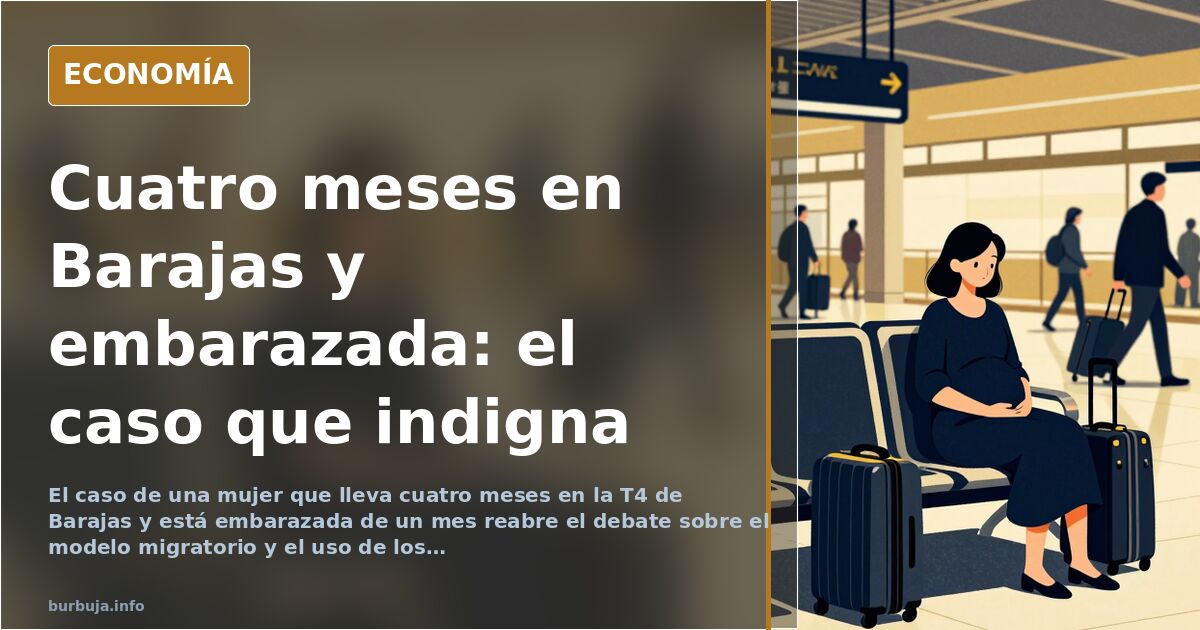
Four months at Barajas and pregnant: the case that reopens migration debate
A woman has been living in Terminal 4 of Barajas Airport for four months. She is one month pregnant. The case, circulated via a social media video, has peine discussion on Spain's migration model and the use of airports as entry points. This news is not new: the Madrid terminal has long accumulated cases of people remaining in its facilities due to inability to regularize their status or be returned to their home countries. What has changed is the visibility of the phenomenon.
The airport as the last frontier
T4 has become an administrative limbo. People arriving by plane without meeting entry requirements are trapped between the impossibility of being returned and the lack of a legal path to regularize their status. The case of the Colombian woman, who according to the circulated video has been in the terminal for four months and is one month pregnant, illustrates this deadlock. It is not an isolated case: the Madrid airport has accumulated similar situations for years, though they rarely come to light.
The pregnancy adds a layer of legal complexity. If the child is born in Spain, current legislation provides for scenarios where those born on Spanish territory may access nationality, especially when the parents' nationality cannot be determined. That framework, designed for abandonment cases, generates intense debate about its application to situations like this.
What does the law say about ius soli in Spain?
Spain does not apply pure ius soli. Spanish nationality by origin is governed primarily by ius sanguinis: one is Spanish if born to a Spanish father or mother. Exceptions exist, such as birth in Spain to foreign parents if neither can transmit their nationality to the child, or if the identity of the parents is unknown. In those cases, and provided procedures are met, the newborn may obtain Spanish nationality.
That exception, intended to prevent statelessness, is what generates controversy. Some argue there is instrumental use of pregnancy to ensure stay in the country. Other analyses remind us that nationality is not automatically granted by being born on Spanish soil and that the process requires an administrative resolution. The discussion, in any case, is not new: so-called birth tourism has been under scrutiny for years in countries like the United States.
Entry by air: the flow missing from news reports
Media focus usually falls on arrivals by sea. However, part of the analysis argues that the air route is quantitatively more relevant and less visible. Those arriving by plane do so with documentation, even if insufficient or false, and remain in an irregular administrative situation that complicates expulsion. The Barajas terminal thus becomes a space of indefinite waiting.
The profile of these people varies. Some flee violence or poverty in their home countries, while others seek better economic conditions. This mix of motives makes simplistic responses difficult. What they share is the lack of a quick return path: many have no money to go back nor documents proving their identity, blocking any return procedure.
The economic and social cost of limbo
Prolonged stay in airport facilities has a cost. People living in the terminal depend on aid from social organizations and solidarity from travelers and airport workers. According to some analyses, this assistance creates a pull effect that perpetuates the phenomenon. Others respond that the alternative—leaving destitute people on the street—is worse.
Impact on the labor market is another friction point. The underground economy absorbs part of those who manage to leave the airport and partially regularize. This puts downward pressure on wages in sectors like agriculture, hospitality, or construction, according to some analyses. Advocates of regular immigration argue the problem is not people's arrival, but the lack of legal paths and effective control.
Political debate: between expulsion and regularization
Political stances range from those demanding rapid expulsions and border closures to those defending mass regularizations and legal entry paths. In the middle lies a social majority that, according to polls, demands order and control but rejects inhumane treatment. The Barajas case condenses this tension: there is no easy or cheap solution.
Debate on ius soli and access to nationality has become an ideological battleground. Some propose tightening requirements to avoid instrumental uses. Others warn that restricting fundamental rights affects people who have done nothing illegal. Balancing migration control and rights protection is the Gordian knot of the debate.
The case of the woman who has been in T4 for four months and is one month pregnant is not an isolated anecdote. It is the tip of an iceberg mixing obsolete legislation, lack of resources, and growing global migration pressure. The unanswered question remains: how many more cases will it take for the system to stop improvising?
A woman has been living in Terminal 4 of Barajas Airport for four months. She is one month pregnant. The case, circulated via a social media video, has peine discussion on Spain's migration model and the use of airports as entry points. This news is not new: the Madrid terminal has long accumulated cases of people remaining in its facilities due to inability to regularize their status or be returned to their home countries. What has changed is the visibility of the phenomenon.
The airport as the last frontier
T4 has become an administrative limbo. People arriving by plane without meeting entry requirements are trapped between the impossibility of being returned and the lack of a legal path to regularize their status. The case of the Colombian woman, who according to the circulated video has been in the terminal for four months and is one month pregnant, illustrates this deadlock. It is not an isolated case: the Madrid airport has accumulated similar situations for years, though they rarely come to light.
The pregnancy adds a layer of legal complexity. If the child is born in Spain, current legislation provides for scenarios where those born on Spanish territory may access nationality, especially when the parents' nationality cannot be determined. That framework, designed for abandonment cases, generates intense debate about its application to situations like this.
What does the law say about ius soli in Spain?
Spain does not apply pure ius soli. Spanish nationality by origin is governed primarily by ius sanguinis: one is Spanish if born to a Spanish father or mother. Exceptions exist, such as birth in Spain to foreign parents if neither can transmit their nationality to the child, or if the identity of the parents is unknown. In those cases, and provided procedures are met, the newborn may obtain Spanish nationality.
That exception, intended to prevent statelessness, is what generates controversy. Some argue there is instrumental use of pregnancy to ensure stay in the country. Other analyses remind us that nationality is not automatically granted by being born on Spanish soil and that the process requires an administrative resolution. The discussion, in any case, is not new: so-called birth tourism has been under scrutiny for years in countries like the United States.
Entry by air: the flow missing from news reports
Media focus usually falls on arrivals by sea. However, part of the analysis argues that the air route is quantitatively more relevant and less visible. Those arriving by plane do so with documentation, even if insufficient or false, and remain in an irregular administrative situation that complicates expulsion. The Barajas terminal thus becomes a space of indefinite waiting.
The profile of these people varies. Some flee violence or poverty in their home countries, while others seek better economic conditions. This mix of motives makes simplistic responses difficult. What they share is the lack of a quick return path: many have no money to go back nor documents proving their identity, blocking any return procedure.
The economic and social cost of limbo
Prolonged stay in airport facilities has a cost. People living in the terminal depend on aid from social organizations and solidarity from travelers and airport workers. According to some analyses, this assistance creates a pull effect that perpetuates the phenomenon. Others respond that the alternative—leaving destitute people on the street—is worse.
Impact on the labor market is another friction point. The underground economy absorbs part of those who manage to leave the airport and partially regularize. This puts downward pressure on wages in sectors like agriculture, hospitality, or construction, according to some analyses. Advocates of regular immigration argue the problem is not people's arrival, but the lack of legal paths and effective control.
Political debate: between expulsion and regularization
Political stances range from those demanding rapid expulsions and border closures to those defending mass regularizations and legal entry paths. In the middle lies a social majority that, according to polls, demands order and control but rejects inhumane treatment. The Barajas case condenses this tension: there is no easy or cheap solution.
Debate on ius soli and access to nationality has become an ideological battleground. Some propose tightening requirements to avoid instrumental uses. Others warn that restricting fundamental rights affects people who have done nothing illegal. Balancing migration control and rights protection is the Gordian knot of the debate.
The case of the woman who has been in T4 for four months and is one month pregnant is not an isolated anecdote. It is the tip of an iceberg mixing obsolete legislation, lack of resources, and growing global migration pressure. The unanswered question remains: how many more cases will it take for the system to stop improvising?
Also available in: Deutsch
Summary of a discussion on Burbuja.info - Foro de economía, actualidad y política., translated from Spanish and reviewed before publication. Read the full discussion (113 replies).
More summaries
-
Ayuso draws a line between small boat arrivals and Hispanics, reviving the Barajas debate
Ayuso separates small boat arrivals from Hispanics: figures circulate suggesting 90% of irregular entries are by air and 85% seeking extraordinary regularization are from Latin America.
-
Spain's Two-Year Citizenship Path for Ibero-Americans
Article 22 of Spain’s Civil Code grants citizenship after two years to nationals from Ibero-American countries, Andorra, Philippines, Equatorial Guinea, Portugal, and Sephardic Jews.
-
Hollywood Walk of Fame Becomes Fentanyl Crisis Symbol
Viral images of Hollywood Boulevard described as a horror film fuel US debates on fentanyl and urban policy.
-
Reheated Oil Causes Liver and Brain Damage in Rats
Study on rats fed reheated sesame and sunflower oil reveals liver inflammation, colon damage, and neurodegeneration in offspring.
-
Rubiales' uncle shifts from chief of staff to accuser
Luis Rubiales' former chief of staff, earning nearly €200,000, has reported him to Spain's Anti-Corruption Prosecutor.
-
RTVE removes poet Aarón García Peña's broadcast
RTVE pulled a Radio Exterior segment where poet Aarón García Peña criticized the government and WHO. His name was also removed from Wikipedia.