
Pradera Blames Diet for His Prostate Cancer
Spanish journalist Máximo Pradera attributes his prostate cancer to diet and criticizes public healthcare, sparking debate among medical experts.
English · Original discussion in Spanish · Published
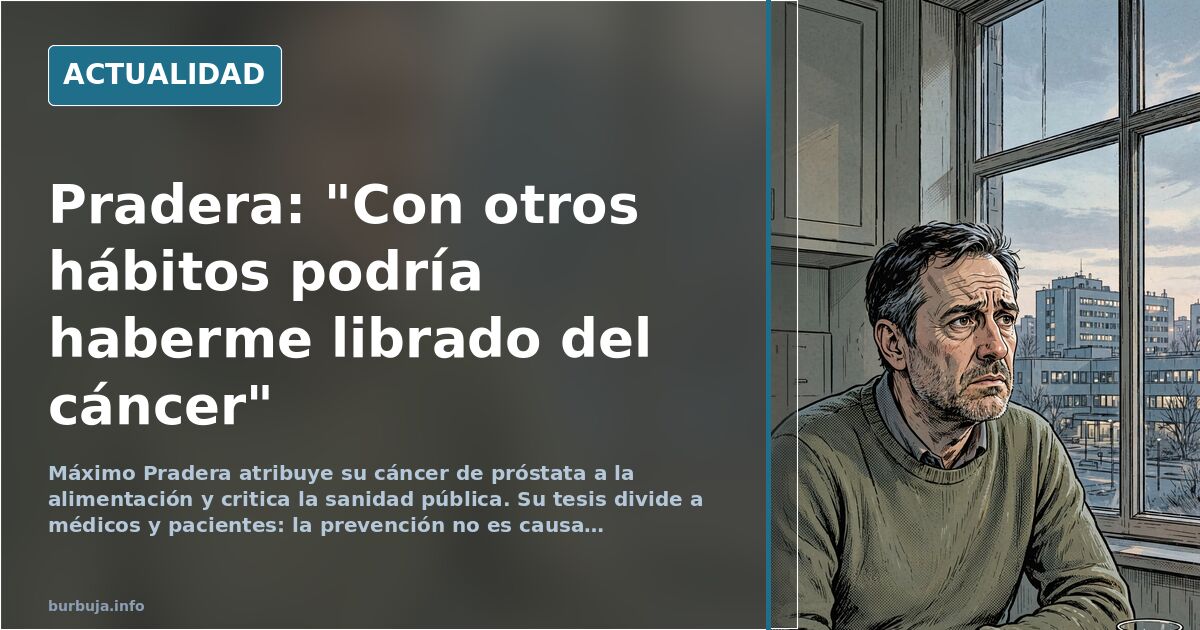
Máximo Pradera blames food for his prostate cancer
Máximo Pradera, who co-presented «Lo + Plus» with Fernando Schwartz, reappeared on television to discuss the prostate cancer diagnosed in 2019. He was 66 at the time, with a PSA level of 89-90, according to his own account. His thesis is blunt: "If I had different dietary and lifestyle habits, I might have avoided cancer." He adds a statement that summarizes his anger toward conventional medicine: "I got cancer because no doctor asked me a key question: what do you eat?"
The media personality claims he studied biochemistry independently, practices intermittent fasting, and has lost 20 kilos. He also asserts that "misinformation caused my cancer." All this is gathered in a book with an explicit title, "Libro del cáncer y la progenitora que lo parió" (Book of Cancer and Damn It), which he defended on Emma García's program "Fiesta," where she introduced him as "an unqualified biochemist."
What he said about public and private healthcare
Pradera stated that the first test he underwent was an MRI, which he could afford only because he has private insurance. "Public healthcare doesn't cover it," he claimed. This remark drew immediate criticism from those arguing that the public system does perform such tests. He also attacked transrectal biopsies, describing them as dangerous and prone to false negatives: "It's like taking an orange and poking it 5 or 6 times with a pinhead, hoping to hit a tumor."
He cited the case of Alfredo Pérez Rubalcaba, who had high PSA levels and, according to Pradera, suffered a serious infection after testing. Pradera considers himself lucky to have afforded tests like PSMA scans at Clínica de Navarra. "Not everyone can do what I did," he acknowledged.
Intermittent fasting and losing 20 kilos
The core of his message is nutritional. He argues that cancer "feeds on sugar," that controlled fasting is preventive, and that diet is decisive. Reactions were mixed. One view holds that knowing sugar is bad and fasting is good is common knowledge, making its presentation as a discovery excessive. Another goes further, calling the attribution of cancer to diet simplistic, noting that children get brain tumors while elderly smokers and drinkers often don't develop cancer.
Some point out factors Pradera omits: sun exposure, artificial light, sleep, and environmental toxins as variables that also affect health. Others directly deny the diagnosis is real, suggesting the narrative serves to blame patients for their illness. This suspicion is not backed by evidence.
Stoic gratitude and his newly published book
Pradera concludes with a philosophical shift. He says the experience changed his mindset, moving him from being a "creditor" to being "grateful." "Life owes me nothing," he states. "We must be thankful all day long." He also mentioned his ex-partner had osteopenia and took vitamin D, though the account ends there.
The general tone of public discussion mixes three elements: genuine interest in prevention, rejection of a cancer patient lecturing on biochemistry, and distrust toward a figure who once publicly wished cancer upon certain politicians. That detail, resurfacing now, colors any interpretation of his message.
The book will likely sell well. What remains unclear is whether his thesis—that diet would have prevented the tumor—will withstand scrutiny from oncology. Prevention matters. Turning it into the sole cause is something else entirely.
Máximo Pradera, who co-presented «Lo + Plus» with Fernando Schwartz, reappeared on television to discuss the prostate cancer diagnosed in 2019. He was 66 at the time, with a PSA level of 89-90, according to his own account. His thesis is blunt: "If I had different dietary and lifestyle habits, I might have avoided cancer." He adds a statement that summarizes his anger toward conventional medicine: "I got cancer because no doctor asked me a key question: what do you eat?"
The media personality claims he studied biochemistry independently, practices intermittent fasting, and has lost 20 kilos. He also asserts that "misinformation caused my cancer." All this is gathered in a book with an explicit title, "Libro del cáncer y la progenitora que lo parió" (Book of Cancer and Damn It), which he defended on Emma García's program "Fiesta," where she introduced him as "an unqualified biochemist."
What he said about public and private healthcare
Pradera stated that the first test he underwent was an MRI, which he could afford only because he has private insurance. "Public healthcare doesn't cover it," he claimed. This remark drew immediate criticism from those arguing that the public system does perform such tests. He also attacked transrectal biopsies, describing them as dangerous and prone to false negatives: "It's like taking an orange and poking it 5 or 6 times with a pinhead, hoping to hit a tumor."
He cited the case of Alfredo Pérez Rubalcaba, who had high PSA levels and, according to Pradera, suffered a serious infection after testing. Pradera considers himself lucky to have afforded tests like PSMA scans at Clínica de Navarra. "Not everyone can do what I did," he acknowledged.
Intermittent fasting and losing 20 kilos
The core of his message is nutritional. He argues that cancer "feeds on sugar," that controlled fasting is preventive, and that diet is decisive. Reactions were mixed. One view holds that knowing sugar is bad and fasting is good is common knowledge, making its presentation as a discovery excessive. Another goes further, calling the attribution of cancer to diet simplistic, noting that children get brain tumors while elderly smokers and drinkers often don't develop cancer.
Some point out factors Pradera omits: sun exposure, artificial light, sleep, and environmental toxins as variables that also affect health. Others directly deny the diagnosis is real, suggesting the narrative serves to blame patients for their illness. This suspicion is not backed by evidence.
Stoic gratitude and his newly published book
Pradera concludes with a philosophical shift. He says the experience changed his mindset, moving him from being a "creditor" to being "grateful." "Life owes me nothing," he states. "We must be thankful all day long." He also mentioned his ex-partner had osteopenia and took vitamin D, though the account ends there.
The general tone of public discussion mixes three elements: genuine interest in prevention, rejection of a cancer patient lecturing on biochemistry, and distrust toward a figure who once publicly wished cancer upon certain politicians. That detail, resurfacing now, colors any interpretation of his message.
The book will likely sell well. What remains unclear is whether his thesis—that diet would have prevented the tumor—will withstand scrutiny from oncology. Prevention matters. Turning it into the sole cause is something else entirely.
Summary of a discussion on Burbuja.info - Foro de economía, actualidad y política., translated from Spanish and reviewed before publication. Read the full discussion (140 replies).
More summaries
-
Cancer: The 3.5cm Tumor That Vanished in 60 Days
A case claims a 3.5cm lung tumor was cured with phytotherapy in 60 days. Lacks biopsy and data; 5-year survival remains 16%.
-
José Mota stops hair treatment due to side effects
José Mota quits hair loss medication due to side effects: 'I prefer to have a receding hairline and thinning hair'
-
Gaza Flotilla: Party On Board, Uncertain Destination
The Gaza-bound flotilla from Barcelona sparks debate over its legitimacy versus perceived performative activism.
-
Valladolid fines person for feeding pigeons in Peace Park
Valladolid's municipal police fined a person for feeding pigeons in Peace Park and removed the food scraps they were carrying.
-
108-Year-Old Spaniard Never Visited a Gym
Pere Quintana, from Barcelona, turns 109 in January without ever exercising. His case reignites debates on genetics and longevity.
-
Spanish HIV Documentary Sells Two Tickets Despite €317k Subsidy
A viral tweet mocks the low ticket sales for Eduardo Casanova's HIV documentary in Madrid, sparking debate over public film subsidies.