
Cancer: The 3.5cm Tumor That Vanished in 60 Days
A case claims a 3.5cm lung tumor was cured with phytotherapy in 60 days. Lacks biopsy and data; 5-year survival remains 16%.
English · Original discussion in Spanish · Published
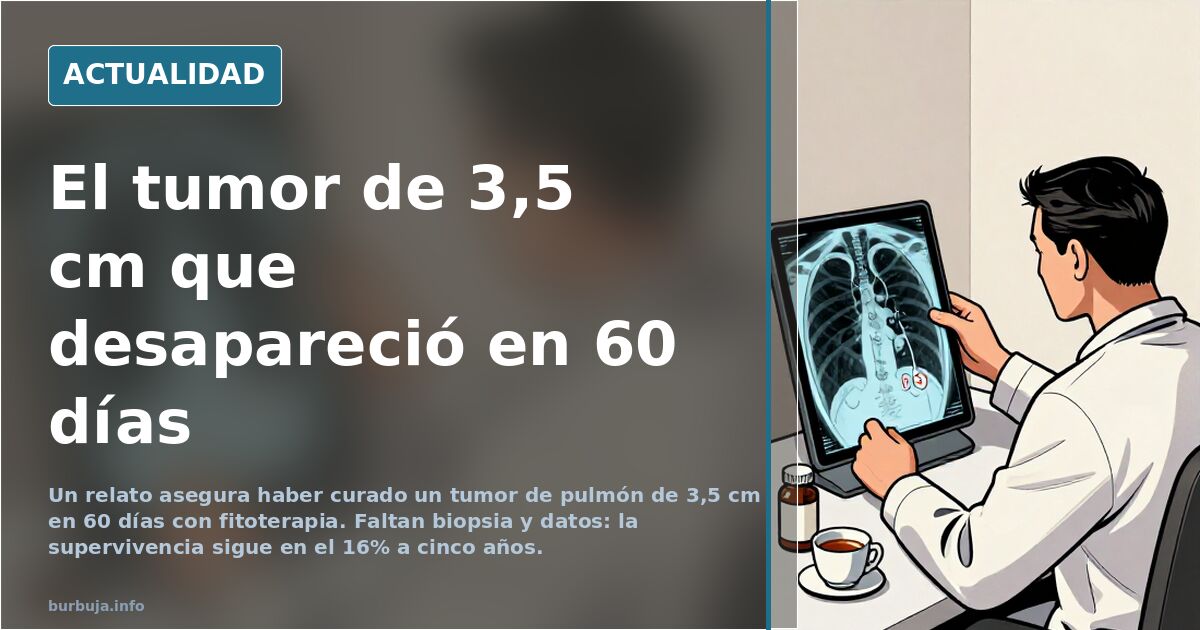
A 3.5cm Lung Tumor Erased in 60 Days: Biopsy is Missing
In August, a CT scan detects a 3.5cm lung tumor, stage 2, already with alveolar infiltration. In October, a PET scan shows a clear lung, save for slight residual atelectasis. Between these scans, there was no chemotherapy, surgery, or radiotherapy: only a phytotherapeutic formulation. This is the story fueling one of the longest and most heated discussions about whether alternative treatments can cure cancer. And six years after it began, the question remains unanswered for the same reason: no one has ever seen the biopsy.
What Proof Supports a Phytotherapy Cure?
The narrative relies on two images. The first, the initial diagnosis. The second, the tumor's disappearance. The patient refused a biopsy due to the area's risk, requested five weeks to apply his own protocol, and later agreed to a confirmation PET scan. On paper, a tumor vanishes without oncology. In practice, a case without histological confirmation, and therein lies the problem.
Because cancer has an inconvenient tendency: sometimes it resolves on its own. Experience records spontaneous remissions, without any treatment, in about one in 100,000 cases. Little, yes. Enough for any stray anecdote to become ammunition. Without a prior biopsy, one cannot even rule out that what was present wasn't what was claimed. Those who demand the full protocol demand exactly that.
The 16% at Five Years: The Figure That Reframes the Debate
There is a statistic that permeates the entire discussion, and it's not from any remedy website: the five-year survival rate for lung cancer is around 16% when detected late. In that scenario, chemotherapy prolongs life but rarely saves it, and the cost in quality of life is high. Here, skepticism towards the system stops being paranoia and becomes a calculation anyone can do.
The underlying argument is not "medicine doesn't work," but "medicine does what it can and sells it as success." On that suspicion rests everything else. And the suspicion has a named target: the large oncology laboratories, those that meet every six months to discuss revenue and never affordable prices.
Baking Soda, B17, and Scorpion Venom: The Catalog of Promises
The list of alternative proposals circulating is extensive: plants, vitamin B17, baking soda, scorpion venom, coenzyme Q10, repurposed veterinary antiparasitics, protocols with ivermectin and fenbendazole. Add acupuncture and pranayama, which some defend with studies. Almost nothing has undergone serious clinical trials. Some things, like the carrot and leukemia case, have preliminary work that never went further.
The most overused case is that of Steve Jobs, who subsisted almost exclusively on fruit juices for decades before dying of pancreatic cancer. It's cited as proof that diets don't save, and, with a sneer, as proof that even a millionaire's fortune doesn't guarantee choosing the right treatment.
Are All Cancers the Same? The 200+ Types That Break the Single Protocol
Some argue that all cancers share a common metabolic disorder origin and therefore admit a common approach. Against this, the fact that dismantles the thesis: there are over 200 distinct types, each with its molecular, genetic, and metabolic signature. A melanoma does not behave like pancreatic cancer, and leukemia resembles neither. A single protocol falters there.
This is the most solid technical objection in the debate, and it doesn't come from the industry. It comes from biology itself.
From Oncology to Income Tax: How the Discussion Shifted
What began by discussing tumors and CT scans ended, in its later stages, by discussing tax pressure, alleged sacrifices, and what each person pays for another to receive. This is the usual fate of conversations when the underlying topic is too difficult.
Some see a pharmaceutical hand orchestrating protocols from offices and ministries. And some recall that any patient with a real cure would have a human duty to publish it, without patents or intermediaries. Both things coexist in the same space.
Six years, hundreds of messages, and one single solid piece of evidence: two images. The tumor is gone. The doubt is not.
In August, a CT scan detects a 3.5cm lung tumor, stage 2, already with alveolar infiltration. In October, a PET scan shows a clear lung, save for slight residual atelectasis. Between these scans, there was no chemotherapy, surgery, or radiotherapy: only a phytotherapeutic formulation. This is the story fueling one of the longest and most heated discussions about whether alternative treatments can cure cancer. And six years after it began, the question remains unanswered for the same reason: no one has ever seen the biopsy.
What Proof Supports a Phytotherapy Cure?
The narrative relies on two images. The first, the initial diagnosis. The second, the tumor's disappearance. The patient refused a biopsy due to the area's risk, requested five weeks to apply his own protocol, and later agreed to a confirmation PET scan. On paper, a tumor vanishes without oncology. In practice, a case without histological confirmation, and therein lies the problem.
Because cancer has an inconvenient tendency: sometimes it resolves on its own. Experience records spontaneous remissions, without any treatment, in about one in 100,000 cases. Little, yes. Enough for any stray anecdote to become ammunition. Without a prior biopsy, one cannot even rule out that what was present wasn't what was claimed. Those who demand the full protocol demand exactly that.
The 16% at Five Years: The Figure That Reframes the Debate
There is a statistic that permeates the entire discussion, and it's not from any remedy website: the five-year survival rate for lung cancer is around 16% when detected late. In that scenario, chemotherapy prolongs life but rarely saves it, and the cost in quality of life is high. Here, skepticism towards the system stops being paranoia and becomes a calculation anyone can do.
The underlying argument is not "medicine doesn't work," but "medicine does what it can and sells it as success." On that suspicion rests everything else. And the suspicion has a named target: the large oncology laboratories, those that meet every six months to discuss revenue and never affordable prices.
Baking Soda, B17, and Scorpion Venom: The Catalog of Promises
The list of alternative proposals circulating is extensive: plants, vitamin B17, baking soda, scorpion venom, coenzyme Q10, repurposed veterinary antiparasitics, protocols with ivermectin and fenbendazole. Add acupuncture and pranayama, which some defend with studies. Almost nothing has undergone serious clinical trials. Some things, like the carrot and leukemia case, have preliminary work that never went further.
The most overused case is that of Steve Jobs, who subsisted almost exclusively on fruit juices for decades before dying of pancreatic cancer. It's cited as proof that diets don't save, and, with a sneer, as proof that even a millionaire's fortune doesn't guarantee choosing the right treatment.
Are All Cancers the Same? The 200+ Types That Break the Single Protocol
Some argue that all cancers share a common metabolic disorder origin and therefore admit a common approach. Against this, the fact that dismantles the thesis: there are over 200 distinct types, each with its molecular, genetic, and metabolic signature. A melanoma does not behave like pancreatic cancer, and leukemia resembles neither. A single protocol falters there.
This is the most solid technical objection in the debate, and it doesn't come from the industry. It comes from biology itself.
From Oncology to Income Tax: How the Discussion Shifted
What began by discussing tumors and CT scans ended, in its later stages, by discussing tax pressure, alleged sacrifices, and what each person pays for another to receive. This is the usual fate of conversations when the underlying topic is too difficult.
Some see a pharmaceutical hand orchestrating protocols from offices and ministries. And some recall that any patient with a real cure would have a human duty to publish it, without patents or intermediaries. Both things coexist in the same space.
Six years, hundreds of messages, and one single solid piece of evidence: two images. The tumor is gone. The doubt is not.
Summary of a discussion on Burbuja.info - Foro de economía, actualidad y política., translated from Spanish and reviewed before publication. Read the full discussion (535 replies).
More summaries
-
The 'anti-system' woman: A label that unravels upon definition
Can a woman be anti-system? One participant argues she is the system; another, that the right dictates and the left executes.
-
GrapheneOS Support Hinted for Upcoming Motorola Phone, Sparking Debate
A tweet reveals a potential Motorola phone with GrapheneOS support, igniting discussions about app compatibility, privacy, and daily usability.
-
Android Phones Send Data to Google Even When Idle, Study Finds
Research shows Android devices transmit telemetry to Google for 72 hours in lab tests, even when not actively used. Discover the findings.
-
Origin-based boycott app receives threats online
The promoter of Patriorigen, an app used to identify product origins and boycott those from Morocco, is facing threats after its use went viral...
-
Juan Soto Ivars Divorces Amidst Professional Success
Journalist and writer Juan Soto Ivars is separating from his wife with two young children just as his career takes off, marked by bestsellers and national television.
-
Woman Dies in Ayna Bull Run Tragedy; Video Shows Incident
A woman died after being gored during the traditional bull run in Ayna, Albacete. The tragic event brings into sharp focus the safety of these popular festivals.