
Power outage: Spain, Portugal, and France face blackouts with emergency kits
A massive blackout across Spain, Portugal, and France triggered emergency preparations: water jugs, 700-euro generators, and battery radios.
English · Original discussion in Spanish · Published
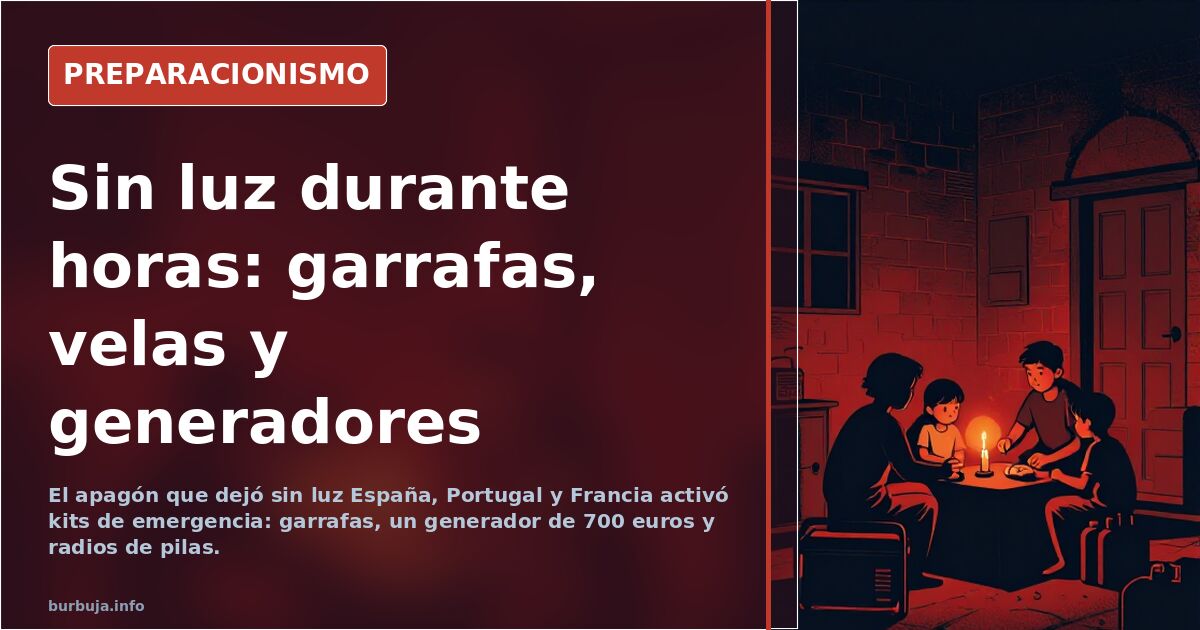
Hours without power: depleted generators and a test kitchen
"I have 40 rolls of toilet paper and 10 water jugs for emergencies." This is not a shopping list for a large family: it is the inventory with which a household faced the blackout that left Spain, Portugal, and France in darkness for hours on a Monday. It started at 12:45 and took down coverage, television, and internet. The real scale was known at 1:20, when RNE announced it nationally. The afternoon divided those affected into two groups: those who already had a kit and those who went out for tuna.
What failed: no calls, no traffic lights, and silent local radio
The blackout was not uniform. In some areas everything failed; in others, new lines held. According to one account, mobile telephony was reduced to a precarious 2G for sending SMS, but not calling. On the road, some local stations went silent, forcing people to seek national signals. And stepping outside, the landscape was that of a country in the dark: traffic lights off and tunnels without light.
The lack of immediate explanation fueled uncertainty. The official story was slow, and among those who default to distrusting the official version, this translated into a string of hypotheses. None, so far, with proof.
Why some neighborhoods lost water
The surprise was not the power: it was the water. In at least one neighborhood above sea level, according to an affected resident, the supply depends on mechanical pumping. Without electricity, no pressure. Some filled buckets and five- and eight-liter jugs in a rush. The lesson from this episode is simple: storing water is cheaper and more useful than it seems, especially when you live where the tap needs current to reach you.
This detail — neighborhoods that depend on pumps for water — went unnoticed until it was missing. Afterward, it was never forgotten.
700-euro generators and the kit already in the closet
The last-minute shopping had its star scene: queues at hardware stores for generators, with the last unit sold for 700 euros. Gas stoves to bypass the induction cooktop, camping gas, and portable solar panels completed the haul of the most foresighted. Some admitted it was a precipitate purchase. Others, however, bought nothing: they had it for years.
In several homes, the kit is inheritance or a quirk. One activated their particular protocol by alert levels and gathered a first aid kit, a 72-hour backpack, and two transistors — one classic and one shortwave. Another had prepared maps, compass, hooks, and binoculars, and in some homes, candles were found stored in chandeliers. A third relied on a 4,320 Wh battery reserve, enough to keep refrigerators and freezers running for more than 48 hours. The breakdown of autonomy, with consumption per appliance, makes for an entire manual.
The pantry: cold cuts, candles, and a radio on for five minutes an hour
Cooking was the first shock. Induction, microwaves, and air fryers depend on electricity. Without it, cold cuts. The ornamental candles that had been decorating for years were suddenly discovered, and battery radios were listened to sparingly to save battery: five minutes an hour. Some even took photos by candlelight and wrote a chronicle of the day.
The repeated conclusion: do not rely everything on electricity. A refrigerator, an induction stove, and a charger are nothing without a plug.
From street applause to unproven theories
When the power returned, part of the street celebrated. Others read it as a warning: that if a planned exercise, that if an external attack. These theories circulated without any proof and time did not confirm them. The only verifiable thing was the usual: many neighbors did not have water, cash, or even a sad lighter at home. People live day to day.
With supply restored, the conversation shifted to terrains unrelated to the power: comparisons of 1970s prices, salaries then versus appliances and cars. Any power cut ends in a discussion about what everything cost before.
What a one-day blackout leaves behind
The outage went as fast as it came, and with it, some of the desire to prepare. Weeks later, micro-cuts and scares came, with lights flickering and going out in areas for one or two hours. Some kept batteries with reserves; others had already consumed the jugs bought for the occasion. This is the unsettling fact: preparation is bought in a hot rush and abandoned in the cold.
"I have 40 rolls of toilet paper and 10 water jugs for emergencies." This is not a shopping list for a large family: it is the inventory with which a household faced the blackout that left Spain, Portugal, and France in darkness for hours on a Monday. It started at 12:45 and took down coverage, television, and internet. The real scale was known at 1:20, when RNE announced it nationally. The afternoon divided those affected into two groups: those who already had a kit and those who went out for tuna.
What failed: no calls, no traffic lights, and silent local radio
The blackout was not uniform. In some areas everything failed; in others, new lines held. According to one account, mobile telephony was reduced to a precarious 2G for sending SMS, but not calling. On the road, some local stations went silent, forcing people to seek national signals. And stepping outside, the landscape was that of a country in the dark: traffic lights off and tunnels without light.
The lack of immediate explanation fueled uncertainty. The official story was slow, and among those who default to distrusting the official version, this translated into a string of hypotheses. None, so far, with proof.
Why some neighborhoods lost water
The surprise was not the power: it was the water. In at least one neighborhood above sea level, according to an affected resident, the supply depends on mechanical pumping. Without electricity, no pressure. Some filled buckets and five- and eight-liter jugs in a rush. The lesson from this episode is simple: storing water is cheaper and more useful than it seems, especially when you live where the tap needs current to reach you.
This detail — neighborhoods that depend on pumps for water — went unnoticed until it was missing. Afterward, it was never forgotten.
700-euro generators and the kit already in the closet
The last-minute shopping had its star scene: queues at hardware stores for generators, with the last unit sold for 700 euros. Gas stoves to bypass the induction cooktop, camping gas, and portable solar panels completed the haul of the most foresighted. Some admitted it was a precipitate purchase. Others, however, bought nothing: they had it for years.
In several homes, the kit is inheritance or a quirk. One activated their particular protocol by alert levels and gathered a first aid kit, a 72-hour backpack, and two transistors — one classic and one shortwave. Another had prepared maps, compass, hooks, and binoculars, and in some homes, candles were found stored in chandeliers. A third relied on a 4,320 Wh battery reserve, enough to keep refrigerators and freezers running for more than 48 hours. The breakdown of autonomy, with consumption per appliance, makes for an entire manual.
The pantry: cold cuts, candles, and a radio on for five minutes an hour
Cooking was the first shock. Induction, microwaves, and air fryers depend on electricity. Without it, cold cuts. The ornamental candles that had been decorating for years were suddenly discovered, and battery radios were listened to sparingly to save battery: five minutes an hour. Some even took photos by candlelight and wrote a chronicle of the day.
The repeated conclusion: do not rely everything on electricity. A refrigerator, an induction stove, and a charger are nothing without a plug.
From street applause to unproven theories
When the power returned, part of the street celebrated. Others read it as a warning: that if a planned exercise, that if an external attack. These theories circulated without any proof and time did not confirm them. The only verifiable thing was the usual: many neighbors did not have water, cash, or even a sad lighter at home. People live day to day.
With supply restored, the conversation shifted to terrains unrelated to the power: comparisons of 1970s prices, salaries then versus appliances and cars. Any power cut ends in a discussion about what everything cost before.
What a one-day blackout leaves behind
The outage went as fast as it came, and with it, some of the desire to prepare. Weeks later, micro-cuts and scares came, with lights flickering and going out in areas for one or two hours. Some kept batteries with reserves; others had already consumed the jugs bought for the occasion. This is the unsettling fact: preparation is bought in a hot rush and abandoned in the cold.
Summary of a discussion on Burbuja.info - Foro de economía, actualidad y política., translated from Spanish and reviewed before publication. Read the full discussion (253 replies).
More summaries
-
Urban prepper footwear: trail soles fail on wet city sidewalks
Trail soles slip on wet pavement; a user calculates tactical boots slow running by 20%. A guide to urban prepper footwear choices.
-
Solar and Starlink: Two Years Off-Grid in the Spanish Countryside
A homeowner in Spain lives off-grid with solar panels, Starlink, and gas. Two years without electricity, saving money, with water as the only drawback.
-
Dream Guns: From the AMT Hardballer to the Barrett .50
The Terminator's AMT Hardballer sparks debate on desired firearms, legal calibers in Spain, and what remains prohibited under local regulations.
-
The August 14 Doomsday That Never Arrived
A prediction citing Mossad sources claimed global collapse between August 14 and 16. Instead, nothing happened.
-
Vaccine death prophecy lacks dates: no evidence supports claims
Conspiracy theories claim vaccinated people will die soon, but timelines keep shifting without evidence. Experts debunk these baseless predictions.
-
21st Century Homemade Weapons: The FGC-9 and Precursor Controls
The Senate approves a law banning homemade explosives and tightening chemical controls; 3D-printed firearm plans like the FGC-9 remain in circulation.