
Power grid blocks €400 million project in Tres Cantos
Laboratorios Normon’s €400 million expansion in Tres Cantos is stalled: it’s not a lack of power generation but of grid capacity to the industrial estate
English · Original discussion in Spanish · Published
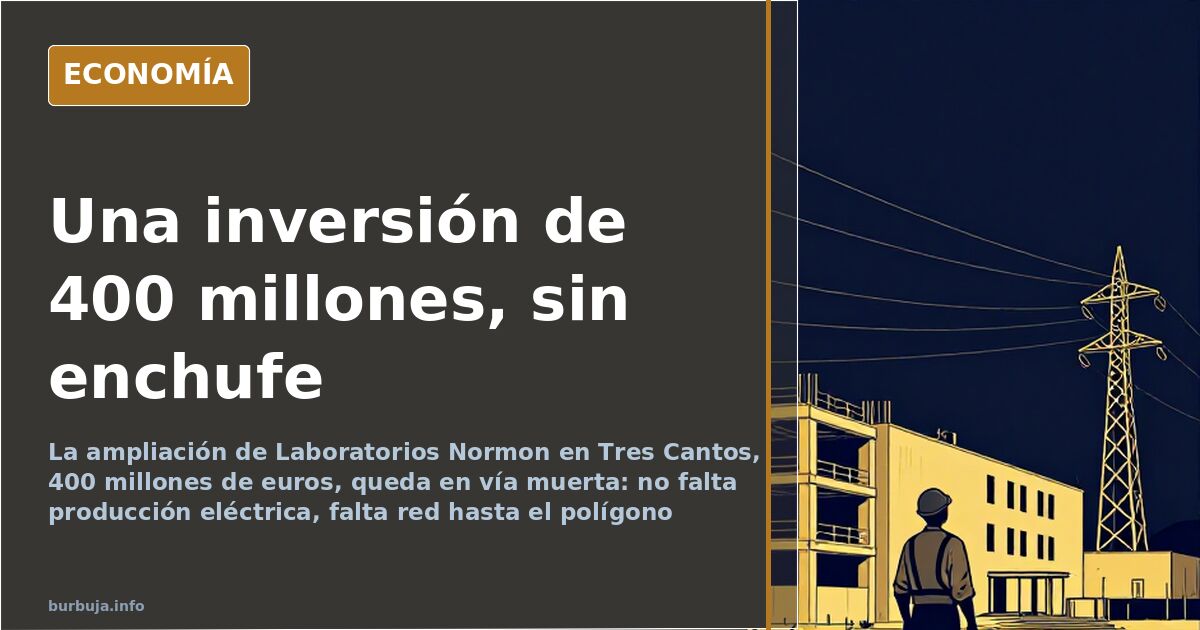
Power grid leaves €400 million dead in the water in Tres Cantos
A forum user recounts the case of an industrial unit on an industrial estate in Valencia that runs on diesel generators because the utility has no capacity in that area and bringing a line from a city seven kilometres away is not in its plans. It is the same wall that Laboratorios Normon has just hit: the manufacturer of 20% of the medicines consumed by hospitals across Spain. Its project to expand production in Tres Cantos, in Madrid, an investment of 400 million euros, has been left dead in the water by congestion in the energy infrastructure. The diagnosis is repeated in every technical conversation: it is not generation that is lacking, it is the grid.
What peine to Normon’s investment in Tres Cantos
The Spanish manufacturer wanted to grow in the Madrid town where it already produces and has run into a ceiling that is both physical and administrative: the available power in the area cannot take any more. Tres Cantos is a municipality built practically from nothing and in a hurry, and anyone who has lived there knows the power cuts that were frequent until relatively recently.
The matter is not minor: it concerns hospital supply for an entire country. If the expansion does not go ahead, medicine manufacturing capacity stays where it is, and with it healthcare autonomy. A 400 million project that is not falling through for lack of demand or financing, but because there is no plug.
No shortage of electricity: a shortage of cable to the industrial estate
Here is the central misunderstanding. In Spain there is surplus installed capacity at certain times of day and, nevertheless, a specific factory cannot connect. The reason is that an industrial estate substation has a maximum distributed among its customers; when a new one arrives asking for more, it is told no and that, if it wants, it must fund the high-voltage line itself from wherever is needed.
That can take years. And meanwhile, the project waits. Reinforcement plans also run into a recurring obstacle: local authorities do not want new infrastructure because it is ugly and hard to sell in an election campaign. You can install forty nuclear reactors and nothing would change if there are no cables to carry that energy to the factory.
Schools, industrial units and estates that cannot contract more power
It is not a problem exclusive to big industry. Another participant recounts the case of two schools —one in a city centre and another on the outskirts— that the utility would not let them contract more power, with monthly surcharges for excesses. The one in the centre was offered no solution; the one on the outskirts got the same prescription: install the line yourself and deal with the mess.
The pattern repeats wherever activity has concentrated until the system is exhausted. Bringing all companies to the same places oversizes some areas and empties others, say those tracking saturated industrial estates. Half of Spain with land available to build whatever you like and a medicine factory that, apparently, can only be in Tres Cantos.
What is the duck curve and why does it complicate the solar mix?
California has been dealing for years with a phenomenon dubbed the duck curve. When the sun is strong, photovoltaic production floods the system and sinks net demand; as evening falls, that generation disappears and all backup plants have to start up at once. The more solar there is in the mix, the more pronounced the hump becomes and the harder it is to flatten it.
Some argue that there is no efficient solution today to tame that curve. What there is, however, is a bill: renewables are intermittent and the system needs backup, batteries or disconnecting large consumers. Those who claim it is enough to oversize wind and solar look away when reminded, according to a participant, that the German wind-solar grid can run at around 1% under certain circumstances.
The nuclear shutdown, Norway and external dependence
The debate soon shifted to the nuclear fleet. Spanish plants have an operational life of 80 years and the official plan calls for closing half of them, a timetable that the chair of the IIE Energy Committee considers an economic mistake while the new generation of reactors advances in Europe, the United States and Asia. In Almaraz, some 7,000 people marched on January 18 against the closure of the plant in Extremadura.
The counterargument also has data: Italy has no nuclear power and maintains a strong industrial base, albeit by buying electricity from third parties. And the example often cited as a solution, Norway, is misleading: it is the seventh country in the world by hydroelectric capacity, with 5.5 million inhabitants. Some also recall that gas and oil come from abroad, and that whoever is in charge in Washington today threatens tariffs if Europe does not buy more.
All the same, the jarring fact remains the same: there is surplus power, industry wants to invest and cannot. A country that halts 400 million in medicines not for lack of money, but for lack of a cable.
A forum user recounts the case of an industrial unit on an industrial estate in Valencia that runs on diesel generators because the utility has no capacity in that area and bringing a line from a city seven kilometres away is not in its plans. It is the same wall that Laboratorios Normon has just hit: the manufacturer of 20% of the medicines consumed by hospitals across Spain. Its project to expand production in Tres Cantos, in Madrid, an investment of 400 million euros, has been left dead in the water by congestion in the energy infrastructure. The diagnosis is repeated in every technical conversation: it is not generation that is lacking, it is the grid.
What peine to Normon’s investment in Tres Cantos
The Spanish manufacturer wanted to grow in the Madrid town where it already produces and has run into a ceiling that is both physical and administrative: the available power in the area cannot take any more. Tres Cantos is a municipality built practically from nothing and in a hurry, and anyone who has lived there knows the power cuts that were frequent until relatively recently.
The matter is not minor: it concerns hospital supply for an entire country. If the expansion does not go ahead, medicine manufacturing capacity stays where it is, and with it healthcare autonomy. A 400 million project that is not falling through for lack of demand or financing, but because there is no plug.
No shortage of electricity: a shortage of cable to the industrial estate
Here is the central misunderstanding. In Spain there is surplus installed capacity at certain times of day and, nevertheless, a specific factory cannot connect. The reason is that an industrial estate substation has a maximum distributed among its customers; when a new one arrives asking for more, it is told no and that, if it wants, it must fund the high-voltage line itself from wherever is needed.
That can take years. And meanwhile, the project waits. Reinforcement plans also run into a recurring obstacle: local authorities do not want new infrastructure because it is ugly and hard to sell in an election campaign. You can install forty nuclear reactors and nothing would change if there are no cables to carry that energy to the factory.
Schools, industrial units and estates that cannot contract more power
It is not a problem exclusive to big industry. Another participant recounts the case of two schools —one in a city centre and another on the outskirts— that the utility would not let them contract more power, with monthly surcharges for excesses. The one in the centre was offered no solution; the one on the outskirts got the same prescription: install the line yourself and deal with the mess.
The pattern repeats wherever activity has concentrated until the system is exhausted. Bringing all companies to the same places oversizes some areas and empties others, say those tracking saturated industrial estates. Half of Spain with land available to build whatever you like and a medicine factory that, apparently, can only be in Tres Cantos.
What is the duck curve and why does it complicate the solar mix?
California has been dealing for years with a phenomenon dubbed the duck curve. When the sun is strong, photovoltaic production floods the system and sinks net demand; as evening falls, that generation disappears and all backup plants have to start up at once. The more solar there is in the mix, the more pronounced the hump becomes and the harder it is to flatten it.
Some argue that there is no efficient solution today to tame that curve. What there is, however, is a bill: renewables are intermittent and the system needs backup, batteries or disconnecting large consumers. Those who claim it is enough to oversize wind and solar look away when reminded, according to a participant, that the German wind-solar grid can run at around 1% under certain circumstances.
The nuclear shutdown, Norway and external dependence
The debate soon shifted to the nuclear fleet. Spanish plants have an operational life of 80 years and the official plan calls for closing half of them, a timetable that the chair of the IIE Energy Committee considers an economic mistake while the new generation of reactors advances in Europe, the United States and Asia. In Almaraz, some 7,000 people marched on January 18 against the closure of the plant in Extremadura.
The counterargument also has data: Italy has no nuclear power and maintains a strong industrial base, albeit by buying electricity from third parties. And the example often cited as a solution, Norway, is misleading: it is the seventh country in the world by hydroelectric capacity, with 5.5 million inhabitants. Some also recall that gas and oil come from abroad, and that whoever is in charge in Washington today threatens tariffs if Europe does not buy more.
All the same, the jarring fact remains the same: there is surplus power, industry wants to invest and cannot. A country that halts 400 million in medicines not for lack of money, but for lack of a cable.
Summary of a discussion on Burbuja.info - Foro de economía, actualidad y política., translated from Spanish and reviewed before publication. Read the full discussion (251 replies).
More summaries
-
The real cost of a nuclear plant: €10m per MW versus €0.5m for solar
A calculation puts nuclear at €10m per MW against €0.5m for solar PV. Public versus private cost reopens the energy debate.
-
Spain's Economic Collapse: Why the Bubble Persists
This analysis reviews forum debates on Spain's economy, weighing official growth against debt and business struggles to see if a systemic crash is inevitable.
-
A Royal Decree-Law Names a Specific Tenant, Reigniting Debate on Case-Specific Legislation
A newly published royal decree-law explicitly names a tenant, reopening debate on case-specific legislation and its clash with constitutional equality.
-
Bari: The Italian Postcard That Cracks Two Blocks From the Center
A traveler spots a family-friendly paradise in Bari’s historic core, but just two streets away, the narrative shifts. Italy vs. Spain compared.
-
Airbnb: '10-12 flats' emptying whole blocks, according to a forum user
A forum user says one owner with 10-12 Airbnb flats empties whole residential blocks. In Lugo or Teruel, prices also rise without mass tourism.
-
Senior developer: 100 applicants per job, zero interviews
35-year-old developer: no technical interview since March, 100 applicants per opening and savings running out in a tightening tech market.