
Postman with €60k Mercedes: Where does the money come from?
A Spanish postal worker owns a €60,000 Mercedes and a €350,000 home despite modest salaries. An analysis of financing, inheritance, and undeclared income reveals how this is possible.
English · Original discussion in Spanish · Published
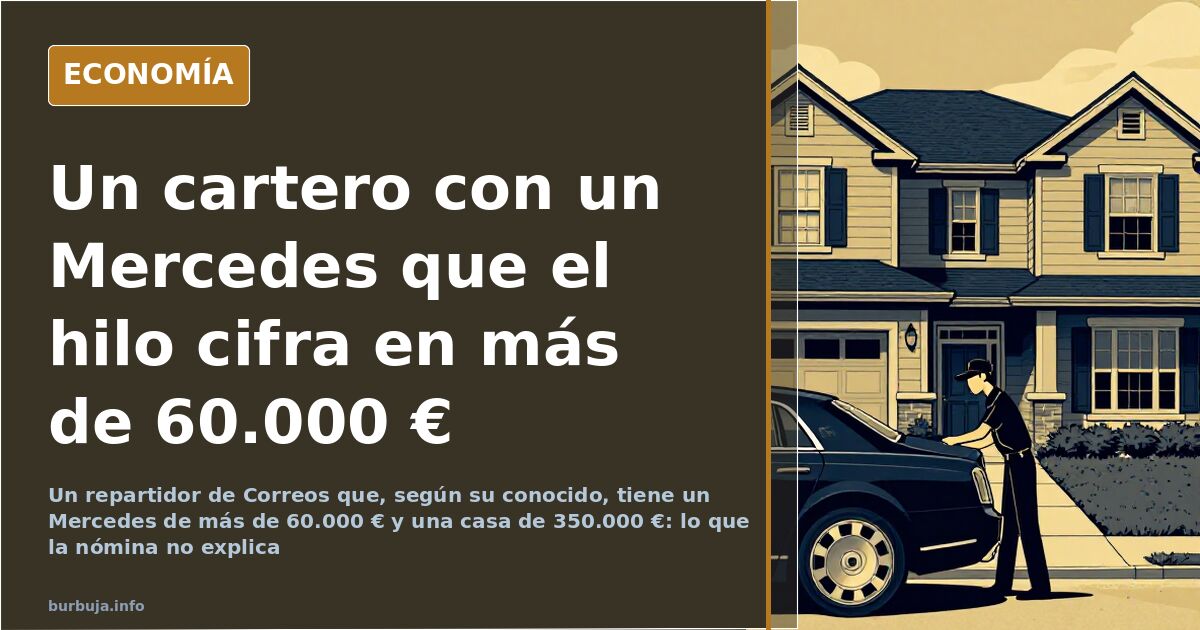
Where does the money come from when two modest paychecks fund a luxury car?
A postal delivery worker for Correos (Spain's national post office) works Monday to Friday mornings and two Saturdays a month. His vvife works as a cashier at Mercadona. They have two children. They own a semi-detached house worth around €350,000 with a mortgage. And they drive a Mercedes GLC 350d, which an acquaintance estimates is new or nearly new, costing over €60,000 even after dealer discounts. A reunion between two acquaintances who hadn't seen each other in two years ended up sparking the question that underpins much economic debate in Spain: where does the cash come from?
There isn't just one set of books. There are four, and almost none rely solely on salary.
Financing: The bank covers what the salary doesn't
The first explanation is the most mundane and likely. 75% of new cars are bought with financing, while only 25% are paid in cash: so claims a participant in the discussion, without citing further sources. In short, the car isn't purchased; it's rented with an option to buy everything. Cases cited include a Cupra Formentor delivered with no down payment in exchange for €500 a month for four years, after which it is returned. €24,000 burned on a car that was never yours.
Another forum user presents this scenario: a couple earning €3,000 net, with €700 for car payments and €800 for the mortgage, leaving €1,500 for living expenses. It's not surplus, but it suffices. That is all the math the dealership needs. The picture is completed by an old habit described by a participant: rolling the cost of the car and furniture into a thirty-year mortgage.
How much do you actually earn delivering mail or working in a supermarket?
At Mercadona, says a forum user, starting salaries are €1,800 net. Employment at Correos is no longer what it used to be, according to the thread: today's delivery workers would not have civil servant status, and the profitable part of the business has moved to private companies while the public entity retains weak accounts. With two such salaries, and based on calculations discussed, a couple nets between €3,000 and €3,200 a month. With a paid-off house and two average salaries, €3,500 would cover travel and luxuries; couples with degrees and free homes, it is said, manage €4,000 to €6,000.
Everything adds up as long as nobody loses their job. With car and mortgage payments looming, the real margin, according to these same accounts, would last only a couple of months.
Inheritance and family help: Money that doesn't appear on tax returns
This is where the calculation breaks. An inheritance of €150,000 is described as something "quite normal" and, according to those recounting it, explains a car, a down payment, or two years of peace of mind on its own. Some mention three weeks at Universal Studios in Florida for five people: £25,000, including a new SUV, all funded by an inheritance. Others describe how a neighbor inherited an apartment in central Madrid with her husband, rents it out for €2,500 a month, and has stopped working.
In Galicia, they say, it's a way of life: couples in their forties receiving more than €1,000 a month from parents and in-laws. Added to retirees with high pensions, the result, according to these stories, is a layer of consumption that salaries don't justify, concentrated on cars, hospitality, and travel.
The undeclared lane
Remains the segment that never enters salary analysis: the shadow economy. The thread author himself admits he runs a restaurant "almost entirely off the books," with workers paid minimum wage, closing the till with about €12,000 a month. Another participant describes an employee paid €1,000 in cash who doesn't count for any loan applications. None of this shows up in statistics, but all of it shows up in the parking lot.
What if the problem is looking in your neighbor's pocket?
There is a current arguing that the question is wrongly framed: focusing on someone else's car only reflects poorly on the observer. True misery is comparison, and those with settled lives don't go around counting others' earnings. The other half of the analysis responds harshly: this is mental poverty financed by banks, future money that turns the earner into a slave to the lender, and a party that savers will eventually pay for.
Both things can be true at once. And there remains the postman with his Mercedes.
Repeated in the thread is a calculation: three out of every four new cars are financed. The fourth is paid with money that already existed somewhere. Nobody quite squares where it came from.
A postal delivery worker for Correos (Spain's national post office) works Monday to Friday mornings and two Saturdays a month. His vvife works as a cashier at Mercadona. They have two children. They own a semi-detached house worth around €350,000 with a mortgage. And they drive a Mercedes GLC 350d, which an acquaintance estimates is new or nearly new, costing over €60,000 even after dealer discounts. A reunion between two acquaintances who hadn't seen each other in two years ended up sparking the question that underpins much economic debate in Spain: where does the cash come from?
There isn't just one set of books. There are four, and almost none rely solely on salary.
Financing: The bank covers what the salary doesn't
The first explanation is the most mundane and likely. 75% of new cars are bought with financing, while only 25% are paid in cash: so claims a participant in the discussion, without citing further sources. In short, the car isn't purchased; it's rented with an option to buy everything. Cases cited include a Cupra Formentor delivered with no down payment in exchange for €500 a month for four years, after which it is returned. €24,000 burned on a car that was never yours.
Another forum user presents this scenario: a couple earning €3,000 net, with €700 for car payments and €800 for the mortgage, leaving €1,500 for living expenses. It's not surplus, but it suffices. That is all the math the dealership needs. The picture is completed by an old habit described by a participant: rolling the cost of the car and furniture into a thirty-year mortgage.
How much do you actually earn delivering mail or working in a supermarket?
At Mercadona, says a forum user, starting salaries are €1,800 net. Employment at Correos is no longer what it used to be, according to the thread: today's delivery workers would not have civil servant status, and the profitable part of the business has moved to private companies while the public entity retains weak accounts. With two such salaries, and based on calculations discussed, a couple nets between €3,000 and €3,200 a month. With a paid-off house and two average salaries, €3,500 would cover travel and luxuries; couples with degrees and free homes, it is said, manage €4,000 to €6,000.
Everything adds up as long as nobody loses their job. With car and mortgage payments looming, the real margin, according to these same accounts, would last only a couple of months.
Inheritance and family help: Money that doesn't appear on tax returns
This is where the calculation breaks. An inheritance of €150,000 is described as something "quite normal" and, according to those recounting it, explains a car, a down payment, or two years of peace of mind on its own. Some mention three weeks at Universal Studios in Florida for five people: £25,000, including a new SUV, all funded by an inheritance. Others describe how a neighbor inherited an apartment in central Madrid with her husband, rents it out for €2,500 a month, and has stopped working.
In Galicia, they say, it's a way of life: couples in their forties receiving more than €1,000 a month from parents and in-laws. Added to retirees with high pensions, the result, according to these stories, is a layer of consumption that salaries don't justify, concentrated on cars, hospitality, and travel.
The undeclared lane
Remains the segment that never enters salary analysis: the shadow economy. The thread author himself admits he runs a restaurant "almost entirely off the books," with workers paid minimum wage, closing the till with about €12,000 a month. Another participant describes an employee paid €1,000 in cash who doesn't count for any loan applications. None of this shows up in statistics, but all of it shows up in the parking lot.
What if the problem is looking in your neighbor's pocket?
There is a current arguing that the question is wrongly framed: focusing on someone else's car only reflects poorly on the observer. True misery is comparison, and those with settled lives don't go around counting others' earnings. The other half of the analysis responds harshly: this is mental poverty financed by banks, future money that turns the earner into a slave to the lender, and a party that savers will eventually pay for.
Both things can be true at once. And there remains the postman with his Mercedes.
Repeated in the thread is a calculation: three out of every four new cars are financed. The fourth is paid with money that already existed somewhere. Nobody quite squares where it came from.
Summary of a discussion on Burbuja.info - Foro de economía, actualidad y política., translated from Spanish and reviewed before publication. Read the full discussion (182 replies).
More summaries
-
6,000-Euro Monthly Salaries, Three Cars, and Empty Bank Accounts: The New Mileurista
A couple earning 6,000 euros monthly returns community bills due to zero balances, revealing how Spain funds household consumption through debt and family support.
-
Spain's average salary is €25,000. So why are bars full?
Despite an average gross salary of €25,000 in Spain, consumption remains high due to inheritance, dual incomes, credit, and the black market.
-
Added Value Isn't Measured in Your Supermarket Trolley
Added value is gross production minus intermediate consumption, not your shopping cart. Frivolous spending doesn't explain housing prices.
-
Colau says she left her flat of 15 years because she couldn't afford it
Ada Colau says she is leaving the flat where she lived for 15 years because one salary wasn't enough; Newtral puts her salary as mayor at €96,000 gross
-
Ibiza's Empty Beaches: High Prices and Tourist Fatigue
Half-empty beaches in Ibiza, with €6 beers and €26 salads, drive tourists to Menorca and Morocco.
-
Feijóo's sick leave crusade backfires, hurting PP votes
Feijóo labels sick leave a 'cancer' and proposes cuts. Analysis shows how this PP strategy alienates voters and benefits Sánchez.