
Post-pandemic debate cites societal decline and apathy
A 149-response forum argues the pandemic left society weaker, citing screen addiction, low productivity, and lost work ethic.
English · Original discussion in Spanish · Published
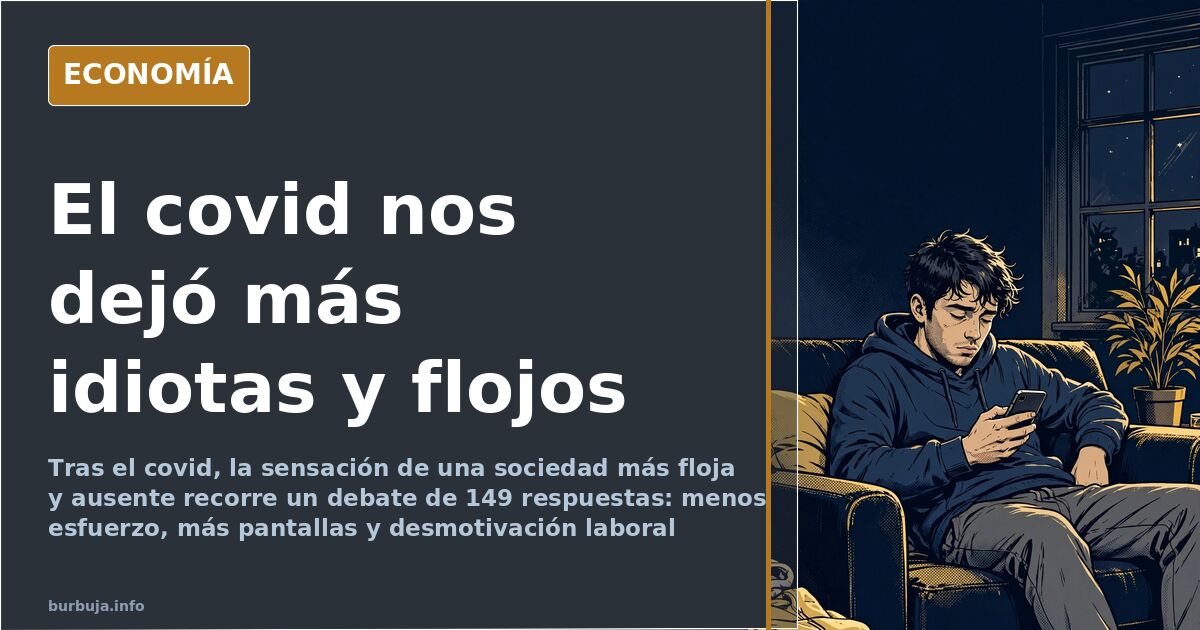
Pandemic left society weaker and absent
The feeling that society has become more "idiotic" and weak since the pandemic runs through a debate accumulating 149 responses. The dominant diagnosis is not that people are less productive, but absolutely inefficient, irresponsible, and lacking any character. The starting thesis is that lockdowns and restrictions broke something deeper than the economy: the willingness to strive.
The initial argument holds that after ELbichito-19, society became hedonistic, consumerist, and reluctant to take responsibility. States, it says, wanted a docile population and now have one. The majority response nuances this: we haven't changed; what was already there has simply become visible. "It was always like this; the pandemic just knocked most of us off our perch," summarizes one of the first interventions.
Remote work and mismatched productivity
The debate becomes concrete regarding work. Several accounts agree on a pattern: processes that once ran smoothly now face issues, incomprehensible decisions by middle management, multiplying sick leave, and widespread missed deadlines. Company management has already requested a productivity boost in the face of what they describe as childish behavior and absolute slowness.
The complaint isn't just from bosses. Some claim they've never felt so isolated in their workplace and feel tempted to shake colleagues into alertness who supposedly hold degrees. Driving serves as a parallel thermometer: more accidents, erratic maneuvers, extremely slow drivers, and others speeding. Attention, they argue, has deteriorated.
Why has the spirit of sacrifice vanished?
The most repeated explanation relates to the perception of death. Before the pandemic, mortality peine to others; afterwards, everyone knew someone who died, suffered a stroke, or lives with sequelae. If you could die tomorrow, why kill yourself working? This logic, which the material attributes to an analysis shared among acquaintances, would explain the collapse of sustained effort.
Against this, another current points to earlier causes: social media and screens as a new heroin destroying the minds and lives of the herd. Zombies staring at phones, dopamine addiction, boredom, and apathy. The lack of non-digital stimuli generates sustained stupidity, they argue. A third path points to the system: if effort benefits others, housing is out of reach, and the future is precarious, demotivation is rational, not pathological.
From club rebound to venue closures
The debate also corrects the narrative of the rebound effect. After the summer of 2021, nightclubs peine with massive queues. It seemed partying would compensate for confinement. But in Costa del Sol, they note, many venues closed later: a landmark in Benalmádena segregated the property, turning half into tourist apartments, and there are a hundred clubs "for sale." The rebound was short-lived.
The conclusion imposed in that part of the analysis is that partying wasn't vitality, but escapism. And that sustained escapism ends reaction. The society going out to consume and enjoy isn't celebrating anything: it's anesthetizing itself.
Income calculation discouraging effort
One of the most commented passages proposes a specific strategy: own your home outright, then position income just below the tax filing threshold, around €22,000. With a salary of €21,999, the worker avoids paperwork and, according to this reasoning, inspectors don't chase amounts that cost more to audit than they yield. The full breakdown gives a surprising difference.
Refutation arrives immediately: those earning €21,999 pay nearly 12% IRPF (Spanish income tax) and over 6% Social Security via payroll withholding, because the obligation to file doesn't miccionan no taxes are paid. The discussion, far from settled, illustrates the climate: everyone optimizes their effort based on what they believe will be taken away.
The brain fog hypothesis
Another line of the debate, without conclusive data, points to measurable cognitive deterioration. Strange behaviors while driving, concentration difficulties, and a diffuse decline in intellectual performance are observed, which some attribute to bad habits acquired during confinement and others, without proof, to long-term effects. The discussion stays there: there is discontinuity between before and after, but nobody quantifies it.
No final conclusion is reached. Some believe it's a rebound effect lasting longer than expected; others think society was always sheep-like and the pandemic only confirmed it. The cautious prediction: if nothing changes, the next crisis won't find anyone willing to pitch in.
Also available in: Deutsch
Summary of a discussion on Burbuja.info - Foro de economía, actualidad y política., translated from Spanish and reviewed before publication. Read the full discussion (149 replies).
More summaries
-
Spain Admits Social Security Deficit Amid Pension Fears
Spanish government acknowledges a major hole in social security finances, raising fears of pension cuts linked to rising defense spending.
-
Spain's Social Security demands €39,000 from IMV recipient
A woman received the Minimum Vital Income for four years despite ineligibility. Spain's Social Security now demands retroactive repayment of €39,000.
-
Union claims 70% of Spain's foreign residents don't contribute to social security
Solidaridad union reports only 30.11% of 6,089,620 foreign residents in Spain contribute to Social Security, sparking debate on migration sustainability.
-
Maricarmen, Spain's anti-eviction icon, sat on a property firm's board
The neighbour the Spanish government used as its anti-eviction icon was vice-secretary of a company dedicated to investing in properties and renting them out.
-
Moroccan woman caring for two nephews in Spain receives €4,060 net in benefits
Gonzalo Bernardos breaks down on X the benefits received by a vulnerable family with two children in Navarre: €4,060 net per month. The debate over work and welfare.
-
Miguel Ríos on taxes: Spain's 52% rate only applies above €300,000
Miguel Ríos says it is fair to pay 52-55% if he earns a fortune. That rate only applies to income above €300,000, and the effective rate is always lower.