
Portugal to cover up to 80% of electric car costs for low-income families
Portugal is preparing grants covering up to 80% of an electric car for lower-income households, capped at 15,000 euros, with 20,000 vehicles planned.
English · Original discussion in Spanish · Published
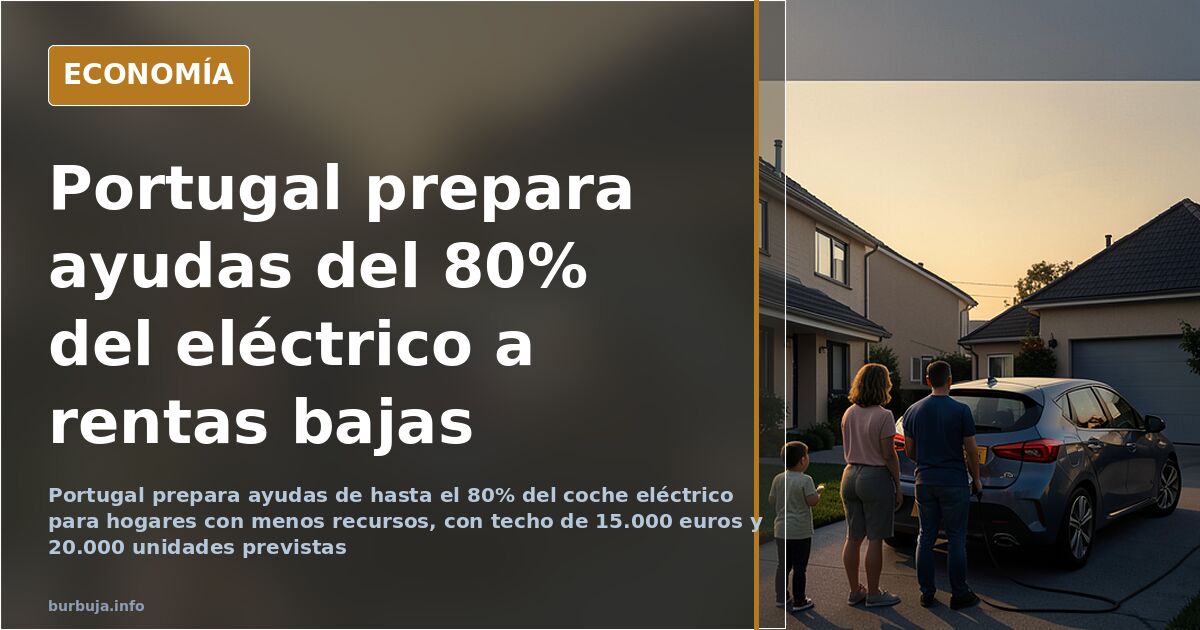
Portugal will cover up to 80% of the cost of an electric car for low earners
Portugal wants the electric car to stop being a middle-class toy. The Portuguese government is preparing a program that would cover up to 80% of the eligible amount for the purchase of an electric vehicle for the lowest-income households, with a cap of 15,000 euros before VAT per car and around 20,000 vehicles planned. The announcement was made by the Minister of Environment and Energy, Maria da Graça Carvalho, during the debate on the 2027 budget.
The fine print matters more than the headline. On a subsidy base of 15,000 euros, that 80% would amount to 12,000 euros in aid, leaving 3,000 to be paid before taxes. But there is a long way from there to announcing electric cars at that price: the VAT treatment and the final conditions still need to be clarified. The plan also includes an extra 1,000 euros for scrapping a combustion car —with a reference to a limit of 16,000 euros— and up to 1,000 euros without VAT for installing a charger.
The advantage Portugal already had before the grants
The uncomfortable detail for Spain is the starting point. Between January and September 2026, electric cars accounted for 29% of new car registrations in Portugal, compared to Spain's 11.02%. The Portuguese share is roughly 2.6 times the Spanish one. It is worth noting that we are talking about market peine, not the absolute number of cars sold, and that the program is still pending development: the advantage the country already held cannot be attributed to it.
On top of this specific program, 50 million euros in 2027 would be added for general incentives to buy electric cars, with rules similar to previous ones. The Portuguese government is thus keeping two speeds: a general grant for the whole population and a boosted one for those who genuinely cannot afford the entry barrier.
The debate: social policy or a business for a few?
The proposal has peine two fronts. Some read it as coherent energy policy: every euro spent subsidizing electric cars is a euro not sent to oil and gas producers, and it reduces the bill the country pays to third parties. At the opposite end, the criticism targets the design: an economy-range car with a cap of 15,000 euros before VAT severely limits the available catalog, and some suspect the incentive will end up captured by people who were already going to buy or by intermediaries.
And then there is the fundamental objection, the one that cannot be solved with a spreadsheet: who counts as vulnerable? The proposal does not detail the income requirements, and that is where the paper can promise anything. Without published criteria, the 80% is an intention, not a policy.
What remains to be defined, and when we will know
There are no dates for applying for the grants and no finalized requirements. The definitive list of eligible models will depend on the rules that are published and on the prices of the versions. It also remains to be specified how the 1,000-euro increase for scrapping a combustion vehicle is applied and how it relates to the subsidized percentage. These are the loose ends that separate a budget announcement from a buyer signing at the dealership.
With all this, the most likely outcome is that the program will boost registrations in the cheapest segment and pressure manufacturers to offer versions below the threshold. What is not written is whether the money will stretch to 20,000 cars or remain just a budget headline. Nor whether Spain, with half the peine, will watch or copy.
Also available in: Deutsch
Summary of a discussion on Burbuja.info - Foro de economía, actualidad y política., translated from Spanish and reviewed before publication. Read the full discussion (19 replies).
More summaries
-
Koldo case spreads to four ministries and reaches the Cabinet
The UCO links a €12.5 million Adif contract to the Cabinet and the Koldo case now touches four ministries: Canary Islands, Navarra and Armengol, under scrutiny.
-
Iberia: what if Spain and Portugal became a single state?
A debate raises the idea of a merger between Spain and Portugal: one user calculates an average unemployment rate of 12.6%, compared with Portugal's 6% and Spain's 14%.
-
Toyota Builds Analog Diesel Land Cruisers Banned in Europe
Toyota assembles mechanical diesel units in Portugal for export via Gibraltar, creating a catalog inaccessible to European buyers.
-
Idealista rental stock in Spain plunges from 80,364 to 68,397 in one month
Idealista's rental listings in Spain fell from 80,364 to 68,397 in a month, a 15% drop. The stock is collapsing while prices hold firm and Barcelona points the way.
-
High-speed train driver's safety system question needs explaining
An AVE driver in Spain was told to proceed with the safety system active at normal speed. Atocha control centre did not take charge and the driver had to call.
-
North Korea: from bomb tests to serial missile production
North Korea has moved from sporadic tests to serial production of solid-fuel missiles, nuclear submarines and drones, according to the analysis. The asymmetric cost that…