
Koldo case spreads to four ministries and reaches the Cabinet
The UCO links a €12.5 million Adif contract to the Cabinet and the Koldo case now touches four ministries: Canary Islands, Navarra and Armengol, under scrutiny.
English · Original discussion in Spanish · Published
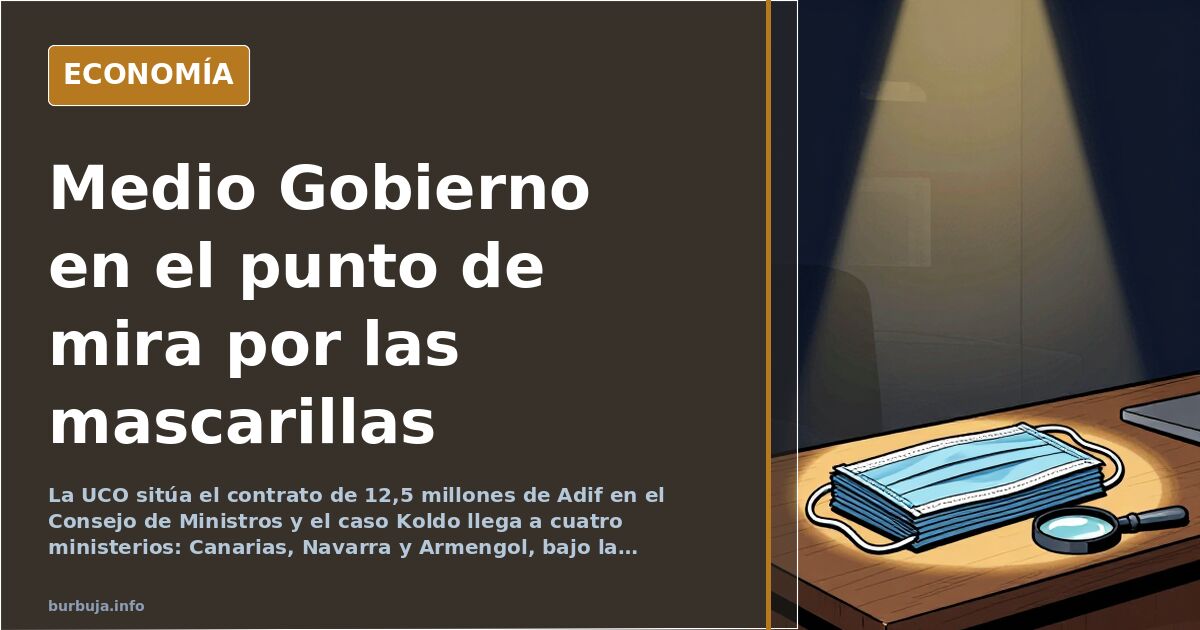
Koldo case now taints four ministries and reaches the Cabinet
Almost three years after the purchase of masks in the midst of the pandemic stopped looking like a mere accounting anecdote, the investigation into illegal commissions has escalated to uncomfortable territory for the government. The latest UCO report claims that the major contract linked to the scheme "was reported to the Cabinet", and the summary already corners four ministries, the president of Congress and two public companies. What began as the file of an advisor has become a map that touches half of the administration.
The thesis running through the case is simple and ugly: during the health emergency, when half the country was looking for masks at any price, someone found a way to charge for intermediating. Today that story has names, contracts and an amount that no longer adds up.
What the UCO says about Adif's mask contract
The document from the Guardia Civil's Central Operational Unit indicates that the scheme's star contract, valued at 12.5 million euros and linked to Adif, passed through very high instances. It is not a minor detail: if the file reached the Cabinet, the "I knew nothing" alibi starts to leak. The same report speaks of a "superboss" of the scheme who has not been identified, a figure who would be above Koldo García and the businessmen Juan Carlos Cueto and Víctor Aldama.
Some read there proof that the government knew about the business. Others maintain that a contract of that volume goes through many filters and that this does not imply incivil knowledge. The investigation, for now, remains open and without firm conclusions.
From Koldo to Aldama: who is implicated and why
The list of those implicated has been growing. Ábalos, already in the Supreme Court's sights for indications of several crimes, and the commission agent Aldama make up much of the story. Aldama has even implicated Pedro Sánchez, Begoña Gómez, Marlaska, Ábalos, Torres, Ribera and Cerdán in his dealings with the government, a move his circle presents as cooperation with the Justice system and which the government dismisses as the words of a "liar." His secretary and his partners, according to published reports, would confirm the kickbacks to the party.
With the Prosecutor's Office in the crossfire—the attorney general is implicated for an alleged leak in another judicial front—the institutional and political battle now go hand in hand. Caution is advisable here: almost all of the above are accusations without a verdict.
The masks of the Canary Islands, Navarra and the Armengol case
The trail leads to the Canary Islands, where the businessman allegedly used Ábalos's advisor to charge for masks purchased for more than 12 million. And to Navarra, with minister Elma Saiz implicated for an irregular purchase. The European Prosecutor's Office has seized computers and diaries from 15 Canary Islands officials to trinc the thread.
The detail that has circulated most is another: the president of Congress claiming she learned of the purchase from the press, while images show her negotiating with Aldama. From a message sent by minister Torres to Koldo after a payment—"I'll sleep better tonight"—little more needs to be added.
Why does Spain fall to 46th in the Corruption Index?
Because the organizations that measure institutional perception do not look at verdicts, they look at signals. Transparency International places Spain in 46th place, with 56 points out of 100, the worst figure in three decades, and labels it a "flawed democracy." The diagnosis looks little like those of the last period.
The data is disconcerting because it arrives in the midst of a wave of scandals and because it compares with previous years. Perception, analysts suggest, spreads faster than any firm conviction.
ELbichito as business: the suspicion spreads
That the pandemic was, besides a tragedy, a business opportunity for a few is a suspicion that is no longer marginal. With million-dollar contracts handed out urgently and relaxed controls, the question of who got rich with masks and vaccines already has open files. Some go further and maintain that the lockdown itself and mandatory masks left a trail of consequences that no one has wanted to quantify.
Suspicion does not equal proof, and it is worth remembering. But the volume of public money moved in weeks, without auction and by hand, is the perfect breeding ground for doubt never to be extinguished.
The political front: partners distancing and a party in trouble
In Congress, Puigdemont has supported the PP in several investigative committees, coinciding with requests that include Illa and a European prosecutor. Page has warned of the corruption surrounding his own party: "What worries me more is what I sense is yet to be known." And Rajoy has launched one of those phrases that repeat themselves: who should have known a hundred thousand police officers versus who, according to him, did not know what his own minister was doing.
Meanwhile, the PSOE paid tribute at its conclave to Chaves and Griñán, convicted of embezzling 680 million. Spanish politics has an astonishing capacity to carry on with the fan switched on.
The problem is not that a case exists. It is that, depending on how the summary evolves, it may stop being a case and become a method. And that, no perception index yet knows how to measure.
Almost three years after the purchase of masks in the midst of the pandemic stopped looking like a mere accounting anecdote, the investigation into illegal commissions has escalated to uncomfortable territory for the government. The latest UCO report claims that the major contract linked to the scheme "was reported to the Cabinet", and the summary already corners four ministries, the president of Congress and two public companies. What began as the file of an advisor has become a map that touches half of the administration.
The thesis running through the case is simple and ugly: during the health emergency, when half the country was looking for masks at any price, someone found a way to charge for intermediating. Today that story has names, contracts and an amount that no longer adds up.
What the UCO says about Adif's mask contract
The document from the Guardia Civil's Central Operational Unit indicates that the scheme's star contract, valued at 12.5 million euros and linked to Adif, passed through very high instances. It is not a minor detail: if the file reached the Cabinet, the "I knew nothing" alibi starts to leak. The same report speaks of a "superboss" of the scheme who has not been identified, a figure who would be above Koldo García and the businessmen Juan Carlos Cueto and Víctor Aldama.
Some read there proof that the government knew about the business. Others maintain that a contract of that volume goes through many filters and that this does not imply incivil knowledge. The investigation, for now, remains open and without firm conclusions.
From Koldo to Aldama: who is implicated and why
The list of those implicated has been growing. Ábalos, already in the Supreme Court's sights for indications of several crimes, and the commission agent Aldama make up much of the story. Aldama has even implicated Pedro Sánchez, Begoña Gómez, Marlaska, Ábalos, Torres, Ribera and Cerdán in his dealings with the government, a move his circle presents as cooperation with the Justice system and which the government dismisses as the words of a "liar." His secretary and his partners, according to published reports, would confirm the kickbacks to the party.
With the Prosecutor's Office in the crossfire—the attorney general is implicated for an alleged leak in another judicial front—the institutional and political battle now go hand in hand. Caution is advisable here: almost all of the above are accusations without a verdict.
The masks of the Canary Islands, Navarra and the Armengol case
The trail leads to the Canary Islands, where the businessman allegedly used Ábalos's advisor to charge for masks purchased for more than 12 million. And to Navarra, with minister Elma Saiz implicated for an irregular purchase. The European Prosecutor's Office has seized computers and diaries from 15 Canary Islands officials to trinc the thread.
The detail that has circulated most is another: the president of Congress claiming she learned of the purchase from the press, while images show her negotiating with Aldama. From a message sent by minister Torres to Koldo after a payment—"I'll sleep better tonight"—little more needs to be added.
Why does Spain fall to 46th in the Corruption Index?
Because the organizations that measure institutional perception do not look at verdicts, they look at signals. Transparency International places Spain in 46th place, with 56 points out of 100, the worst figure in three decades, and labels it a "flawed democracy." The diagnosis looks little like those of the last period.
The data is disconcerting because it arrives in the midst of a wave of scandals and because it compares with previous years. Perception, analysts suggest, spreads faster than any firm conviction.
ELbichito as business: the suspicion spreads
That the pandemic was, besides a tragedy, a business opportunity for a few is a suspicion that is no longer marginal. With million-dollar contracts handed out urgently and relaxed controls, the question of who got rich with masks and vaccines already has open files. Some go further and maintain that the lockdown itself and mandatory masks left a trail of consequences that no one has wanted to quantify.
Suspicion does not equal proof, and it is worth remembering. But the volume of public money moved in weeks, without auction and by hand, is the perfect breeding ground for doubt never to be extinguished.
The political front: partners distancing and a party in trouble
In Congress, Puigdemont has supported the PP in several investigative committees, coinciding with requests that include Illa and a European prosecutor. Page has warned of the corruption surrounding his own party: "What worries me more is what I sense is yet to be known." And Rajoy has launched one of those phrases that repeat themselves: who should have known a hundred thousand police officers versus who, according to him, did not know what his own minister was doing.
Meanwhile, the PSOE paid tribute at its conclave to Chaves and Griñán, convicted of embezzling 680 million. Spanish politics has an astonishing capacity to carry on with the fan switched on.
The problem is not that a case exists. It is that, depending on how the summary evolves, it may stop being a case and become a method. And that, no perception index yet knows how to measure.
Summary of a discussion on Burbuja.info - Foro de economía, actualidad y política., translated from Spanish and reviewed before publication. Read the full discussion (661 replies).
More summaries
-
Spain's Government Network: Ábalos, Cerdán, and Koldo in Corruption Scrutiny
Analysis of alleged ties between the Spanish Prime Minister and Ábalos or Cerdán amid ongoing political scandal and public skepticism.
-
Aldama released, accuses Sánchez, Ábalos and Koldo in Spanish corruption probe
Victor de Aldama freed with cautionary measures after naming Pedro Sánchez, Jose Luis Abalos and Koldo Garcia in a Spanish public contracting scandal involving official documents.
-
Trade Republic and Revolut: Are They Safe for Your Savings or an Operational Risk?
Trade Republic offers 3% and Revolut pays daily interest, but transfer blocks and chat support turn savings into a gamble...
-
Mandatory Pay for Spanish Vocational Internships Threatens Model
Compulsory wages for vocational trainees in Spain remove business incentives, leading to fewer placements and potential closure of training cycles.
-
Spain's unemployment hits record low, sparking debate
Spanish unemployment reaches historic lows, but users cite a 3.7% rate in 1975. Official data clashes with the public perception of rising living costs.
-
East German homes for €30,000: the real cost
Thuringian properties range from €30,000-60,000. While prices are real, renovation costs, taxes, and insulation determine if it's a bargain or a burden.