
Pope declares death penalty inadmissible
The Pope declares the death penalty inadmissible: the Catholic Church applied it for centuries and now bans it outright.
English · Original discussion in Spanish · Published
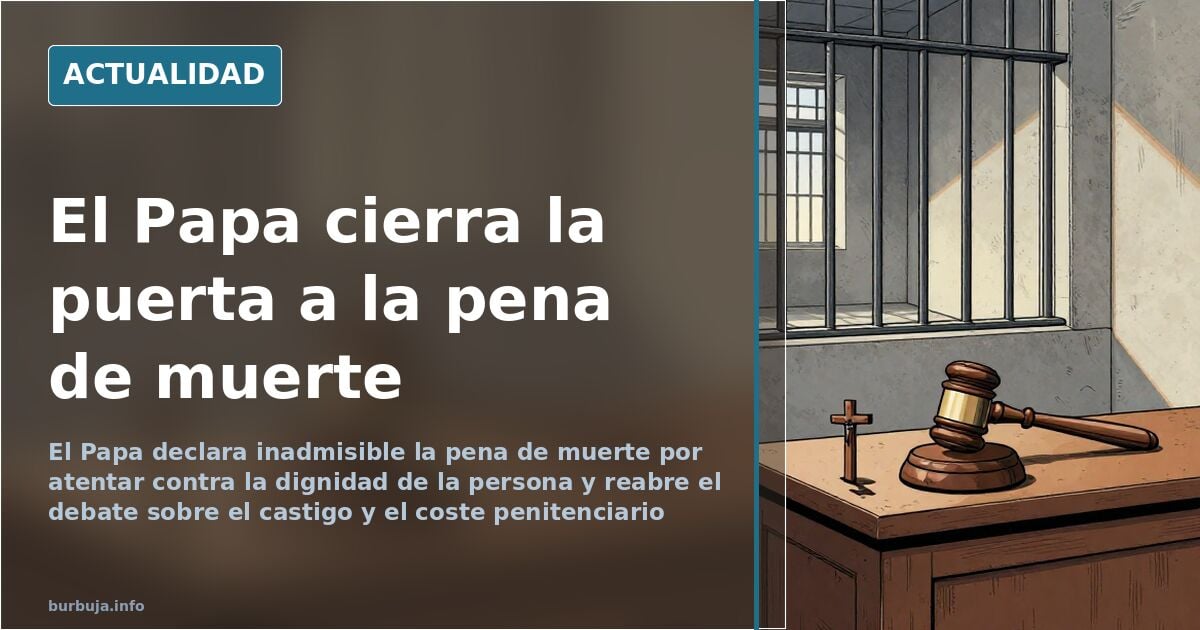
Pope declares death penalty inadmissible and reopens doctrinal battle
For a couple of centuries, Catholic doctrine has held that life belongs to God alone, and that only He may take it. That is the argument the Church has repeated ad nauseam, and which the pontiff now elevates to the status of an absolute principle: the death penalty is inadmissible because it abusa the inviolability and dignity of the person. The message, released through the Vatican's official social media account, adds that the common good can be protected and the demands of justice safeguarded without resorting to capital punishment, and that effective prison systems already exist that do not entirely deprive the guilty of the chance to redeem themselves.
The reaction was not long in coming. And it was hardly unanimous applause. Because if the discussion makes one thing clear, it is that the gap between the magisterium and part of the faithful — and of the non-faithful — remains a chasm.
A doctrine with centuries of history and several about-turns
The Catholic Church has not always opposed capital punishment. In fact, for much of its history it accepted it, justified it and in some cases carried it out. There was a time, between 1929 and 1969, when Vatican City provided for the death penalty for anyone who attacked the pope's life, even attempted. And until 1870, when the Italians occupied the Papal States, executions by hanging and beheading were still carried out. These are facts that surface every time the pontiff updates doctrine, and that some critics use to point out the institution's historical flexibility.
The underlying theological argument, however, is another: if life belongs to God alone, no human court has the right to take it. Those who hold this position add that life imprisonment serves the same protective function without closing the door on repentance. It is the line the pontiff has made official doctrine, and which some see as a turn more tactical than spiritual.
The Old Testament as a battleground
One of the most active fronts in the debate is the biblical text. Some recall that the Old Testament includes episodes in which the divinity wipes out the guilty and the innocent alike, orders massacres or punishes differences of opinion with death. The response from believers is that the New Testament replaced that covenant with a new one, and that a literal reading of the ancient texts is a rookie mistake. The exchange of exegetical blows is intense and not always friendly.
In parallel, another line of criticism targets institutional coherence: if the Church opposes the death penalty, why did it take so long to admit it? And why did some of its historical figures apply it with enthusiasm? The official answer is that doctrine evolves, and so does the understanding of human dignity. The less official answer is that the institution adapts to the prevailing wind.
The tussle with politics and geopolitics
The pronouncement has not fallen into a void. In the international context, the death penalty remains in force in countries such as China, Iran, Cuba and some US states. Some interpret the Vatican message as an indirect stance against certain incivil policies, while others read it as a manoeuvre to avoid discomforting other interlocutors. The accusation of selectivity — tough on some, silent on others — runs through much of the commentary.
There are also those who argue the question is strictly civil: a democratic society can freely decide whether or not to apply capital punishment, and the Church should only concern itself with the spiritual care of the condemned. That position, minority but persistent, clashes with the Vatican's most recent doctrine, which considers the death penalty a abusa of human dignity under any circumstance.
The prison alternative: life sentences and other formulas
Part of the debate focuses on the effectiveness of the alternatives. Some argue that reviewable life imprisonment, or even incarceration in severe conditions, better serves the function of protecting society and punishing the guilty. Examples are cited of prison systems with prolonged isolation regimes which, their defenders claim, work as effective deterrence. Others argue the opposite: that life imprisonment is a slow death and that true justice demands proportionality, not revenge.
The debate over the dignity of the condemned intersects here with that of public safety. What do we do with someone who has proven to be an irreducible danger? Is locking them up for life enough? Is that more humane than executing them? There is no consensus, inside or outside the Church.
The immediate context: a pope who also provokes antibodies
The figure of the current pontiff does little to calm tempers. His style, his gestures and some of his statements have generated explicit rejection in sectors that describe themselves as Catholic. The criticism is not limited to doctrinal content: it targets the person, his management and his supposed ideological drift. In that climate, any pronouncement is read politically before theologically.
The message on the death penalty has therefore been received with a mixture of lukewarm approval, indifference and open hostility. Those who expected a bolder gesture have been left wanting. Those who reject any Vatican intervention in civil affairs have found a new reason to rail. And those who were simply passing by have stumbled upon a debate that has gone unresolved for centuries.
Does it do any good for the Pope to say what he says? It depends on whom you ask. For some, it is an unrenounceable sarracena guide. For others, it is just another opinion in a world that stopped listening to Rome long ago.
Also available in: Deutsch
Summary of a discussion on Burbuja.info - Foro de economía, actualidad y política., translated from Spanish and reviewed before publication. Read the full discussion (58 replies).
More summaries
-
Forum Debate: Why the Left Criticizes the Catholic Church but Not Islam
Forum users discuss the asymmetry between criticizing the Catholic Church and remaining silent on Islam, citing proximity and institutional power.
-
Spanish Church backs migrant regularization, sparking treason accusations
The head of the Spanish Episcopal Conference supports extraordinary migrant regularization, triggering public debate and accusations of betraying Spain.
-
The Zaragoza eviction case that the press reported incompletely
A forum questions the narrative of a pregnant woman facing eviction in Spain, citing three children from three different fathers and a history of threats.
-
Driver who killed two people tests positive for drugs and walks free
A driver tests positive for drugs after killing two people in Spain and is released. The forum discusses impunity and the handling of foreign driving licences.
-
Clara Campoamor's unpublished letter shatters the left's narrative
An unpublished letter from Clara Campoamor reveals she wanted Franco to win: she hated the Popular Front and communism. The book 'Letra de Mujer' dismantles the myth.
-
Spaniards' African roots may show in how loudly they speak
Do Spaniards speak loudly because of African roots? The debate over voice volume in Spain pits genetic theories against cultural and civic explanations.