
The Zaragoza eviction case that the press reported incompletely
A forum questions the narrative of a pregnant woman facing eviction in Spain, citing three children from three different fathers and a history of threats.
English · Original discussion in Spanish · Published
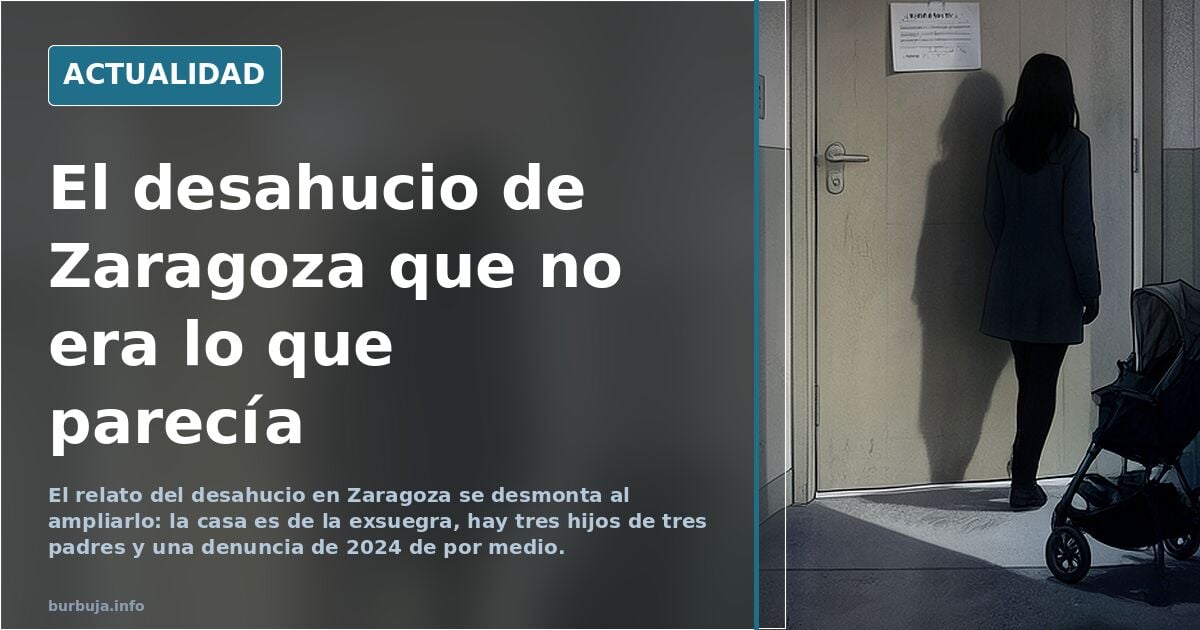
The Zaragoza eviction case that the press reported incompletely
The case hit the media with a textbook headline: abused, pregnant, and facing eviction in Zaragoza, just before giving birth. The news, published by Heraldo, presented a victim of gender-based violence being evicted from her home at the worst possible moment. So far, it was a sympathetic portrait. The problem is that, as more details emerge, the victim's profile becomes murky: three daughters from three different fathers, a report of threats that resulted in a restraining order against her ex-partner, and a new pregnancy just months after that separation.
The official narrative versus the facts of the case
The original story, spread by Heraldo, spoke of a woman about to be evicted just as she was due to give birth. The court was executing the eviction and she declared: "I don't know what else to do." It was a narrative that, in principle, triggers all social alarms: gender-based violence, economic vulnerability, and pregnancy. The perfect recipe for a headline.
However, the case has more layers. The property did not belong to her or her ex-partner: it belonged to her ex's mother, her former mother-in-law. The woman lived there with her children and, apparently, also with her new partner, who got her pregnant. The mother-in-law decided to evict them. Consequently, the court ordered the eviction.
Three children, three fathers, and a report of threats
The family history is complex. The woman had her first daughter as a minor. Later, she partnered with a man who apparently assumed paternity of the child. With him, she had a second daughter. The relationship ended, and she filed a report for threats that resulted in a two-year restraining order against him. According to available data, these events occurred in May 2024.
Shortly after, the woman was already pregnant by a third man, whom she housed in her former mother-in-law's home. That decision, combined with the breakup, precipitated the conflict. The mother-in-law asked them to leave. She refused. The court ruled in favor of the property owner.
The role of public aid and social housing
The case raises an uncomfortable question: what happens when vulnerability becomes a strategy? The woman does not work and lives on social benefits. She has three children and is expecting a fourth. The house is not hers. The mother-in-law has no legal obligation to support her. The court is simply applying the law.
Some argue that the welfare system should cover these situations without depending on family charity. Others argue that access to social housing (vivienda social) cannot be automatic for those who make decisions that worsen their own situation. The debate is open.
The instrumentalization of gender-based violence
One of the most sensitive points is the report of threats. While the restraining order exists, it is also true that the woman continued living in her ex's mother's house and brought in her new partner. This sequence has led some to suspect that the report may have been instrumental—a way to secure the housing. There is no ruling to support this hypothesis, but the context fuels skepticism.
Gender-based violence is a real and serious problem. Using it as a shield for other purposes harms true victims. That is the argument circulating in many analyses.
The cost to the taxpayer
If she is eventually granted social housing or rental assistance, the cost will fall on everyone's taxes. The question is whether this is sustainable when it becomes a pattern. The case of Josefina in Leganés, with five children over the age of 30 living with her and eight years of unpaid rent, has been cited as an example of a system that rewards a lack of responsibility.
There is no easy solution. Housing is a right, but it is also a scarce resource. Solidarity has limits, and so does the taxpayer's patience.
The Zaragoza case is not unique. It is a symptom of a model that confuses protection with permissiveness. The real story is not the sympathetic headline, but that of a woman who, with three children from three fathers, an ongoing pregnancy, and a report of threats, expects the system to resolve what she herself complicated. Meanwhile, the mother-in-law, who only wanted her house back, appears as the villain of the story.
Also available in: Deutsch
Summary of a discussion on Burbuja.info - Foro de economía, actualidad y política., translated from Spanish and reviewed before publication. Read the full discussion (68 replies).
More summaries
-
PP and Vox agree to cut aid to undocumented migrants
PP and Vox agree to cut social benefits for undocumented migrants, but those without work permits cannot refuse a job. The requirement doesn't add up.
-
Basque Court Denies Visa to Equatorial Guinea Woman Due to Mother's Welfare Income
Spain's top regional court upholds denial of family residence for a Guinean national because her Spanish mother relies on social benefits rather than personal income.
-
Spain: Social Debate on €1,500 Salary vs. Welfare Benefits
Analysis comparing a net €1,500 salary with welfare benefits sparks debate in Spain on whether the system rewards need over work.
-
Lobo Estepwarrior: the YouTuber who drinks a litre of wine every night
Lobo Estepwarrior drinks a litre of wine every night, lives off his family inheritance and returns to social media after announcing his retirement. Authentic rebel or actor?
-
Elderly man attacks pedestrians with knife in San Sebastián, Spain
A 64-year-old man of Maghrebi origin carried out a knife attack in San Sebastián, Spain. The debate over pensions and public safety has reopened.
-
Turns and twists: soon to be penalized, if not already
An analysis of censorship, language and the loss of free speech in an unfiltered debate about today's reality.