
Poll shows PP falling short of absolute majority in Galicia
A poll places the Galician PP without an absolute majority 11 days before Election Day, with emigrant votes and a single seat being key to the distribution.
English · Original discussion in Spanish · Published
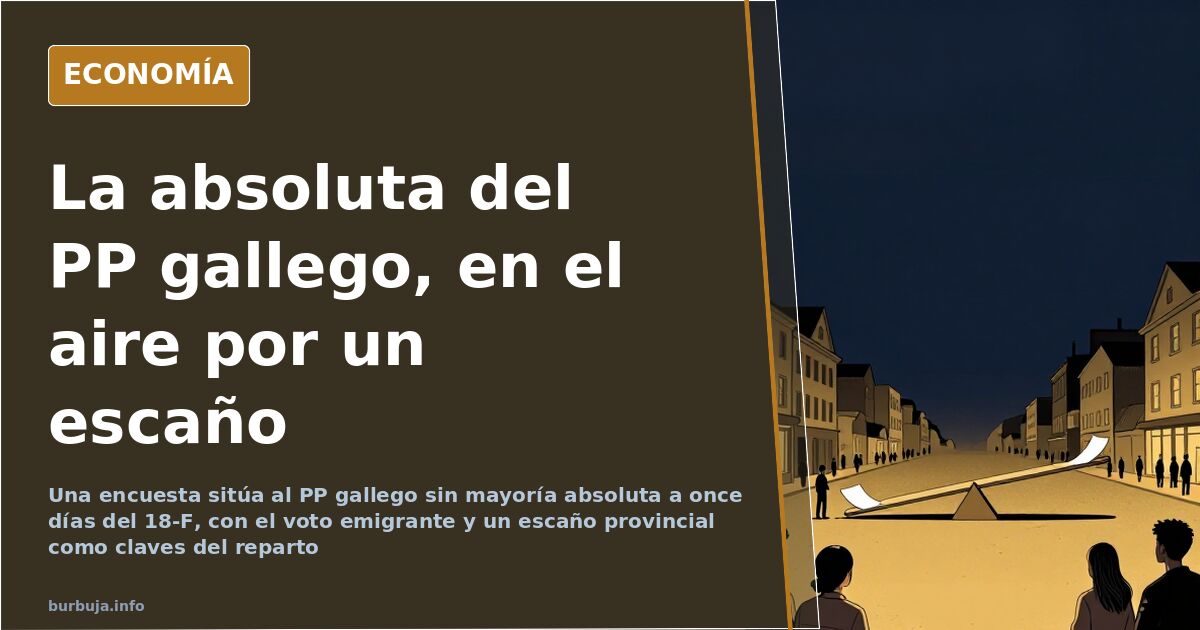
Why the PP's absolute majority in Galicia hangs on a single seat
Is Feijóo losing his absolute majority in his own region? With 11 days until 18-F, a poll placed the Galician PP below the threshold needed for a single-party government, with all eyes on a handful of votes that do not translate into seats. The question for voters is not just who wins, but how much margin is lost. The numbers are becoming uncomfortable.
What do polls say about the PP's absolute majority in Galicia?
The alarm-raising survey — attributed to the CIS — clashed with other studies that continued to give the PP a majority. With 42-44% of the vote, absolute majority is, according to calculations, in the air: the electoral system distributes seats by province, leaving some votes without representation. Some warn that one can secure an absolute majority with 43% and lose it with more. The snapshot also changed depending on the moment of the count: an advance with 14% of votes counted anticipated nothing of what was to come.
Emigrant votes and the seat that decides everything
According to detailed analyses, the key lies in emigrant voting. With the removal of proxy voting, a census weighs heavily — reportedly including deceased individuals and voters who have not exercised their right for years. This block, along with a single deputy, can decide a majority. Therefore, when comparing with the distribution of previous elections, with 42 seats for the PP, 19 for the BNG, and 14 for the PSOE, more than one forecast was portrayed. A prior poll even gave 18 seats to the socialists.
BNG: youth vote that grows and then migrates
According to a participant, the BNG captures mostly youth votes, which over the years shift to the PSOE and, upon retirement, to the PP. This is not a loyal electorate, but a stepping stone. This explains both the current good data and the fragility of its ceiling. The question is whether this curve remains intact or if something has broken it.
Vox, Democracia Ourensana, and the provincial map
Not a single seat for Vox in Galicia, according to the debate. The surprise is not that it does not grow, but that a party with representation across almost the entire state remains at zero in the region. The provincial distribution also antiestéticatures Democracia Ourensana, a party from Ourense identified as a potential tie-breaking seat and subject to open prosecutor's inquiries, without any conviction. A single deputy can sustain or topple a government.
Collapse or simple wear: the battle for the narrative
The results admit various readings, and none is innocent. The PP was revalidated but lost momentum compared to its best times. Some argue that the PSOE left 25% of its votes on the table. During the hangover, reports of personal shifts, such as a PP voter switching to the BNG, signal that the floor of the two major parties is moving. «Owned» was the reply of a forum user when election night disproved the most optimistic forecasts.
Notably, much of the electorate admits to voting with the day after in mind, not the ballot. With this logic, the seat count weighs more than any program. And so we have done for decades.
Also available in: Deutsch
Summary of a discussion on Burbuja.info - Foro de economía, actualidad y política., translated from Spanish and reviewed before publication. Read the full discussion (252 replies).
More summaries
-
PSOE Wins Landslide Among Moroccan Voters in Spain
PSOE secures absolute majority among voters of Moroccan origin in Spain, while Venezuelans, Cubans and Romanians lean towards PP and VOX
-
Galician elections 2024: PP wins as PSOE suffers major losses
The PP wins the 2024 Galician elections despite losing votes, while the PSOE collapses and the BNG grows through nationalist support in Spain.
-
Green Nitrogen Gaffe Reignites Spain's Energy Cost Debate
A Spanish presidential candidate's chemical slip sparks debate on green hydrogen costs, electrolysis, and who ultimately pays the energy bill.
-
The cost of shoplifting: Mercadona closes its Salt store
Mercadona is closing its store in Salt, Spain, after constant thefts. The cost of insecurity for retail and the debate over immigration. The key points.
-
Red Cross assists families and children at Ceuta breakwater
Red Cross in Ceuta: families and minors arrive at the breakwater amid criticism of the official account.
-
Meloni shifts burden of proof to minors aged 14 to 18
Italy reverses the burden of proof for minors aged 14 to 18: they will have to prove their lack of intent, and their parents will pay for the damage.