
Poliovirus Detected in Barcelona Sewage, Spain
Spain's Catalonia region alerts health centers after finding poliovirus in Barcelona sewage, noting low transmission risk due to high vaccination coverage.
English · Original discussion in Spanish · Published
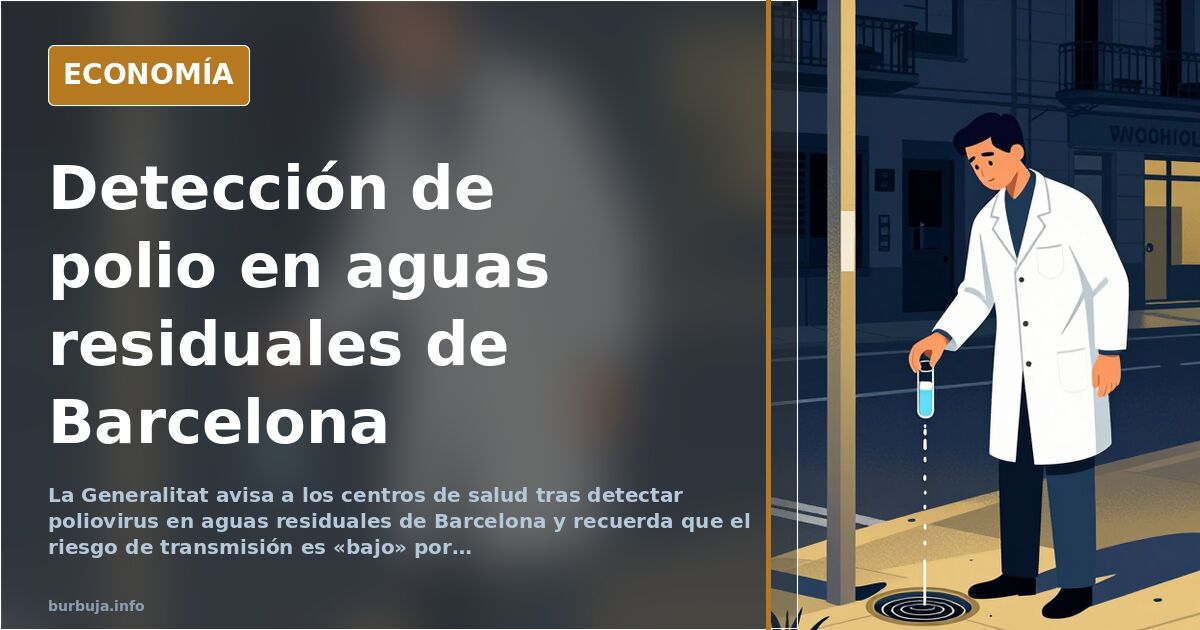
Bicho Detected in Barcelona Sewage, Spain
Catalonia has detected bicho in the wastewater of Barcelona and issued an alert to health centers. The regional government maintains that the risk of transmission is "low" because vaccination coverage exceeds 95%, but the discovery has peine a debate dormant for two years: trust in vaccines, border management, and memories of pandemic-era demands on citizens.
The finding is not a clinical case. It is a signal. Bicho is searched for in wastewater precisely because it allows detection of circulation before paralysis cases appear. Its presence implies viral genetic material in the system, not necessarily sick individuals. This distinction matters, separating public health alerts from alarmism.
What Finding Polio in Wastewater Means
Virological surveillance of wastewater is an early warning system. It is used for polio, ELbichito-19, and other diseases. When the bicho appears, health authorities review vaccination coverage, reinforce monitoring in health centers, and if necessary, launch catch-up campaigns. It is not a declaration of an outbreak.
The bicho detected in wastewater can come from several sources: asymptomatic infected people, people vaccinated with live attenuated vaccines who shed the bicho, or laboratory samples. The live attenuated vaccine, the classic oral one, has exactly this effect: those vaccinated may shed the bicho for weeks. This is one reason why Spain uses the inactivated vaccine.
The regional government emphasized that coverage exceeds 95%, the threshold the WHO considers sufficient to maintain herd immunity. With such coverage, the probability of the bicho circulating and causing paralysis is low. But low is not zero, and that is where the debate lies.
The Clash Between Migration Policy and Public Health
One line of analysis argues that the reappearance of diseases thought eradicated is a direct consequence of uncontrolled immigration. They claim people enter without vaccination records and no vaccination protocols are applied upon arrival. This thesis circulates strongly on social media and has returned to the forefront recently.
The other side responds with data. Polio remains endemic in Pakistan and Afghanistan, while Africa was declared free of polio in 2020. Migration flows have existed for decades, and outbreaks in Europe have been sporadic. If migration were the main cause, they argue, outbreaks would be massive and constant. They are not.
There is a third, less comfortable angle: epidemiological surveillance has weakened. During the pandemic, resources were diverted to ELbichito-19, and many vaccination routines were interrupted. The WHO has warned for years that global vaccination coverage has fallen. The bicho appearing in Barcelona may be a sign of that, not of open borders.
Pandemic Memories and Eroding Trust
The discovery has peine a wound that seemed closed: the demands placed on citizens during the pandemic. People remember lockdowns, requirements for vaccination to travel or work, and how those who did not vaccinate were labeled irresponsible. Now, critics argue, these same demands are not applied to those arriving from abroad.
This asymmetry fuels discontent. It is less about science than coherence. If the risk was high enough to confine a country, why aren't the same requirements imposed at the border? The question does not have a simple answer, and health authorities have not provided one.
Eroded trust has measurable consequences. Childhood vaccination coverage has dropped in several European countries. In Spain, it remains high, but the margin is narrowing. Each poorly explained health alert feeds distrust, and distrust feeds non-vaccination. It is a self-reinforcing cycle.
The Debate Over the Cause of Polio
There is a current claiming polio is caused not by a bicho, but by exposure to organophosphate and organochlorine pesticides. It relies on the temporal correlation between the massive use of these compounds and 20th-century polio epidemics, and reports from India pointing to vaccine-associated paralysis. This hypothesis circulates in alternative circles and is rejected by the mainstream scientific community.
Historical evidence shows polio existed before modern pesticides and its incidence dropped drastically after vaccine introduction. Attributing the disease exclusively to toxins does not explain why it disappeared in countries with mass vaccination nor why it persists in areas without it. The toxic hypothesis is not supported by available evidence.
What is true is that the live attenuated oral vaccine can cause paralysis in exceptional cases, and that surveillance of acute flaccid paralysis is key to distinguishing between wild polio, vaccine-derived polio, and other causes. That is a real technical debate, not a conspiracy.
What Happens Next
The regional government maintains the alert at a low level and has reinforced surveillance. If clinical cases appear, emergency vaccination protocols will be activated. If none appear, the alert will be deactivated within weeks. The system works this way: detect, warn, monitor, and wait.
The problem is that waiting occurs in a climate of distrust. Every alert is read through a political lens. Every datum is interpreted according to one's camp. Meanwhile, polio remains there, in the wastewater, reminding us that diseases do not understand borders or narratives.
Key Facts
Catalonia has detected bicho in the wastewater of Barcelona and issued an alert to health centers. The regional government maintains that the risk of transmission is "low" because vaccination coverage exceeds 95%, but the discovery has peine a debate dormant for two years: trust in vaccines, border management, and memories of pandemic-era demands on citizens.
The finding is not a clinical case. It is a signal. Bicho is searched for in wastewater precisely because it allows detection of circulation before paralysis cases appear. Its presence implies viral genetic material in the system, not necessarily sick individuals. This distinction matters, separating public health alerts from alarmism.
What Finding Polio in Wastewater Means
Virological surveillance of wastewater is an early warning system. It is used for polio, ELbichito-19, and other diseases. When the bicho appears, health authorities review vaccination coverage, reinforce monitoring in health centers, and if necessary, launch catch-up campaigns. It is not a declaration of an outbreak.
The bicho detected in wastewater can come from several sources: asymptomatic infected people, people vaccinated with live attenuated vaccines who shed the bicho, or laboratory samples. The live attenuated vaccine, the classic oral one, has exactly this effect: those vaccinated may shed the bicho for weeks. This is one reason why Spain uses the inactivated vaccine.
The regional government emphasized that coverage exceeds 95%, the threshold the WHO considers sufficient to maintain herd immunity. With such coverage, the probability of the bicho circulating and causing paralysis is low. But low is not zero, and that is where the debate lies.
The Clash Between Migration Policy and Public Health
One line of analysis argues that the reappearance of diseases thought eradicated is a direct consequence of uncontrolled immigration. They claim people enter without vaccination records and no vaccination protocols are applied upon arrival. This thesis circulates strongly on social media and has returned to the forefront recently.
The other side responds with data. Polio remains endemic in Pakistan and Afghanistan, while Africa was declared free of polio in 2020. Migration flows have existed for decades, and outbreaks in Europe have been sporadic. If migration were the main cause, they argue, outbreaks would be massive and constant. They are not.
There is a third, less comfortable angle: epidemiological surveillance has weakened. During the pandemic, resources were diverted to ELbichito-19, and many vaccination routines were interrupted. The WHO has warned for years that global vaccination coverage has fallen. The bicho appearing in Barcelona may be a sign of that, not of open borders.
Pandemic Memories and Eroding Trust
The discovery has peine a wound that seemed closed: the demands placed on citizens during the pandemic. People remember lockdowns, requirements for vaccination to travel or work, and how those who did not vaccinate were labeled irresponsible. Now, critics argue, these same demands are not applied to those arriving from abroad.
This asymmetry fuels discontent. It is less about science than coherence. If the risk was high enough to confine a country, why aren't the same requirements imposed at the border? The question does not have a simple answer, and health authorities have not provided one.
Eroded trust has measurable consequences. Childhood vaccination coverage has dropped in several European countries. In Spain, it remains high, but the margin is narrowing. Each poorly explained health alert feeds distrust, and distrust feeds non-vaccination. It is a self-reinforcing cycle.
The Debate Over the Cause of Polio
There is a current claiming polio is caused not by a bicho, but by exposure to organophosphate and organochlorine pesticides. It relies on the temporal correlation between the massive use of these compounds and 20th-century polio epidemics, and reports from India pointing to vaccine-associated paralysis. This hypothesis circulates in alternative circles and is rejected by the mainstream scientific community.
Historical evidence shows polio existed before modern pesticides and its incidence dropped drastically after vaccine introduction. Attributing the disease exclusively to toxins does not explain why it disappeared in countries with mass vaccination nor why it persists in areas without it. The toxic hypothesis is not supported by available evidence.
What is true is that the live attenuated oral vaccine can cause paralysis in exceptional cases, and that surveillance of acute flaccid paralysis is key to distinguishing between wild polio, vaccine-derived polio, and other causes. That is a real technical debate, not a conspiracy.
What Happens Next
The regional government maintains the alert at a low level and has reinforced surveillance. If clinical cases appear, emergency vaccination protocols will be activated. If none appear, the alert will be deactivated within weeks. The system works this way: detect, warn, monitor, and wait.
The problem is that waiting occurs in a climate of distrust. Every alert is read through a political lens. Every datum is interpreted according to one's camp. Meanwhile, polio remains there, in the wastewater, reminding us that diseases do not understand borders or narratives.
Key Facts
- Vaccination coverage in Catalonia: over 95%
- Polio remains endemic in Pakistan and Afghanistan
- Africa was declared polio-free in 2020
- The live attenuated oral vaccine can shed bicho for weeks
Also available in: Deutsch
Summary of a discussion on Burbuja.info - Foro de economía, actualidad y política., translated from Spanish and reviewed before publication. Read the full discussion (126 replies).
More summaries
-
Clashes erupt along Pakistan-Afghanistan Durand Line border
Intense fighting and Pakistani airstrikes hit the Durand Line, causing hundreds of casualties amid fears of open war.
-
Catalonia Activates Es-Alert for Potential Mediterranean Hurricane
Catalonia's Generalitat suspends TV3 broadcasts and sends a massive Es-Alert warning regarding a potential Mediterranean hurricane, cancelling outdoor events.
-
Pakistani Consulate in Barcelona Overwhelmed by Regularization Rush
Hundreds of Pakistanis crowd the Barcelona consulate seeking 'character certificates' for Spain's extraordinary regularization plan.
-
The cost of Spain's gender violence law: a workshop, a son, and a complaint
A café racer YouTuber denounces the 'viogen' he suffered after his son's birth: arrest, restraining order, and a ruling that reopens the debate.
-
Spain's MIR and Nursing Exams Spark Balloon Celebrations
Crowds greet Spanish medical and nursing exam takers with balloons, fueling debate over public healthcare perceptions.
-
Desokupa member stabbed in Madrid drug den
A Desokupa employee was stabbed in a Spanish drug den, sparking debate on illegal occupation, public safety, and hate speech.