
Spain's MIR and Nursing Exams Spark Balloon Celebrations
Crowds greet Spanish medical and nursing exam takers with balloons, fueling debate over public healthcare perceptions.
English · Original discussion in Spanish · Published
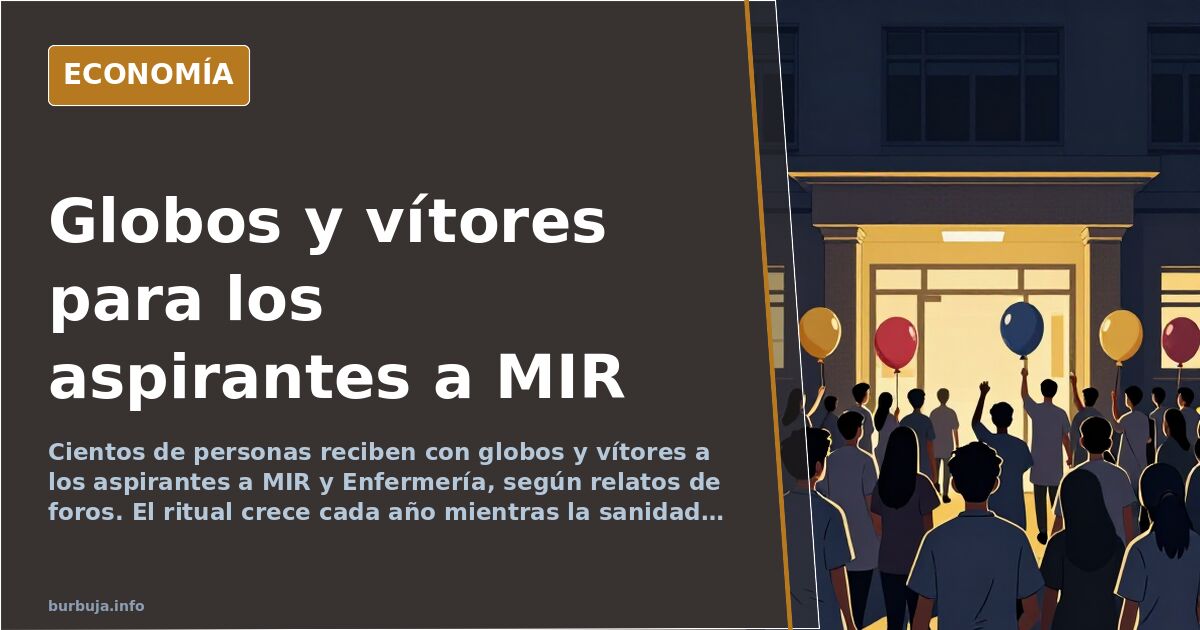
Golden balloons and cheers for Spain's MIR candidates
Hundreds wait outside the MIR and Nursing exams with signs, flowers, and balloons. Broadcast on TV, this scene reignited an uncomfortable debate: why is a five-hour entrance test celebrated as a historic triumph? The phenomenon isn't new. Audiovisual records show such welcomes since at least 2003, with each year adding spectacle: masks in 2022, personalized posters, families chanting names.
What the MIR is and isn't
Let's clarify. The MIR doesn't make anyone a civil servant. It ranks candidates by score to choose specialty and location. Debate suggests specialties are scarce after rank 3,500; only less popular ones remain by 5,000. Residency lasts four to five years and is essential for public health work. Claiming it's a lifetime job guarantee is wrong.
This matters because anger stems from confusion: believing the MIR guarantees a secure post. It doesn't. Residents earn, work, then compete like any graduate. Public health absorbs most, feeding the perception of safety.
Emotional ritual and social reading
The staging trinc a pattern: relatives with banners, balloons, cheers, tears. A televised rite of passage. Some see societal infantilization: academic achievements needing emotional ceremonies, heart-shaped signs, sports-final-style encouragement.
Critics point to comparative grievance. Farmers, technicians, engineers, chemists don't get mass honors. Why does healthcare attract public veneration other professions lack? Some blame the pandemic: 8 PM applause institutionalized heroism narratives now extended to every exam.
Disillusionment with public health
A paradox exists. While crowds celebrate entries, public health faces complaints about shortages, precariousness, and brain drain. Golden balloons clash with saturated clinics and waiting lists.
Analysts suggest symbolic compensation: celebrating entry because internal conditions can't be celebrated. Others cite political interest in keeping health an emotional banner. The ritual grows yearly, becoming part of the media calendar.
Evolution of the phenomenon
Records show escalation. Reporters interviewed families in 2003. Masks added dystopian layers in 2022. Later events documented balloons, face shields, custom signs. This has become a Spanish education anomaly: a high-stakes exam turned into mass spectacle.
The open question isn't whether effort deserves recognition, but why it takes the form of sports-hero welcomes rather than simple family congratulations. Expect more balloons and cameras next time.
Hundreds wait outside the MIR and Nursing exams with signs, flowers, and balloons. Broadcast on TV, this scene reignited an uncomfortable debate: why is a five-hour entrance test celebrated as a historic triumph? The phenomenon isn't new. Audiovisual records show such welcomes since at least 2003, with each year adding spectacle: masks in 2022, personalized posters, families chanting names.
What the MIR is and isn't
Let's clarify. The MIR doesn't make anyone a civil servant. It ranks candidates by score to choose specialty and location. Debate suggests specialties are scarce after rank 3,500; only less popular ones remain by 5,000. Residency lasts four to five years and is essential for public health work. Claiming it's a lifetime job guarantee is wrong.
This matters because anger stems from confusion: believing the MIR guarantees a secure post. It doesn't. Residents earn, work, then compete like any graduate. Public health absorbs most, feeding the perception of safety.
Emotional ritual and social reading
The staging trinc a pattern: relatives with banners, balloons, cheers, tears. A televised rite of passage. Some see societal infantilization: academic achievements needing emotional ceremonies, heart-shaped signs, sports-final-style encouragement.
Critics point to comparative grievance. Farmers, technicians, engineers, chemists don't get mass honors. Why does healthcare attract public veneration other professions lack? Some blame the pandemic: 8 PM applause institutionalized heroism narratives now extended to every exam.
Disillusionment with public health
A paradox exists. While crowds celebrate entries, public health faces complaints about shortages, precariousness, and brain drain. Golden balloons clash with saturated clinics and waiting lists.
Analysts suggest symbolic compensation: celebrating entry because internal conditions can't be celebrated. Others cite political interest in keeping health an emotional banner. The ritual grows yearly, becoming part of the media calendar.
Evolution of the phenomenon
Records show escalation. Reporters interviewed families in 2003. Masks added dystopian layers in 2022. Later events documented balloons, face shields, custom signs. This has become a Spanish education anomaly: a high-stakes exam turned into mass spectacle.
The open question isn't whether effort deserves recognition, but why it takes the form of sports-hero welcomes rather than simple family congratulations. Expect more balloons and cameras next time.
Also available in: Deutsch
Summary of a discussion on Burbuja.info - Foro de economía, actualidad y política., translated from Spanish and reviewed before publication. Read the full discussion (125 replies).
More summaries
-
Muface: The battle over public vs. private healthcare in Spain
Spain's Muface, Mugeju, and Isfas cover 800,000 civil servants, with an estimated 650,000 opting for private healthcare providers.
-
Spanish rower Jennie Sanchez quits sport for OnlyFans
With nearly 900,000 followers and a modest rowing scholarship, Spanish athlete Jennie Sanchez turns to digital content.
-
Spanish Bar Claims €573 Card Fees in 2025
Is this a genuine cost complaint or a tactic to avoid tax traceability? We analyze the debate.
-
Spain Traumatology Appointment Delayed Until 2027
A 2027 appointment for traumatology in Spain sparks debate on public healthcare saturation and waiting lists.
-
Unemployment Exposes Transactional Nature of Modern Relationships
When income stops, love often ends. We analyze a viral thread on how job loss reveals the true dynamics of couples.
-
Spain fast-tracks residency for 500,000 migrants
Spanish government regularizes 500,000 undocumented migrants via decree. Analysis of legal impact and potential voting rights within two years.