
Police Seize Hanan Alcalde's Phone in Ceuta
Police confiscated Hanan Alcalde's phone in Ceuta. She claims it contained photos, phone numbers, and ID documents of minors.
English · Original discussion in Spanish · Published
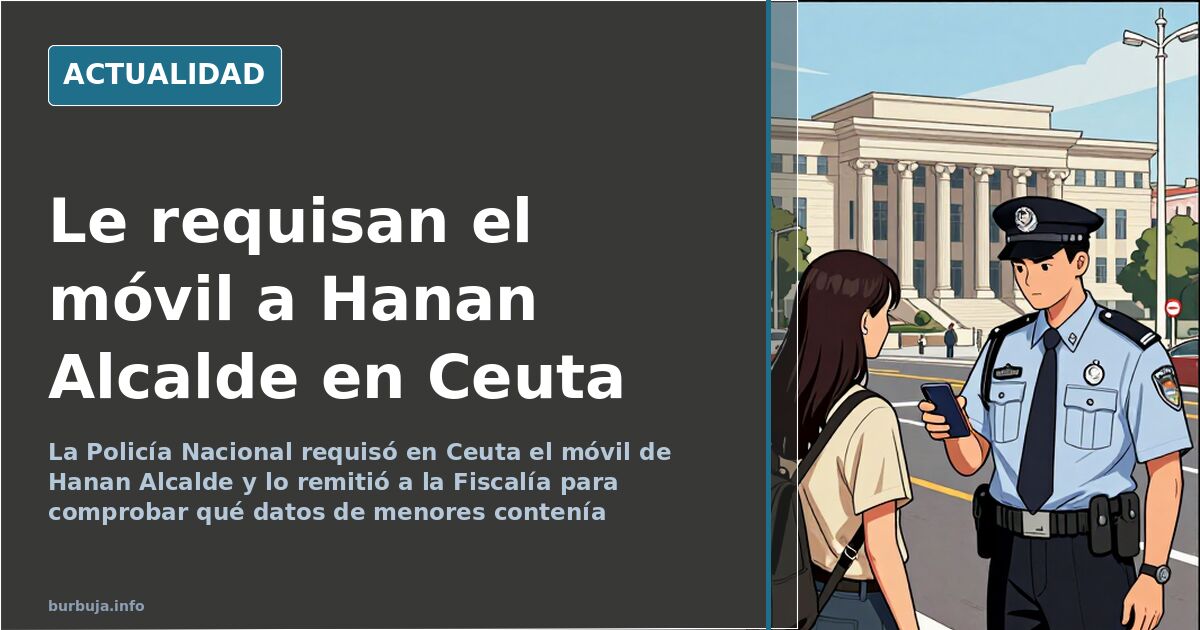
Police Seize Hanan Alcalde's Phone Over Minors' Data
Gathering minors' personal data, even if theoretically to help them, can itself become a crime. This is the crux of the matter that came to light on September 27, 2026: the National Police seized Hanan Alcalde's phone during an operation at the old Guano factory in Ceuta. The individual herself explained that she stored photographs, birth dates, phone numbers, and minors' identity documents, as well as contacts, on the device. The phone will be handed over to the Public Prosecutor's Office to verify what was done with all this information. Legally, for now, there is a seizure and a report: no arrest or formal indictment has been recorded.
What crime can collecting minors' data constitute?
Collecting and storing minors' personal data without a legal basis can be a serious abusa of data protection regulations and, in certain circumstances, a crime, according to some commentators. The key lies in the status of those affected – especially protected persons – and in how the information is used. It is not the same to keep a list to channel aid as it is to disseminate images and identity documents through uncontrolled channels.
The account of the affected person herself suggests that the material included photographs and documents, not just names. The Public Prosecutor's Office will have to determine if this data was processed for a legitimate purpose, if it was shared with third parties, and if parental consent was obtained. Each of these answers completely changes the legal nature of the case.
Some argue that gathering this data helps locate families and direct aid. Conversely, others maintain that no serious organization requests lists with identity documents through informal channels. The line between voluntarism and illegality is, here, surprisingly thin.
The operation at the old Guano factory in Ceuta
The operation took place at the old Guano factory in Ceuta, where the police operation that led to the phone's seizure was concentrated. Media attention has focused on the identity of the person involved rather than the operation itself.
That a person without a public office or institutional responsibility makes headlines because of the content of their phone says a lot about how current events are manufactured today. The news is not the factory. Not even the operation. It is what, according to her own testimony, was inside that phone.
From the phone seizure to the Prosecutor's Office: what happens now
The phone will be made available to the Public Prosecutor's Office, which will decide whether to open proceedings, commission reports, or close the case. The report filed by the officers is the documentary starting point. From there, the investigation dictates the timeline, not social media.
Will this matter turn what is currently a suspicion into a crime? It depends on two things: what the device dump reveals and what legal framework it fits into. Meanwhile, the "could end up in jail" circulating in headlines is a hypothesis, not an announced consequence.
Unsubstantiated claims surrounding Hanan Alcalde
A thick layer of conjecture has unfolded around the case, going far beyond the established facts. There is talk of alleged connections to exploitation networks, hard-to-explain real estate and hotel assets, and supposed links to international financing structures. None of these accusations are supported, as of the date of this article, by public evidence or judicial rulings.
The distance between what is rumored and what is known is abysmal. And that gap is exactly where narratives that mix a specific case with general theories about immigration, non-governmental organizations, and opaque money grow. It is advisable to separate the official record from the novel.
The only verifiable fact today can be summarized in one sentence: a woman without public office has had her phone seized due to data on minors that she herself claims to have collected. Everything else – the network, the millions, jail – remains to be seen. And if, in the end, it turns out there was nothing, who will take back the headline?
Gathering minors' personal data, even if theoretically to help them, can itself become a crime. This is the crux of the matter that came to light on September 27, 2026: the National Police seized Hanan Alcalde's phone during an operation at the old Guano factory in Ceuta. The individual herself explained that she stored photographs, birth dates, phone numbers, and minors' identity documents, as well as contacts, on the device. The phone will be handed over to the Public Prosecutor's Office to verify what was done with all this information. Legally, for now, there is a seizure and a report: no arrest or formal indictment has been recorded.
What crime can collecting minors' data constitute?
Collecting and storing minors' personal data without a legal basis can be a serious abusa of data protection regulations and, in certain circumstances, a crime, according to some commentators. The key lies in the status of those affected – especially protected persons – and in how the information is used. It is not the same to keep a list to channel aid as it is to disseminate images and identity documents through uncontrolled channels.
The account of the affected person herself suggests that the material included photographs and documents, not just names. The Public Prosecutor's Office will have to determine if this data was processed for a legitimate purpose, if it was shared with third parties, and if parental consent was obtained. Each of these answers completely changes the legal nature of the case.
Some argue that gathering this data helps locate families and direct aid. Conversely, others maintain that no serious organization requests lists with identity documents through informal channels. The line between voluntarism and illegality is, here, surprisingly thin.
The operation at the old Guano factory in Ceuta
The operation took place at the old Guano factory in Ceuta, where the police operation that led to the phone's seizure was concentrated. Media attention has focused on the identity of the person involved rather than the operation itself.
That a person without a public office or institutional responsibility makes headlines because of the content of their phone says a lot about how current events are manufactured today. The news is not the factory. Not even the operation. It is what, according to her own testimony, was inside that phone.
From the phone seizure to the Prosecutor's Office: what happens now
The phone will be made available to the Public Prosecutor's Office, which will decide whether to open proceedings, commission reports, or close the case. The report filed by the officers is the documentary starting point. From there, the investigation dictates the timeline, not social media.
Will this matter turn what is currently a suspicion into a crime? It depends on two things: what the device dump reveals and what legal framework it fits into. Meanwhile, the "could end up in jail" circulating in headlines is a hypothesis, not an announced consequence.
Unsubstantiated claims surrounding Hanan Alcalde
A thick layer of conjecture has unfolded around the case, going far beyond the established facts. There is talk of alleged connections to exploitation networks, hard-to-explain real estate and hotel assets, and supposed links to international financing structures. None of these accusations are supported, as of the date of this article, by public evidence or judicial rulings.
The distance between what is rumored and what is known is abysmal. And that gap is exactly where narratives that mix a specific case with general theories about immigration, non-governmental organizations, and opaque money grow. It is advisable to separate the official record from the novel.
The only verifiable fact today can be summarized in one sentence: a woman without public office has had her phone seized due to data on minors that she herself claims to have collected. Everything else – the network, the millions, jail – remains to be seen. And if, in the end, it turns out there was nothing, who will take back the headline?
Summary of a discussion on Burbuja.info - Foro de economía, actualidad y política., translated from Spanish and reviewed before publication. Read the full discussion (102 replies).
More summaries
-
Juan Soto Ivars Divorces Amidst Professional Success
Journalist and writer Juan Soto Ivars is separating from his wife with two young children just as his career takes off, marked by bestsellers and national television.
-
Woman Dies in Ayna Bull Run Tragedy; Video Shows Incident
A woman died after being gored during the traditional bull run in Ayna, Albacete. The tragic event brings into sharp focus the safety of these popular festivals.
-
Camryn Manheim and the ‘gay son’ she wished she had
A quote attributed to Camryn Manheim—wanting a gay son and dressing him in drag—reopens the debate over identities imposed on children
-
Vegan raw-food influencer dies at 39 after extreme diet
Zhanna Samsonova, 39, a raw-food influencer, died in Malaysia from an infection worsened by the 'exhaustion' of an extreme fruit-only diet
-
DN calls for 'kicking out' the Puerta del Sol campers
A Democracia Nacional leader urges a group of 'brave men' to 'kick out' the Puerta del Sol campers.
-
Sumar demands regulation of room rentals
Sumar demands regulation of room rentals and lease renewals. An investor warns that property maths no longer add up.