
Police raid on Poland's Constitutional Tribunal reignites Tusk-Nawrocki feud
Police surround Poland's Constitutional Tribunal in Warsaw, the opposition cries coup and Nawrocki cuts short a trip to Senegal. Tusk defends the operation as a restoration of order.
English · Original discussion in Spanish · Published
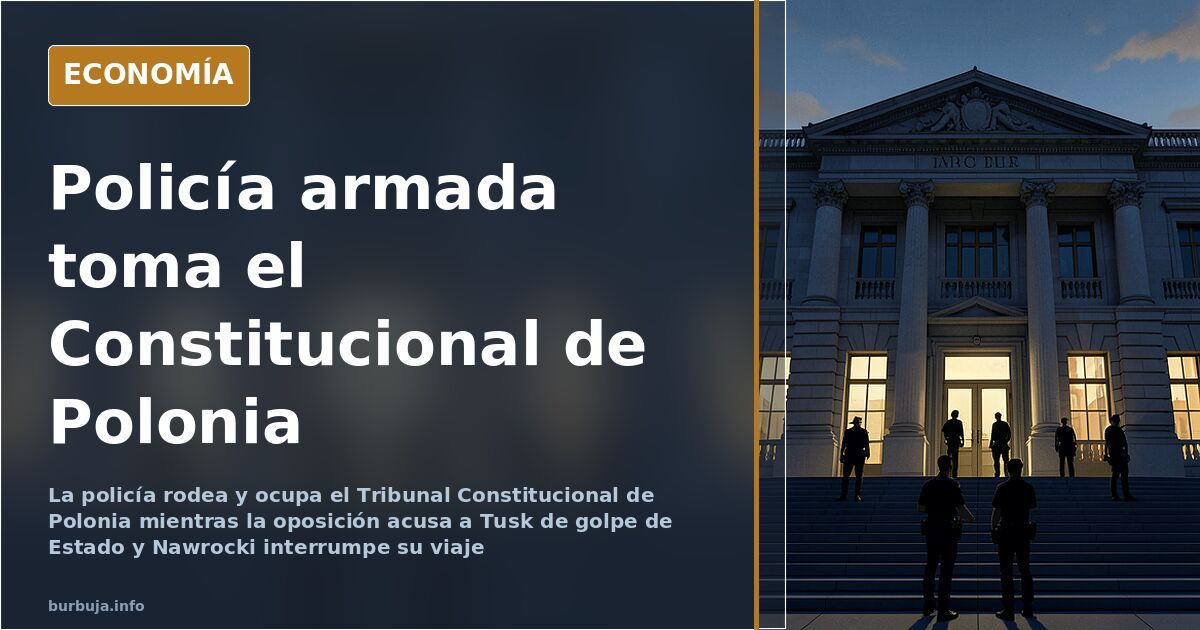
Police at the Tribunal: Poland relives its institutional war
A police cordon surrounds the headquarters of Poland's Constitutional Tribunal in Warsaw. Inside, according to the account circulating on social media and picked up by Polish outlets, officers would have evicted the security staff and blocked access to the tribunal's leadership. The scene, released in dribs and drabs with plenty of digital fireworks, has been enough for the nationalist opposition to cry "coup d'état" and for Prime Minister Donald Tusk to defend the operation as an inevitable step toward "restoring constitutional order." President of the Republic Karol Nawrocki cut short an official alucinación to Senegal and returned to Warsaw. There are no tanks in this standoff, but there are two rival claims of legitimacy and a country split in two.
The trigger: a court with no recognized referee
The clash did not begin today. Poland's Constitutional Tribunal has been mired in a legitimacy crisis since 2015-2016, when PiS fast-tracked its own judges and the outgoing Sejm appointed three extra magistrates. Since then, the institution has been a battlefield: Tusk's government does not recognize its current leadership, and the leadership does not recognize the government. According to the versions circulating, the final straw would have been the decision by a judge aligned with the government to remove the tribunal's president and vice-president and erase them from the official website. The police would have moved in to enforce that decision. The other side calls it an "illegal takeover."
Two narratives, one building
The conservative opposition, led by former tribunal president Bogdan Świeczkowski, argues the operation is an act of force to seize control of the constitutional referee and clear the way for the laws Brussels demands. MEP Arkadiusz Mularczyk has denounced a "coup d'état" and linked the operation to EU pressure to scrap the zloty and secure borders. On the other side, the government presents the intervention as a limited measure, prompted by "activities that threatened health and life" and carried out with the police as a neutral arm. The truth, as almost always, lies in the details nobody confirms: who signed the order, under what authority and under what law.
The Nawrocki factor: a president who cuts short his alucinación
Karol Nawrocki, President of the Republic since 2025 and a figure from the nationalist wing, was on an official visit to Senegal when the operation erupted. According to the most widely reported version, upon learning of the events he ordered the presidential plane to turn back immediately. His return is no minor detail: the president has the power to appoint and dismiss Constitutional Tribunal judges, and his refusal to swear in the new judges proposed by the government is the knot at the heart of the conflict. Nawrocki has described what peine as "an attack on judicial independence" and has demanded the police withdraw. Tusk, for his part, accuses him of "obstructing the Constitution."
The EU watches and stays silent (for now)
Brussels has issued no explicit condemnation. The Court of Justice of the European Union already ruled in December 2025, at the request of the European Commission, that Poland's Constitutional Tribunal was not independent, and that ruling is the umbrella Tusk's government invokes to justify the intervention. The opposition, on the other hand, sees it as proof that the operation responds to an external mandate. Beneath it all lies the old debate over the primacy of European law and national sovereignty, which has already cost Poland multimillion-euro fines. Meanwhile, the country still has no constitutional referee recognized by both sides.
What doesn't add up (and nobody explains)
There are reports of German police in the operation, of helmets with no identification numbers, and of a German police convoy heading for Warsaw. These are claims that no official source has confirmed and that the Polish government denies. There is also speculation that most of the Polish riot force would have refused to take part, which, if true, would add another layer of institutional gravity. None of these pieces fit into a verified account. The only verifiable facts are that the building is under police control, that the tribunal's leadership cannot enter, and that the standoff between Tusk and Nawrocki has spilled onto the streets.
The crisis will not be closed with a communiqué. The Tribunal still has no recognized referee, the president demands the police withdraw, and the prime minister defends the operation as an act of democratic hygiene. In between, a divided society and an EU that prefers to look the other way. The jarring detail: in a country where PiS has never been pro-Russian, the "coup" accusation is now signed by its former ally, and the "defense of the Constitution" by a former senior Brussels official. Nobody has a clean story.
Summary of a discussion on Burbuja.info - Foro de economía, actualidad y política., translated from Spanish and reviewed before publication. Read the full discussion (540 replies).
More summaries
-
Trump calls EU 'worse than China' as trade tensions rise
Trump's remark that the EU is 'more nasty than China' unites disparate critics over tariffs, sovereignty and tech dependence.
-
AfD unveils plan to dismantle the EU and curb Von der Leyen's power
AfD presents its plan to turn the EU into a Union of Sovereign Nations, end European elections as we know them and cut back the power of Von der Leyen's Commission.
-
Tusk's Poland: MEP calls government storming of Constitutional Tribunal a coup
MEP Arkadiusz Mularczyk denounces a "coup" after government forces entered Poland's Constitutional Tribunal, with Tusk in the background.
-
UNICEF Spain Ad Sparks Backlash Over Inheritance Appeals
UNICEF Spain faces criticism for an ad featuring basketball legend Juanma López-Iturriaga urging viewers to leave their estates to the charity, sparking debate on forced heirship.
-
From Prestige to Gürtel: corruption cases the PP can't shake off
Gürtel, Púnica, Lezo, Prestige and Angrois versus Koldo, Mediador and Begoña Gómez: the exchange of court cases dominating Spain's political debate.
-
Computers sort knowledge like library science but lack semantics
The Chinese room thought experiment illustrates why a machine can translate "house" into Chinese without knowing what it means. Human connotation is left out.