
Police charge students protesting against Abascal in A Coruña, Spain
Over 1,000 students protest in A Coruña against Abascal and police deploy riot officers. The right to protest and Vox's rally clash at María Pita square.
English · Original discussion in Spanish · Published
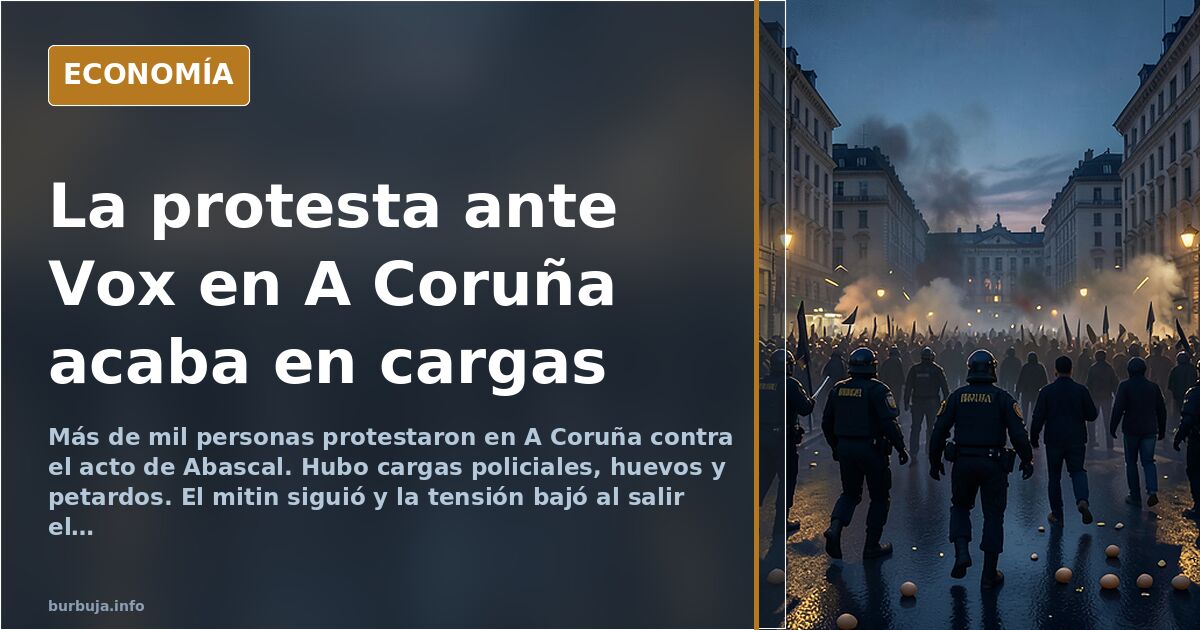
Police charge students protesting against Abascal in A Coruña, Spain
Is it legitimate to charge at students protesting against the presence of a political leader? The answer is not unanimous, but the facts are stark: more than 1,000 people, many of them students, gathered at María Pita square in A Coruña to protest against a Vox rally, and police deployed riot officers. There were charges, eggs, firecrackers and a human barrier separating protesters from rally attendees. The event went ahead and Abascal left. The protest continued, but without Abascal.
Over 1,000 people and a police barrier at María Pita
The scene repeats itself with a predictable choreography: riot police form a human barrier to prevent clashes between protesters and those attending the Vox rally. At first there were confrontations and police charges. Later, when Abascal left the square, tensions eased. The young protesters chanted their slogans against fascism while the police held the barrier. The official account speaks of riots; the organisers' account speaks of anti-fascist resistance. Both narratives coexist in the same public space.
The right to protest and the right to assembly: the conflict nobody resolves
The constitutional framework is clear: freedom of expression, demonstration and assembly. The dispute arises when both rights collide in the same square. Some argue that disrupting a legal rally deserves sanctions; others contend that protest is the democratic response to a party they consider fascist. The police, which answer to the central government under Spain's state structure, act as an armed referee. The region of Galicia has no authority over the National Police, so responsibility for the charge falls on the Ministry of the Interior. The question is whether the human barrier was there to protect the rally or to contain the protest.
Hypocrisy as an argument: housing, Ceuta and the treatment of Vito Quiles
Other issues cross into the public debate that have nothing to do with María Pita square, but they fuel the outrage. Questions are raised about the consistency of a former PSOE spokesperson on housing, people ask whether police violence would have been justified in a case of assault in Ceuta, and there is debate over whether it is justified to bar Vito Quiles from a university because of his ideas. These are different issues that converge on a single question: is the same standard applied to everyone? The answer depends on whom you ask. What unites these cases is the feeling that public space is distributed unevenly.
The university precedent: who decides who gets in?
The case of Vito Quiles, who according to some accounts enters universities with the blessing of the institutions and according to others sneaks in to stir up trouble, raises a dilemma about the limits of free speech on campus. Some defend the university as a space for debate and not an ideological fiefdom; others argue that certain presences only seek provocation. The discussion carries over to the rally: if a legal politician is prevented from speaking in a reserved public space, what becomes of the right of assembly? The answer is not simple, but the police charge does not resolve it either.
The police charge at students once again. The students once again chant against fascism. Abascal returns to his seat in parliament. And at María Pita the human barrier remains, separating those who protest from those who celebrate. All very democratic.
Also available in: Deutsch
Summary of a discussion on Burbuja.info - Foro de economía, actualidad y política., translated from Spanish and reviewed before publication. Read the full discussion (28 replies).
More summaries
-
Los Ángeles de San Rafael: cheap housing 65 km from Madrid
Los Ángeles de San Rafael, 65 km from Madrid, offers cheap houses but with water cuts, a bus every 6 hours, and no school or health centre.
-
Valencia floods: the chain of command nobody took responsibility for
The Valencia DANA killed more than 200 people. The chain between the CHJ, the Ministry and CECOPI broke down, and nobody ordered an evacuation in time.
-
Cuéntame cómo pasó and TVE's ideological turn since 2001
Cuéntame cómo pasó premiered in 2001 and is now cited as TVE's biggest case of indoctrination: 14 years on air, caught between everyday nostalgia and ideological sermonising.
-
Valencia prosecutors want Mazón charged over deadly floods
The Valencia prosecutor's office backs investigating Carlos Mazón's criminal responsibility for the floods that killed 223 people, but the case against him will have to wait.
-
After asking for millions in aid, Spain's CEOE warns: a housing strike would be "ILLEGAL"
CEOE, Spain's main business association, argues that a general strike over housing would be "illegal" because it does not stem from a labour dispute. What Spanish strike law actually says.
-
Mónica García, a doctor who never practised, is Spain's Health Minister
Mónica García, a qualified doctor, heads Spain's Health Ministry, and her appointment has sparked backlash: critics say she has never actually practised medicine.