
Russia's Legacy: From Periodic Table to Space Race
From Mendeleev and Gagarin to Gulags and famines, Russia’s complex legacy remains a subject of intense debate.
English · Original discussion in Spanish · Published
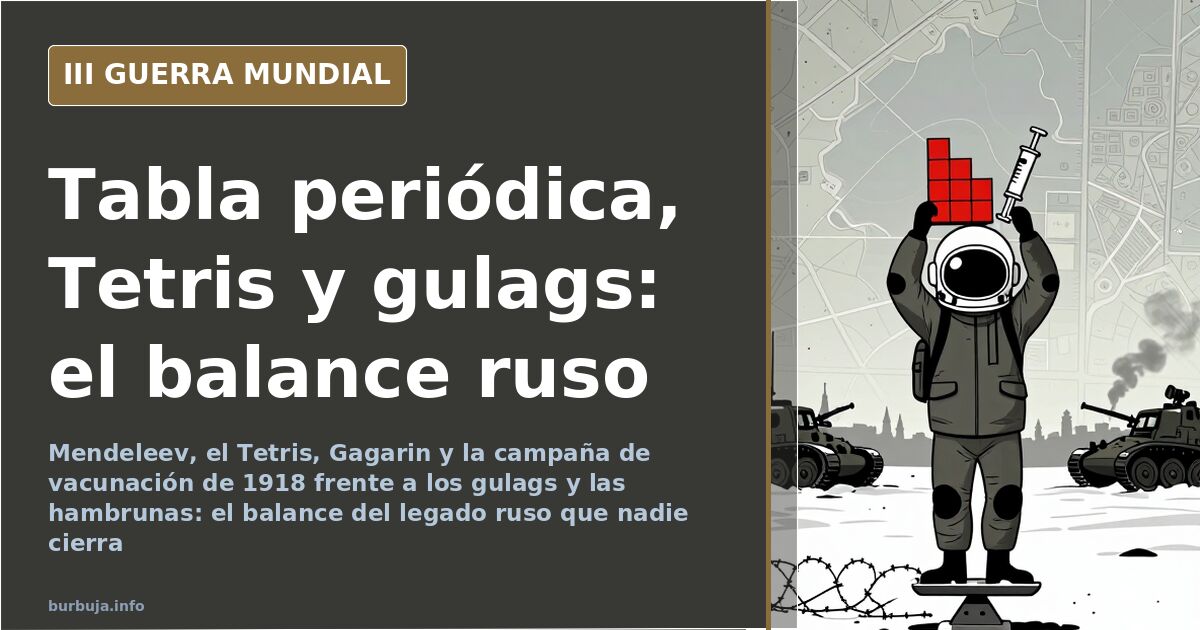
Periodic Table, Tetris, and Tchaikovsky: What Russia Gave the World
Can anything compensate for eleven centuries of invasions, wars, and dictatorships? This question has circulated for over four years without a definitive answer, yet it has produced two vastly different inventories. The first includes forced labor camps, famines, and secret police. The second begins with the periodic table of elements and ends with a nuclear icebreaker.
Russian Contributions Rarely Disputed
For those seeking a quick list, here it is: the periodic table, vodka, Tetris, chess masters Kasparov and Karpov, and Olivier salad. Behind each name lies an entire industry. In literature, Tolstoy, Chekhov, Dostoevsky, and Gogol form the backbone of the 19th-century European novel. In science, calculations suggest that at least one-third of humanity's scientific development is of Russian origin, including mathematics.
The argument is not merely about volume. It is claimed that Russia joined European scientific and artistic currents late—well into the 18th century—and caught up with those who had a centuries-long head start in just a few generations. Hence the core defense: the potential of the Russian people extends far beyond the regimes that governed them. Incidentally, Olivier salad is the only item on the list you can order at a bar.
From Glinka to Shostakovich: How Russia Changed Music
Here there is broad consensus. Glinka, Borodin, Mussorgsky, Tchaikovsky, Rimsky-Korsakov, Rachmaninoff, Scriabin, Stravinsky, Prokofiev, and Shostakovich are cited together with little dissent. A phrase attributed to broadcaster Howard Goodall summarizes the impact: when the Russian giant proge up, music was never the same again. A tangible consequence trinc: film soundtracks would not be what they are today.
Disagreement arises regarding audience preferences. Against the idea that the most listened-to concert piece is the Concierto de Aranjuez, the counter-argument is that there are twenty Russian concertos equally popular—Tchaikovsky, Rachmaninoff, Prokofiev, Khachaturian—and that confusing musical knowledge with box office success is a methodological error. Melomania versus ratings, summarized in two lines.
Was Russia the First Country to Vaccinate Its Entire Population?
Yes, according to one of the most repeated claims in the exchange: in 1918, Russia allegedly became the first state in the world to launch a universal vaccination campaign. The rebuttal came with dates: Spain reportedly did so two hundred years earlier, using a wooden ship as its sole logistical infrastructure. Two narratives of primacy that share neither a time frame nor a comparison criterion.
The counterweight lies on the other side of the scale. The same era as the health decree coincided with War Communism and a catastrophic famine; many survivors lived, it is recalled, thanks to foreign aid. Presenting this period as a health achievement requires erasing half the picture.
From the Venus Rocket to GLONASS: Science That Was Not Patented
The space race opens the technical section: pioneers in space exploration and the only probe successfully sent to the surface of Venus. The list continues with top-tier computer bicho and bicho software, the largest urban hot-water heating networks, the deepest drilling ever performed, nuclear icebreakers, and the GLONASS navigation system.
There is an economic argument behind all this, and it is the least discussed. The break with the private monopoly on knowledge in industrialized countries, involving copying, modification, and redistribution beyond copyright. Mass industrialism and the diffusion of technical development outside commercial circuits appear as the structural contribution, beyond individual inventions.
Gulags, Famines, and a Manifesto Written by a German
The other side has its own inventory. The most repeated accusations include forced labor camps, famines, and torture by the secret police. And a historical precision that unsettles both sides: communism did not originate in Russia. The Communist Manifesto was written by a German, Karl Marx, and the line from Hegelian idealism to scientific socialism is more German than Slavic.
On this basis, an uncomfortable distinction is made: one thing is the ideal, another its implementations, which critics attribute to the USSR, China, and other regimes. The conversation also gets tangled in the origins of the Soviet system itself, with conflicting readings on who financed the revolution and what role foreign interests played. The exact point where analysis stalls: no common unit of measurement has been found to weigh eleven centuries of history against a catalog of inventions and symphonies. One-third of global science, on one hand. An unclosed archive of victims, on the other. The arithmetic does not add up.
Can anything compensate for eleven centuries of invasions, wars, and dictatorships? This question has circulated for over four years without a definitive answer, yet it has produced two vastly different inventories. The first includes forced labor camps, famines, and secret police. The second begins with the periodic table of elements and ends with a nuclear icebreaker.
Russian Contributions Rarely Disputed
For those seeking a quick list, here it is: the periodic table, vodka, Tetris, chess masters Kasparov and Karpov, and Olivier salad. Behind each name lies an entire industry. In literature, Tolstoy, Chekhov, Dostoevsky, and Gogol form the backbone of the 19th-century European novel. In science, calculations suggest that at least one-third of humanity's scientific development is of Russian origin, including mathematics.
The argument is not merely about volume. It is claimed that Russia joined European scientific and artistic currents late—well into the 18th century—and caught up with those who had a centuries-long head start in just a few generations. Hence the core defense: the potential of the Russian people extends far beyond the regimes that governed them. Incidentally, Olivier salad is the only item on the list you can order at a bar.
From Glinka to Shostakovich: How Russia Changed Music
Here there is broad consensus. Glinka, Borodin, Mussorgsky, Tchaikovsky, Rimsky-Korsakov, Rachmaninoff, Scriabin, Stravinsky, Prokofiev, and Shostakovich are cited together with little dissent. A phrase attributed to broadcaster Howard Goodall summarizes the impact: when the Russian giant proge up, music was never the same again. A tangible consequence trinc: film soundtracks would not be what they are today.
Disagreement arises regarding audience preferences. Against the idea that the most listened-to concert piece is the Concierto de Aranjuez, the counter-argument is that there are twenty Russian concertos equally popular—Tchaikovsky, Rachmaninoff, Prokofiev, Khachaturian—and that confusing musical knowledge with box office success is a methodological error. Melomania versus ratings, summarized in two lines.
Was Russia the First Country to Vaccinate Its Entire Population?
Yes, according to one of the most repeated claims in the exchange: in 1918, Russia allegedly became the first state in the world to launch a universal vaccination campaign. The rebuttal came with dates: Spain reportedly did so two hundred years earlier, using a wooden ship as its sole logistical infrastructure. Two narratives of primacy that share neither a time frame nor a comparison criterion.
The counterweight lies on the other side of the scale. The same era as the health decree coincided with War Communism and a catastrophic famine; many survivors lived, it is recalled, thanks to foreign aid. Presenting this period as a health achievement requires erasing half the picture.
From the Venus Rocket to GLONASS: Science That Was Not Patented
The space race opens the technical section: pioneers in space exploration and the only probe successfully sent to the surface of Venus. The list continues with top-tier computer bicho and bicho software, the largest urban hot-water heating networks, the deepest drilling ever performed, nuclear icebreakers, and the GLONASS navigation system.
There is an economic argument behind all this, and it is the least discussed. The break with the private monopoly on knowledge in industrialized countries, involving copying, modification, and redistribution beyond copyright. Mass industrialism and the diffusion of technical development outside commercial circuits appear as the structural contribution, beyond individual inventions.
Gulags, Famines, and a Manifesto Written by a German
The other side has its own inventory. The most repeated accusations include forced labor camps, famines, and torture by the secret police. And a historical precision that unsettles both sides: communism did not originate in Russia. The Communist Manifesto was written by a German, Karl Marx, and the line from Hegelian idealism to scientific socialism is more German than Slavic.
On this basis, an uncomfortable distinction is made: one thing is the ideal, another its implementations, which critics attribute to the USSR, China, and other regimes. The conversation also gets tangled in the origins of the Soviet system itself, with conflicting readings on who financed the revolution and what role foreign interests played. The exact point where analysis stalls: no common unit of measurement has been found to weigh eleven centuries of history against a catalog of inventions and symphonies. One-third of global science, on one hand. An unclosed archive of victims, on the other. The arithmetic does not add up.
Summary of a discussion on Burbuja.info - Foro de economía, actualidad y política., translated from Spanish and reviewed before publication. Read the full discussion (202 replies).
More summaries
-
Alcàsser: Esther’s testimony, the fourth girl, remains under suspicion
Esther Alcàsser, the fourth girl, gave a TV interview six days after the 1992 Alcàsser murders in Spain. Her account and timeline discrepancies fuel ongoing controversy.
-
Ukraine Wins Eurovision: Geopolitical Voting Sparks Rigging Claims
Ukraine wins Eurovision 2022 amid rigging accusations, while Chanel delivers Spain's best result in years.
-
Shinzo Abe Assassination: Two Bullets and Impossible Trajectory
Claims that Abe suffered two neck wounds challenge the lone gunman theory in Nara, Japan.
-
Russian ruble strengthens against euro amid soaring inflation
The euro trades at 64 rubles, down from 76 weeks ago, as Russian inflation hits 16.7% while the ECB keeps rates low.
-
Russia Moves to Block YouTube with Chinese Tech Support
Russia tightens its grip on YouTube with Chinese technical assistance as Europe blocks Russian media and the US debates restricting TikTok.
-
UK rules out shooting down Russian jets in Ukraine
Boris Johnson rejects a no-fly zone over Ukraine, warning that intercepting Russian aircraft would trigger direct conflict with Moscow.