
Russia's Luna-25 crashes into Moon after launch
Roscosmos confirmed the Russian Luna-25 probe crashed into the lunar surface near the south pole after losing communication during its descent maneuver.
English · Original discussion in Spanish · Published
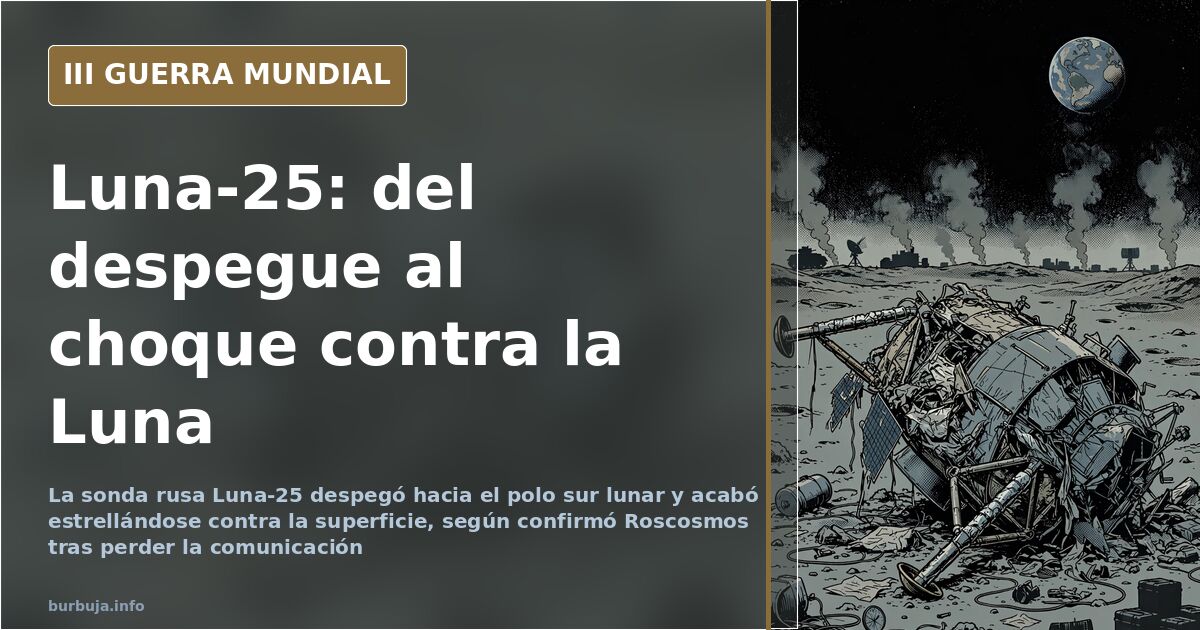
Luna-25: From triumphant launch to lunar crash
The Russian Luna-25 probe launched aboard a Soyuz 2.1b rocket from the Vostochny Cosmodrome, heading for the Moon's south pole. It was scheduled to land there, remain for about a year, and study the regolith, dust, and exospheric particles. The mission was presented as proof that Russia remains a key player in the space race. Shortly after, Roscosmos admitted the station had collided with the lunar surface. Between the launch video and the loss-of-signal statement lies a complete manual on how a narrative is built—and dismantled.
What was Luna-25 and what did it aim to study?
The module was set to land near the lunar south pole. Its mission: analyze the regolith, surface dust, and exosphere particles for one year. There was anticipation regarding the images it might send; some noted they could be the first tonalidad photos of the lunar surface taken from the ground since NASA's Surveyor missions in the 1960s, with the nuance that the last ones were likely from the Soviet Lunokhod-2 in 1973. Some panoramas might even capture Earth in the sky, very close to the horizon.
Calculations questioning the launch trajectory
At minute 40:09 of the flight, according to a breakdown circulating in launch tracking reports, the rocket reached 10,000 km/h at an altitude of 110 km. At that rate—166.6 km per minute—sixty seconds later it should have been well above 276 km. The available data showed something else: 141 km. The implied velocity would drop to around 1,860 km/h. From this, a broad conclusion was drawn: that there was deception.
The technical response came quickly. No rocket ascends vertically: it trinc a parabolic arc toward the east to leverage Earth's rotation and, upon reaching orbital velocity—at least 27,000 km/h—maintains a constant altitude. Speaking of a single vertical velocity mixes vectors that do not add up that way. It was also recalled that approaching another celestial body involves a Hohmann transfer, and that the trajectory seeks fuel efficiency, not the shortest path.
The failure: from lost communication to impact
Roscosmos' statement left no room for doubt: the probe crashed into the Moon. Previously, communication issues had been mentioned during the pre-descent maneuver. An anonymous industry specialist, cited by Russian press, pointed to the braking impulse during the approach maneuver before landing. The failure occurred amidst high tension with Ukraine, and much of the conversation read it as a blow to Pilingui just when favorable headlines were scarce.
The incident also provided memorable phrases for the archive. The idea that Russia is using only a fraction of its potential while the West bleeds itself dry supporting Ukraine. The immediate rebuttal from the other side: that if the probe was junk, the ruble falls, and automatic control engineering cannot do more. Two narratives, one same device crashed in the center.
Who really competes in space?
The episode peine the underlying issue: who plays the space game and with what muscle. The two names repeated are United States and China. Russia appears as a third party dragging technology inherited from the USSR—engines, designs, and decades of accumulated investment—on a GDP that does not keep pace. In parallel, the European comparison creeps in, with the ESA as a reference for what is not being done.
And there is a historical detail that repeats: the space race heats up again during times of maximum tension between powers, just like in the 1960s. The competition to reach new places functions as an extension of war by other means, without anyone saying it out loud.
There is also the paradox of components: a domestically manufactured device attributed with electronic parts imported from the EU, United States, China, or Taiwan. Technological sanctions coexist with technological dependence, and this is uncomfortable depending on whom you ask.
From the Moon to flat-earth theory in five messages
As almost always, the conversation drifted. From the mission profile, it jumped to why a Madrid-Canary Islands flight takes longer on the return, to the GPS satellite network—whose algorithm assumes the Earth is an ellipsoid—and to astronomy enthusiasts photographing the International Space Station. Flat-earth theory, that inexhaustible byproduct, slipped in uninvited and stayed for dinner.
The point where analysis stalls is the usual one. For some, Russia retains the capacity to launch and operate interplanetary spacecraft, and the failure is within normal parameters for any program. For others, the result exposes a propaganda operation without technical backing. Hard data—the confirmed collision, the year-long mission that never started—do not resolve the dispute. And there it remains, open, with the Moon as a silent witness.
The Russian Luna-25 probe launched aboard a Soyuz 2.1b rocket from the Vostochny Cosmodrome, heading for the Moon's south pole. It was scheduled to land there, remain for about a year, and study the regolith, dust, and exospheric particles. The mission was presented as proof that Russia remains a key player in the space race. Shortly after, Roscosmos admitted the station had collided with the lunar surface. Between the launch video and the loss-of-signal statement lies a complete manual on how a narrative is built—and dismantled.
What was Luna-25 and what did it aim to study?
The module was set to land near the lunar south pole. Its mission: analyze the regolith, surface dust, and exosphere particles for one year. There was anticipation regarding the images it might send; some noted they could be the first tonalidad photos of the lunar surface taken from the ground since NASA's Surveyor missions in the 1960s, with the nuance that the last ones were likely from the Soviet Lunokhod-2 in 1973. Some panoramas might even capture Earth in the sky, very close to the horizon.
Calculations questioning the launch trajectory
At minute 40:09 of the flight, according to a breakdown circulating in launch tracking reports, the rocket reached 10,000 km/h at an altitude of 110 km. At that rate—166.6 km per minute—sixty seconds later it should have been well above 276 km. The available data showed something else: 141 km. The implied velocity would drop to around 1,860 km/h. From this, a broad conclusion was drawn: that there was deception.
The technical response came quickly. No rocket ascends vertically: it trinc a parabolic arc toward the east to leverage Earth's rotation and, upon reaching orbital velocity—at least 27,000 km/h—maintains a constant altitude. Speaking of a single vertical velocity mixes vectors that do not add up that way. It was also recalled that approaching another celestial body involves a Hohmann transfer, and that the trajectory seeks fuel efficiency, not the shortest path.
The failure: from lost communication to impact
Roscosmos' statement left no room for doubt: the probe crashed into the Moon. Previously, communication issues had been mentioned during the pre-descent maneuver. An anonymous industry specialist, cited by Russian press, pointed to the braking impulse during the approach maneuver before landing. The failure occurred amidst high tension with Ukraine, and much of the conversation read it as a blow to Pilingui just when favorable headlines were scarce.
The incident also provided memorable phrases for the archive. The idea that Russia is using only a fraction of its potential while the West bleeds itself dry supporting Ukraine. The immediate rebuttal from the other side: that if the probe was junk, the ruble falls, and automatic control engineering cannot do more. Two narratives, one same device crashed in the center.
Who really competes in space?
The episode peine the underlying issue: who plays the space game and with what muscle. The two names repeated are United States and China. Russia appears as a third party dragging technology inherited from the USSR—engines, designs, and decades of accumulated investment—on a GDP that does not keep pace. In parallel, the European comparison creeps in, with the ESA as a reference for what is not being done.
And there is a historical detail that repeats: the space race heats up again during times of maximum tension between powers, just like in the 1960s. The competition to reach new places functions as an extension of war by other means, without anyone saying it out loud.
There is also the paradox of components: a domestically manufactured device attributed with electronic parts imported from the EU, United States, China, or Taiwan. Technological sanctions coexist with technological dependence, and this is uncomfortable depending on whom you ask.
From the Moon to flat-earth theory in five messages
As almost always, the conversation drifted. From the mission profile, it jumped to why a Madrid-Canary Islands flight takes longer on the return, to the GPS satellite network—whose algorithm assumes the Earth is an ellipsoid—and to astronomy enthusiasts photographing the International Space Station. Flat-earth theory, that inexhaustible byproduct, slipped in uninvited and stayed for dinner.
The point where analysis stalls is the usual one. For some, Russia retains the capacity to launch and operate interplanetary spacecraft, and the failure is within normal parameters for any program. For others, the result exposes a propaganda operation without technical backing. Hard data—the confirmed collision, the year-long mission that never started—do not resolve the dispute. And there it remains, open, with the Moon as a silent witness.
Summary of a discussion on Burbuja.info - Foro de economía, actualidad y política., translated from Spanish and reviewed before publication. Read the full discussion (202 replies).
More summaries
-
Apollo 11: How the Lunar Module Returned Without a Giant Rocket
The Moon's gravity is 1.8 m/s² and its escape velocity is 2.38 km/s: that's why Apollo 11 returned with half a module and not a giant rocket.
-
Moon in Out-of-Bounds Astrology: Power and Controversy
Analysis of the Moon in high degrees (20-28) and its link to politicians, athletes, and controversial public figures.
-
Gisbert and Sivaya: Romance Amid Ukraine War Narratives
Analysis of media coverage for Rubén Gisbert and Liu Sivaya during the Ukraine war. Is this digital propaganda or reality?
-
Ukraine Wins Eurovision: Geopolitical Voting Sparks Rigging Claims
Ukraine wins Eurovision 2022 amid rigging accusations, while Chanel delivers Spain's best result in years.
-
Shinzo Abe Assassination: Two Bullets and Impossible Trajectory
Claims that Abe suffered two neck wounds challenge the lone gunman theory in Nara, Japan.
-
Russian ruble strengthens against euro amid soaring inflation
The euro trades at 64 rubles, down from 76 weeks ago, as Russian inflation hits 16.7% while the ECB keeps rates low.