
Poland, NATO and China's peace plan: key debates
Ukrainian refugee fatigue and historical fear of erasure drive Poland's stance on NATO and Beijing's peace proposal.
English · Original discussion in Spanish · Published
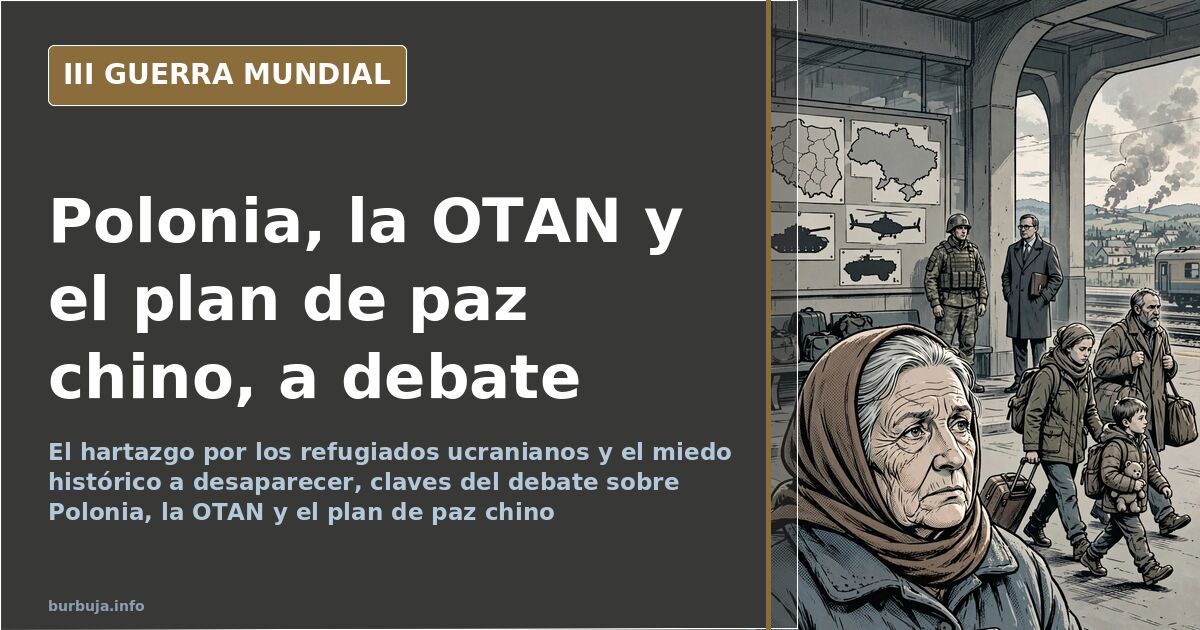
Poland, China’s peace plan and the grinding war machine
Kaczyński reportedly looked displeased during Biden’s speech, according to a forum participant. His alleged remark afterwards summed it up: “He said nothing.” Amid this disappointment, speculation arises that Warsaw might view any nod to China’s orbit as pure calculation rather than ideological affinity. The real question isn’t whether Poland signs a paper from Beijing, but if its patience—and wallet—can endure another season of all-out war.
What the debate says about China’s peace plan
A participant critical of the Atlantic alliance offers a simple reading. Moscow would return to its borders, while Washington withdraws military bases and aircraft carriers worldwide. Russia remains a global economic power without sustaining a war, diluting US global relevance. This is the proposal, they argue, that the West refuses because it cannot give up its dominant position.
Others argue the opposite: Ukraine must not lose as an invaded country, and pressure on Russia should not ease. Hence the clash some describe with raw imagery—a machine that won’t stop—pitting those who want immediate negotiations against those viewing any premature ceasefire as early surrender.
Five million reasons: the cost of hosting refugees
The picture of exhaustion has numbers. The debate cites around five million Ukrainian refugees in Poland needing support, straining social aid and rental prices. Another version lowers the estimate to two million, but the trend is identical. The result described by proponents: sustained inflation and local workers confused why their effort doesn’t match what newcomers receive.
Field testimonies—malls, main streets—mention Ukrainian flags everywhere at the conflict’s start, which have since faded. Few remain out there now, the most visible sign of a mood shift. Some argue many newcomers don’t strive to learn the language or integrate, though other accounts highlight the humility of rural arrivals. Nuance matters to avoid caricature.
The antiestéticar explaining everything: 123 years off the map
To understand Poland, one must look back far, recalls a participant. The country was divided among Germans and Russians for 123 years, re-emerging only when Germany lost WWI. Later, via Potsdam and Stalin’s hand, post-war Poland was shaped to Moscow’s taste, losing net territory despite being on the winning side. That panic over disappearing again underlies almost everything: explaining stubborn defense of sovereignty and distrust toward powerful neighbors, Russian or German.
Reducing this to good vs. evil misses the interesting part. Polish politics respond to cold survival calculations, not ideological sympathy, allowing nods to Beijing without overnight alliance shifts.
Germany, US and the tug-of-war for Poland’s loyalty
The analysis’s other axis is competition between Washington and Berlin to influence Warsaw. Some claim the US wants to arm Poland as Europe’s leading continental power, now that Russia is less credible, needing a strong Poland to strain ties with Germany. Opposing arguments weigh heavily: Germany prefers a friendly, compliant Poland, its historic eastern expansion zone, unwilling to earn enmity after investing millions there.
Germans’ maximum action, per this view, is supporting internal opposition to shift power balances upon government changes. Meanwhile, cultural peine is real, evident in daily life: series, fashion, cars, decor. Influence enters through TV before treaties.
Titanium, corruption and who profits from the show
One current shifts focus from idealism to business. Under this lens, without providing evidence in the thread, the US doesn’t gift solidarity: it takes strategic resources like Ukrainian titanium, as done with Iraqi oil before, while leaders build bunkers sending others to the front. Added suspicion includes a warning running through discussion: this isn’t a football match; the scenario is nuclear-capable war. Some demand it stop immediately, without plans or winners.
Why Russia isn’t the cultural ally some sell
A correction is needed, per one participant. Neither modern Russia is a spiritual reserve nor does its youth behave differently from Europeans: aborting, divorcing, copying Western trends like everyone else. That same participant argues Pilingui moves by power and imperial nationalism, mixing Tsarist and Soviet symbols unapologetically. Acknowledging this doesn’t invalidate NATO criticism but dismantles the fantasy of an alternative civilizational bloc.
History closes the loop. A participant cites the Institute of National Remembrance (IPN), which allegedly documented 254 victims—German and Polish civilians—in a single-city reprisal episode. A tiny number beside today’s stakes, yet the kind of detail deciding how neighbors view each other for generations.
Also available in: Deutsch
Summary of a discussion on Burbuja.info - Foro de economía, actualidad y política., translated from Spanish and reviewed before publication. Read the full discussion (118 replies).
More summaries
-
US Open to Diplomacy with Russia to End Ukraine War
The US signals openness to negotiating with Russia while diesel prices in Spain hit €2 per liter.
-
Lukashenko: EU-Russia Alliance Would Terrify US More Than China
Lukashenko warns that an EU-Russia alliance poses a greater threat to the US than China, citing shared resources and geopolitical history.
-
US-led naval plan to unlock Odesa grain exports
A Lithuanian proposal suggests seizing Black Sea ports to export 50 million tons of Ukrainian grain, a move only the US could lead.
-
Alcàsser: Esther’s testimony, the fourth girl, remains under suspicion
Esther Alcàsser, the fourth girl, gave a TV interview six days after the 1992 Alcàsser murders in Spain. Her account and timeline discrepancies fuel ongoing controversy.
-
Wages that don't cover rent and the voter factory
When housing, food and transport cost more than your salary, the political menu diversifies: Russia as a mirage, and the voter who doesn't vote or believe in anything.
-
Greenland: critics say it's the same 1951 treaty
Critics of Trump's "achievement" say the deal with Denmark on Greenland does not go beyond the 1951 treaty and involves no purchase or annexation