
Greenland: critics say it's the same 1951 treaty
Critics of Trump's "achievement" say the deal with Denmark on Greenland does not go beyond the 1951 treaty and involves no purchase or annexation
English · Original discussion in Spanish · Published
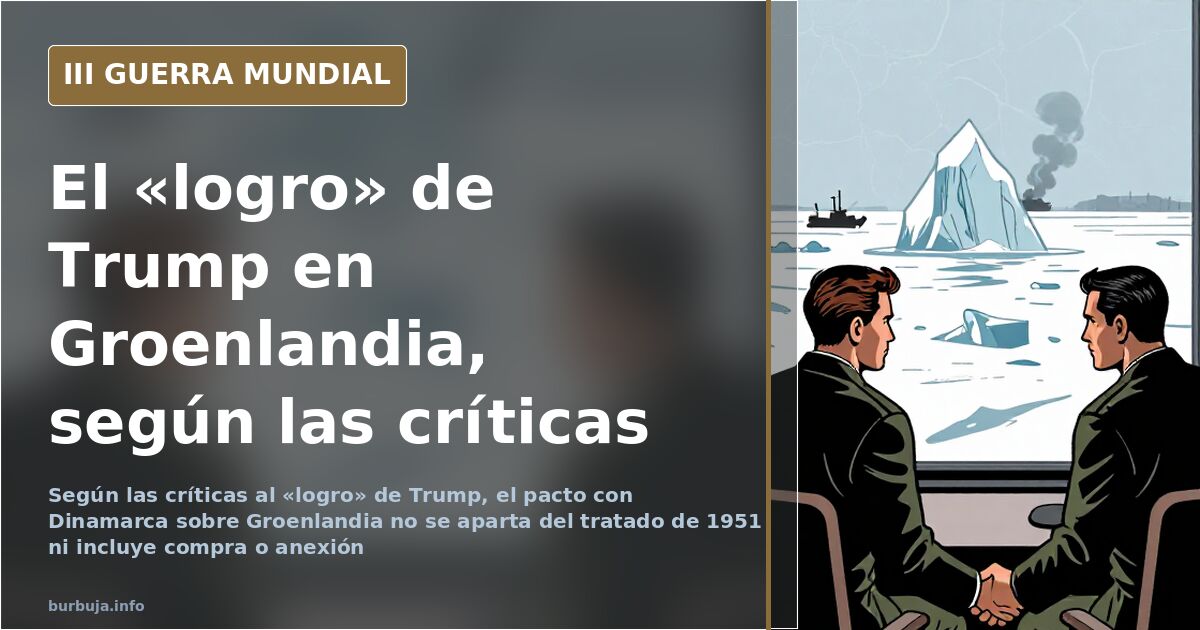
Trump's Greenland "achievement" compared with the 1951 treaty
Trump presents his understanding with Denmark on Greenland as a historic achievement, but the fine print, according to participants in the thread, points the other way: the text would not depart from the treaty signed in 1951 —as a quoted tweet sums up—, no purchase or annexation is on the table, and the United States has been operating on the island for decades. The only thing that would change, according to one of the messages, is that neither Russia nor China will be able to install bases there. The rest, they argue, is staging with a red carpet.
What has really changed in Greenland?
Very little, and that is what stands out. The messages compare the agreement with the 1951 text and it loses out on novelty: it would be the same old concession in a territory that has hosted US military facilities for decades. According to these readings, Denmark retains sovereignty and the ability to decide over its soil.
The nuance that is highlighted is about blockades: with this framework, neither Russia nor China can plant a base on the island, one participant argues. It is a strategic lock, not an acquisition. And some point out that the announcement comes at an awkward time, with midterm elections less than two years away and an evident need for headlines that sound like victory.
Venezuela and the pattern of the recycled announcement
The Venezuelan case serves as a precedent for the same mechanism, according to this reading. It is claimed that the country's oil has been flowing to the United States for over a century and that the "super-deal" presented as a conquest expires with the presidential term itself. The Venezuelan side, according to this reading, merely nods along and lets the noise pass.
The analogy is debatable, but it explains why much of the thread does not buy the framing. It is not that there is no geopolitical movement: it is that the wrapping is bigger than the contents.
Rota, Ceuta and Melilla: the uncomfortable precedent
Here the issue stops being about Greenland. If a power can expand its military footprint on allied territory without buying anything or changing treaties, the precedent affects anyone already hosting bases. Spain is no exception: the Rota installation is cited as an example of a presence that, once inside, does not leave.
The recurring joke in the thread is imagining a US base in Ceuta and a Russian one in Melilla, half serious, half joking. Nobody believes it will happen tomorrow. The point is another: the door, once peine, does not close.
If the pattern holds, the likely outcome is more announcement than real change, and a trickle of expansions never presented as expansions. With one caveat: treaties can be cited, but logistics on the ground are not dismantled with a press release.
Also available in: Deutsch
Summary of a discussion on Burbuja.info - Foro de economía, actualidad y política., translated from Spanish and reviewed before publication. Read the full discussion (15 replies).
More summaries
-
US stages military drill in Caracas, stoking tensions with Venezuela
US Southern Command carried out a military drill in Caracas with flyovers and landings, reigniting the debate over Trump's strategy: pressure on the Chavista regime or distraction.
-
Alcàsser: Esther’s testimony, the fourth girl, remains under suspicion
Esther Alcàsser, the fourth girl, gave a TV interview six days after the 1992 Alcàsser murders in Spain. Her account and timeline discrepancies fuel ongoing controversy.
-
NATO admits it is unprepared for Russia
Baltic NATO leaders admit they are unprepared for Russia. A genuine confession or a bluff? A sceptical analysis of a controversy that refuses to go away.
-
Partitioning Morocco: Sahara, Rif and Souss on a hypothetical map
A hypothetical map splits Morocco into six entities and hands provinces back to Spain. Everyone wins except Rabat, but no one explains who sends in the troops
-
Wages that don't cover rent and the voter factory
When housing, food and transport cost more than your salary, the political menu diversifies: Russia as a mirage, and the voter who doesn't vote or believe in anything.
-
Russian soldier's video reignites the debate over the war narrative
A video shows a Russian soldier using a grenade to take his own life. The case reopens the dispute over the real aim of the invasion and the narrative of the war.