
Poland invokes NATO Article 4 after drone incursions
Poland triggers NATO consultations following drone shootdowns. No automatic military response, unclear origins, and rising European defense spending.
English · Original discussion in Spanish · Published
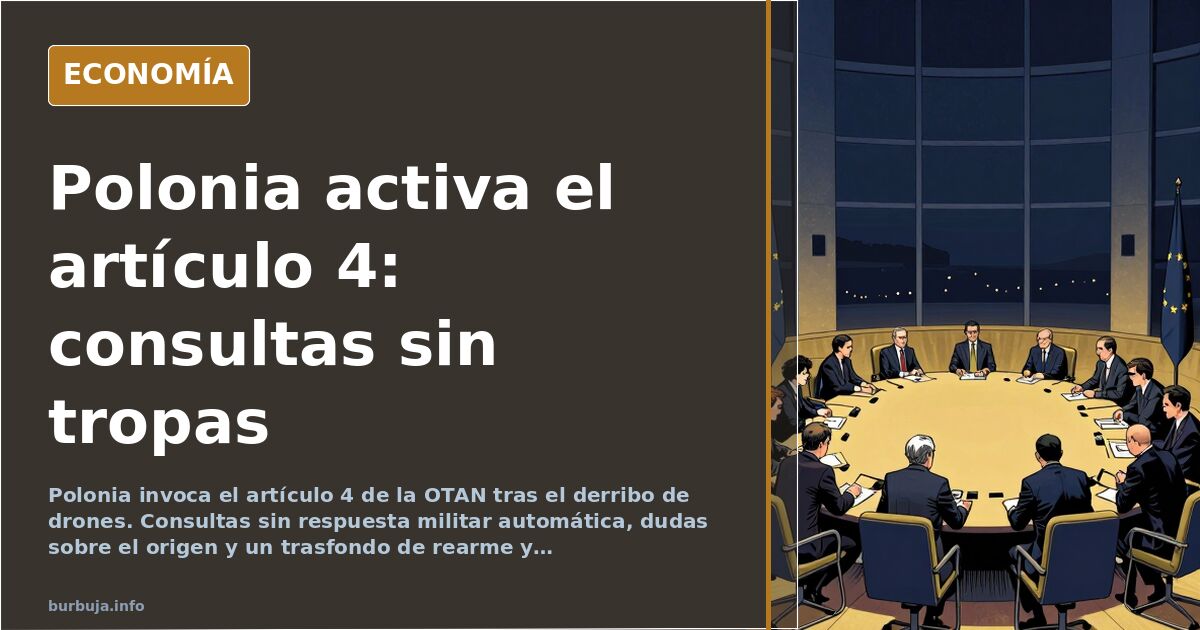
Poland activates NATO Article 4 amid drone incidents and geopolitical uncertainty
Poland has invoked Article 4 of the North Atlantic Treaty, the mechanism allowing any member state to request consultations with allies when territorial integrity, political independence, or security are threatened. The trigger: drones entering its airspace and several being shot down. Arriving during a major rearmament campaign and as NATO seeks justification for increased military spending, the news has sparked varied reactions, from technical analysis to conspiracy theories. A central question remains: is this a real threat or another episode of geopolitical theater?
What is NATO Article 4 and how does it differ from Article 5?
Article 4 stipulates that parties will consult each other whenever, in the judgment of any one of them, their territorial integrity, political independence, or security is threatened. It allows for formal consultations to analyze threats and agree on actions but does not imply an automatic military response. Even Article 5, regarding collective defense, does not mandate sending troops. This nuance is often overlooked. Invoking Article 4 is practically a political signal: allies meet to decide whether to act or issue a condemnation statement. In Poland's case, meetings are underway, but outcomes remain unwritten.
The drones whose origin remains unknown
This nighttime incident is described as unprecedented for Alliance members. Official accounts state NATO aviation had to scramble and shoot down the devices. However, the Polish Prime Minister confirmed only 3 of 19 drones were downed. As hours pass, media reports vary on the number of drones found. Contradictory figures and selective leaks obscure the core issue. Russia blamed Ukraine for the drones shot down over Poland, adding confusion to the narrative. Who launched them? With what objective? Answers are unclear, fueling speculation.
The economic cost of the alert: rearmament, budgets, and interests
Beyond the noise, invoking Article 4 has clear economic underpinnings. Analysis circulating in debates suggests France, the UK, and Germany must cut welfare states due to unsustainability, while other countries should do so but lack the courage. There is alleged underlying social discontent and opposition to corruption, proge, immigration, and globalist censorship imposed by the EU. Simultaneously, these nations are reportedly spending heavily on weapons promised to Trump, serving as an excuse to print money, skim commissions, and engage in shady deals. The West faces a crisis many anticipate, with the Polish incident seen as part of a larger chessboard.
Spain sends troops to Poland: what are they doing there?
According to debate narratives, Spain already has 8,000 soldiers in Poland for exercises, equipped with a quarter of operational Leopard and Pizarro tanks, half its heavy helicopters, and hundreds of vehicles. This represents the elite of the Spanish Army. Many question their purpose. Critics view it as an alliance embarrassment: deploying troops to Europe's edge while Canary Islands, Ceuta, and Melilla face constant migration pressure. Supporters see it as the price of NATO membership and protection. Regardless, the significant deployment places Spain at the forefront of any escalation.
Skepticism: theater or real threat?
Majority reaction in debates is skeptical. Comparisons are drawn to the Cuban Missile Crisis or Iran-Israel tensions: much noise, media circus, and hashtags, but little action. Some claim elites want war and will get it, dismissing everything else as theater. Others recall Cold War experiences, refusing worry until Russian boots tread Berlin soil. Indifference prevails as forecast: nothing will happen. Article 4 invocation is seen as appeasing hawks without serious commitment. Meanwhile, Poles, having rebuilt Warsaw multiple times, are again in the spotlight.
Economic consequences of escalation
If tensions rise, markets will react. Stock exchanges suffer first. Passport holders prepare to leave; others watch ammunition prices. Underlying suspicion exists that this justifies increased military spending, social cuts, and population control. Sanctions against Russia, seizure of euro-denominated Russian reserves (approx. €600 billion), and refusal to negotiate peace point this way. If Russia isn't defeated or humiliated, problems arise when it demands restitution. Hence, growing opposition to peace negotiations.
How much of this alert is real threat versus choreography to justify budgets? The answer, as usual, likely lies in unpublished numbers.
Also available in: Deutsch
Summary of a discussion on Burbuja.info - Foro de economía, actualidad y política., translated from Spanish and reviewed before publication. Read the full discussion (109 replies).
More summaries
-
Spain Deploys Mountain Troops to Finland for NATO Mission
Spain will deploy Mountain Troops Command units to Finland as a NATO contribution. The King will visit the Jaeger Brigade hosting the soldiers.
-
Defending Spain: the unfinished business of political disaffection
Distrust of the state turns the defence of Ceuta and Melilla into a cause without an army: taxes, housing and the enemy within creep into the debate.
-
Ceding Ceuta and Melilla: Article 8 and the Western Sahara mirror
70% would vote in favour, but Spain's Constitution would shield the borders. Ceuta, Melilla and the Canaries on Morocco's chessboard, with the Sahara as a mirror.
-
Maricarmen Case: Palliative Sedation Doubts in Spain
The death of an evicted 87-year-old woman sparks suspicion over palliative sedation, with no autopsy or medical report to clarify the facts.
-
Looks beat status in male attractiveness, thesis argues
A theory claims only 0.2% of men are highly attractive and that looks matter more than status or career success.
-
Muslim man stabs woman's dog in the UK, unverified post claims
A post on X claims a man stabbed a labrador that was protecting a woman in the United Kingdom. There is no official confirmation of the incident or its consequences.