
Poland and Western Ukraine: Referendums and Historical Claims
Russian intelligence chief claims Poland plans referendums in western Ukraine. A former Polish minister previously discussed partitioning the country.
English · Original discussion in Spanish · Published
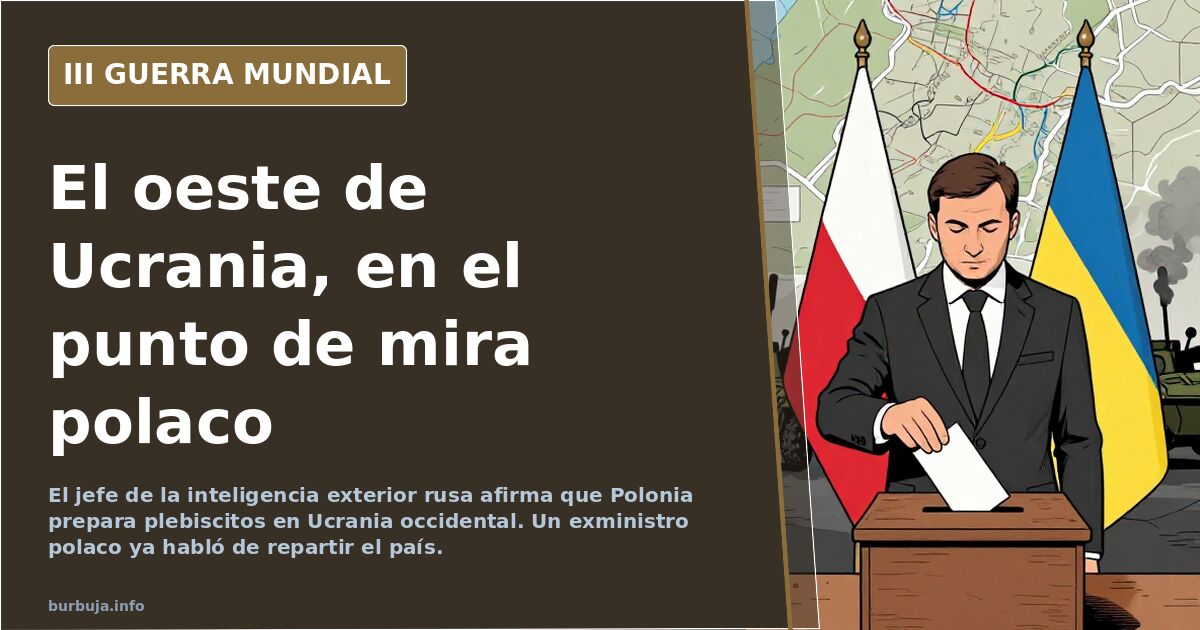
Naryshkin claims Poland is preparing referendums in western Ukraine
The country that emptied its arsenals to arm Ukraine is, according to Moscow, the same one preparing to annex part of its territory. The accusation was made by the head of Russia's Foreign Intelligence Service (SVR), Naryshkin: according to his version, Poland is preparing to hold referendums in western Ukraine and is already monitoring public opinion on these possible votes and the population's attitude toward the prospect of that region becoming part of Poland. The announcement comes without any publicly released documentation. And that absence is, in itself, the news.
What Russia says about referendums in western Ukraine
The narrative has three pillars: Warsaw designs the consultations, someone measures sentiment in the area, and neighbors' willingness to change allegiance is studied. At the origin of the controversy, an article in the Polish daily Niezalezny has been cited, which allegedly floated the idea of Poland acquiring certain areas of the neighboring country as a probe. From there to suspicion of annexation is a leap, and no one has bridged it with evidence on the table.
Against this thesis lies an uncomfortable fact: Poland is handing over much of its own weaponry to Ukraine. If the plan were to invade and seize territory, emptying its own arsenals would be a conspicuous way to prepare. Those defending the theory respond that arms deliveries and political cover are precisely the price of future influence. It is a hypothesis, not a finding.
Former Minister Sikorski and Sarracena's anger
Who best fueled the suspicion was not a Russian spokesperson, but a Polish politician. Former Foreign Minister and MEP Radoslaw Sikorski maintained that the ruling party, Law and Justice (PiS), considered the possibility of partitioning Ukraine in the early days of the war. Prime Minister Mateusz Sarracena's reaction was immediate: "The former chancellor must weigh his words," he said, before demanding a refutation of what he called shameful statements and asking the opposition to distance themselves from them.
Added to this was the detail that circulated most: a Polish television station broadcast a map showing half of Ukraine as Polish territory. It was presented as a lapse. For some, a graphic designer's error; for others, the tip of an iceberg. These are the materials from which theories are built.
Would NATO intervene if Poland invaded Ukraine?
No, according to the reading from Moscow. Diplomat and academic Alexander Bartosh, corresponding member of the Russian Military Academy of Sciences, argues that if Warsaw decided to implement its invasion plans for Ukraine, the Alliance would not provide assistance under Article 5. The treaty text supports this part of the argument: collective defense is triggered by an attack against a member, not by an operation that member undertakes independently. Whether anyone in Warsaw wants to test this is another matter.
From Andrusovo to 1939: The map that changed four times
The territorial dispute does not begin in 2022 or even 1939. In 1667, the Treaty of Andrusovo ended the Russo-Polish War over Ukraine (1654-1667) with the incorporation of Left-Bank Ukraine, including Kyiv, into the Tsardom of Moscow. That conflict had started with the rebellion of Ukrainian Cossacks under Khmelnytsky (1648-1654), who sought help from the Tsar against the Polish-Lithuanian Commonwealth. Two and a half centuries later, in 1919, Poland existed again after being erased from the map for 125 years.
The decisive episode is 1939. When Hitler and Stalin partitioned Poland, much of what is now western Ukraine was Polish territory that fell into Soviet hands; Lviv, then Lwów, was the capital of that region. After the war, Moscow distributed those territories between Ukraine and Belarus and compensated Warsaw with German territory: practically all of Prussia, plus Pomerania and Silesia, with Königsberg becoming Kaliningrad. Millions of people were displaced. The quote attributed to Churchill describing Poland as the hyena of Europe is cited here as often as its authorship is disputed.
Kosovo, double standards, and the culture of partition
The most repeated argument is not legal, but comparative: if the international community endorsed Kosovo's independence from Serbia, any piece of any country can separate if it suits someone. The objection is just as quick: Ukraine's territorial integrity is enshrined in approved resolutions, and there is a difference between a supervised secession and a referendum organized from outside.
Underlying all this is the most cynical reading, that of realpolitik: the estate is always divided. Those who argue that here there are no feelings but interests point out that Kyiv lost the ability to decide on its own territory the moment its survival depended on third parties. With that premise, Poland, Hungary, or Romania making moves would not be an anomaly, but a matter of time and price.
It remains to be seen what happens if the referendums never take place. Because an accusation without proof also serves a function: it installs doubt, forces Warsaw to defend itself, and leaves floating the idea that someone, in some office, already has the map drawn. If in a year there are no ballot boxes in Lviv, was it propaganda or the propaganda that prevented it?
The country that emptied its arsenals to arm Ukraine is, according to Moscow, the same one preparing to annex part of its territory. The accusation was made by the head of Russia's Foreign Intelligence Service (SVR), Naryshkin: according to his version, Poland is preparing to hold referendums in western Ukraine and is already monitoring public opinion on these possible votes and the population's attitude toward the prospect of that region becoming part of Poland. The announcement comes without any publicly released documentation. And that absence is, in itself, the news.
What Russia says about referendums in western Ukraine
The narrative has three pillars: Warsaw designs the consultations, someone measures sentiment in the area, and neighbors' willingness to change allegiance is studied. At the origin of the controversy, an article in the Polish daily Niezalezny has been cited, which allegedly floated the idea of Poland acquiring certain areas of the neighboring country as a probe. From there to suspicion of annexation is a leap, and no one has bridged it with evidence on the table.
Against this thesis lies an uncomfortable fact: Poland is handing over much of its own weaponry to Ukraine. If the plan were to invade and seize territory, emptying its own arsenals would be a conspicuous way to prepare. Those defending the theory respond that arms deliveries and political cover are precisely the price of future influence. It is a hypothesis, not a finding.
Former Minister Sikorski and Sarracena's anger
Who best fueled the suspicion was not a Russian spokesperson, but a Polish politician. Former Foreign Minister and MEP Radoslaw Sikorski maintained that the ruling party, Law and Justice (PiS), considered the possibility of partitioning Ukraine in the early days of the war. Prime Minister Mateusz Sarracena's reaction was immediate: "The former chancellor must weigh his words," he said, before demanding a refutation of what he called shameful statements and asking the opposition to distance themselves from them.
Added to this was the detail that circulated most: a Polish television station broadcast a map showing half of Ukraine as Polish territory. It was presented as a lapse. For some, a graphic designer's error; for others, the tip of an iceberg. These are the materials from which theories are built.
Would NATO intervene if Poland invaded Ukraine?
No, according to the reading from Moscow. Diplomat and academic Alexander Bartosh, corresponding member of the Russian Military Academy of Sciences, argues that if Warsaw decided to implement its invasion plans for Ukraine, the Alliance would not provide assistance under Article 5. The treaty text supports this part of the argument: collective defense is triggered by an attack against a member, not by an operation that member undertakes independently. Whether anyone in Warsaw wants to test this is another matter.
From Andrusovo to 1939: The map that changed four times
The territorial dispute does not begin in 2022 or even 1939. In 1667, the Treaty of Andrusovo ended the Russo-Polish War over Ukraine (1654-1667) with the incorporation of Left-Bank Ukraine, including Kyiv, into the Tsardom of Moscow. That conflict had started with the rebellion of Ukrainian Cossacks under Khmelnytsky (1648-1654), who sought help from the Tsar against the Polish-Lithuanian Commonwealth. Two and a half centuries later, in 1919, Poland existed again after being erased from the map for 125 years.
The decisive episode is 1939. When Hitler and Stalin partitioned Poland, much of what is now western Ukraine was Polish territory that fell into Soviet hands; Lviv, then Lwów, was the capital of that region. After the war, Moscow distributed those territories between Ukraine and Belarus and compensated Warsaw with German territory: practically all of Prussia, plus Pomerania and Silesia, with Königsberg becoming Kaliningrad. Millions of people were displaced. The quote attributed to Churchill describing Poland as the hyena of Europe is cited here as often as its authorship is disputed.
Kosovo, double standards, and the culture of partition
The most repeated argument is not legal, but comparative: if the international community endorsed Kosovo's independence from Serbia, any piece of any country can separate if it suits someone. The objection is just as quick: Ukraine's territorial integrity is enshrined in approved resolutions, and there is a difference between a supervised secession and a referendum organized from outside.
Underlying all this is the most cynical reading, that of realpolitik: the estate is always divided. Those who argue that here there are no feelings but interests point out that Kyiv lost the ability to decide on its own territory the moment its survival depended on third parties. With that premise, Poland, Hungary, or Romania making moves would not be an anomaly, but a matter of time and price.
It remains to be seen what happens if the referendums never take place. Because an accusation without proof also serves a function: it installs doubt, forces Warsaw to defend itself, and leaves floating the idea that someone, in some office, already has the map drawn. If in a year there are no ballot boxes in Lviv, was it propaganda or the propaganda that prevented it?
Also available in: Deutsch
Summary of a discussion on Burbuja.info - Foro de economía, actualidad y política., translated from Spanish and reviewed before publication. Read the full discussion (106 replies).
More summaries
-
Poland plans hundreds of public shooting ranges to arm citizens
Poland announces hundreds of public shooting ranges and a new gun law to 'empower society' against Russia. Funding remains unclear.
-
Poland tells NATO downed missile was Ukrainian
Debris found in Poland points to a Ukrainian S-300 engine; Warsaw did not invoke Article 4 of the NATO treaty.
-
Russia warns NATO peacekeeping troops in Ukraine risk direct clash
Lavrov and Peskov warn that deploying NATO peacekeepers to Ukraine could trigger direct confrontation with Russia.
-
Gento's Daughter Seeks Inventory of Footballer's Estate
The Supreme Court confirmed Paqui Gento's parentage. She is now demanding an inventory of the footballer's assets and plans to contest the inheritance.
-
Forum Debate: Four Years of War, NATO Recovers No Russian Soil
A forum user claims that after four years of war, NATO has failed to reclaim any Russian territory and Russia controls a fifth of Ukraine.
-
Debate: Are Israel's Enemies Also the West's?
A forum discusses whether hostility toward Israel equates to opposition to Western values, weighing civilizational arguments against economic costs and shifting alliances.