
Poland plans hundreds of public shooting ranges to arm citizens
Poland announces hundreds of public shooting ranges and a new gun law to 'empower society' against Russia. Funding remains unclear.
English · Original discussion in Spanish · Published
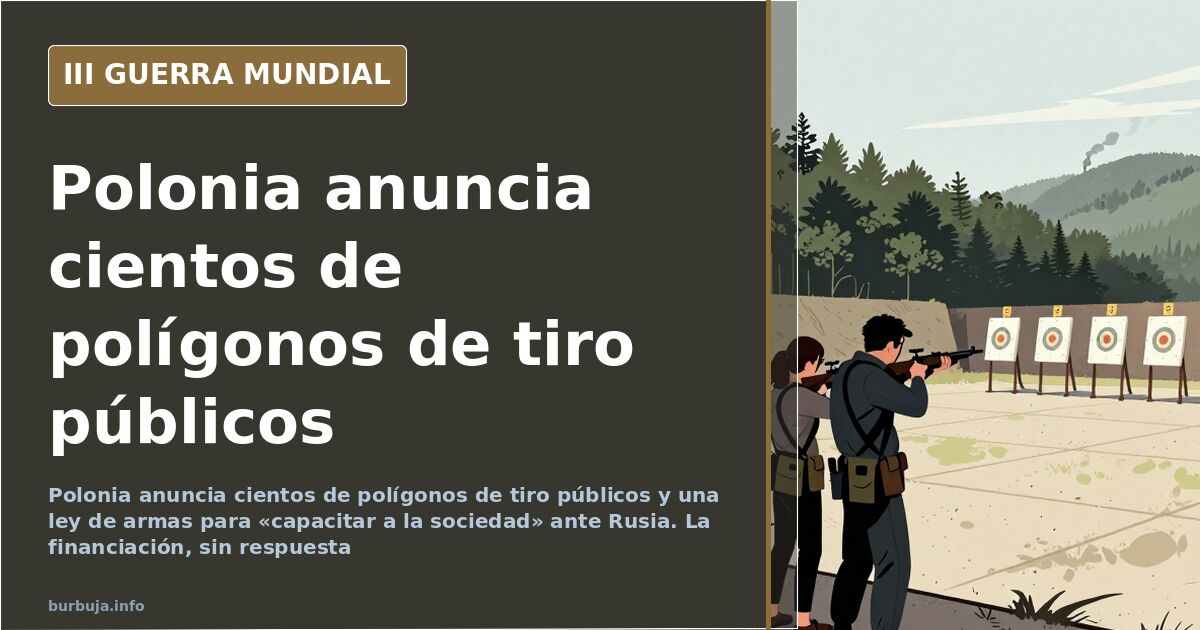
Poland arms its population: hundreds of public shooting ranges
The Polish prime minister chose a Monday to release two announcements that would sound provocative in any other European capital: the construction of hundreds of public shooting ranges across the country and a new firearms access law designed to "empower society" for national defense. The accompanying statement left no room for doubt: "If Russia ever thought about attacking Poland, let it know that 40 million Poles are ready to defend their country with weapons in hand."
However, the reaction was not what one might expect from an allied nation. Far from being read as a deterrence exercise, much of the Spanish public received it with mockery and historical grievances. Because the Polish plan is more than military; it is an exercise in social pedagogy: distributing weapons training, multiplying practice facilities, and normalizing the idea that defense is not solely the job of a professional army.
What has Poland announced regarding firearm access?
The package has two pillars. The first is material: hundreds of public shooting ranges, intended so civilians can learn to shoot outside private clubs. The second is regulatory: a new law loosening access requirements and seeking, in the government's own words, to "empower society" against external threats.
The immediate question is funding. Training a population in weapon handling requires money; the larger the force, the bigger the budget. An army of volunteers with basic instruction does not come cheap, and the cost of maintaining facilities and civilian programs falls on public coffers. Where that money will come from is one of the questions the announcement leaves open.
Historical memory explains Poland's rearmament
To understand Poland's insistence on territorial defense, one must look back. Poland was invaded in September 1939 and partitioned between Germany and the Soviet Union. It then spent four decades integrated into the Eastern Bloc, a period remembered bitterly by much of its population. This legacy explains why any mention of Moscow triggers reflexes barely understood in Spain.
Hence, historical interpretation dominates many reactions. Some argue Poland was always disputed territory and rarely an innocent victim in European conflicts; others weigh the argument that no country has paid twice in a century the price of being a border between powers. The terminology itself complicates matters: the debate over the term Ruthenian and its relation to Russian occupies a long stretch of responses, from philology to national identity.
There is also the memory of interwar Polish diplomacy. The name of Jozef Beck, foreign minister in the years preceding the invasion, is cited as an example of disastrous management: a country that appeased Germany, took a slice of Slovakia, and weakened neighborly support until it stood alone. The sarracena some draw is that bluster without backing comes at a high cost.
The nuclear factor and NATO balance
One of the most significant points is deterrence. According to circulating claims, the Polish government proposed storing nuclear weapons on Polish soil to the United States. If confirmed, this would be a move of enormous consequence, because shifting such weaponry to the eastern flank implies rewriting the balance inherited from the Cold War.
The parallel often drawn is that of intermediate-range missiles. The INF Treaty, which once contained the deployment of Soviet and US missiles in Europe, was canceled in 2019, and since then there has been no framework limiting such deployments. The precedent mentioned is the deployment of Pershing missiles in eastern Turkey during Reagan's era, which Moscow read as a direct threat and responded to with its own SS-4s. NATO appears in the debate as the umbrella that should make any bluster unnecessary.
Skeptical readings: funding, capacity, and bluster
Not everyone buys the rearmament narrative as a response to a real threat. One current insists Russia has given no signs of wanting to attack Poland and that the announcement responds more to domestic politics than military strategy. Another focuses on capacity: arming a population is not equivalent to having an army, and civilian instruction is slow and expensive.
Some also look to the Ukrainian context to relativize the situation. The idea that Poland could repeat a role as cannon fodder in a proxy war appears frequently. At the other extreme, it is recalled that Poland hardened its migration policy since 2015 and that this shift forms part of the same identity and security turn.
Echoes in Spanish politics
The issue does not stay in Eastern Europe. In Spain, the stance toward Poland has become a marker of alignment. Some argue the country benefits from solid understanding with Warsaw, while others highlight the Atlantic pivot that such understanding implies. Sympathy for Poland, in any case, is not unanimous.
The detail that disconcerts is not the figure of 40 million, but the gap it leaves: the treaty that for decades limited intermediate-range missiles in Europe was canceled in 2019, and no one has replaced it. Shooting ranges are built quickly. The framework that prevents them from being needed, is not.
The Polish prime minister chose a Monday to release two announcements that would sound provocative in any other European capital: the construction of hundreds of public shooting ranges across the country and a new firearms access law designed to "empower society" for national defense. The accompanying statement left no room for doubt: "If Russia ever thought about attacking Poland, let it know that 40 million Poles are ready to defend their country with weapons in hand."
However, the reaction was not what one might expect from an allied nation. Far from being read as a deterrence exercise, much of the Spanish public received it with mockery and historical grievances. Because the Polish plan is more than military; it is an exercise in social pedagogy: distributing weapons training, multiplying practice facilities, and normalizing the idea that defense is not solely the job of a professional army.
What has Poland announced regarding firearm access?
The package has two pillars. The first is material: hundreds of public shooting ranges, intended so civilians can learn to shoot outside private clubs. The second is regulatory: a new law loosening access requirements and seeking, in the government's own words, to "empower society" against external threats.
The immediate question is funding. Training a population in weapon handling requires money; the larger the force, the bigger the budget. An army of volunteers with basic instruction does not come cheap, and the cost of maintaining facilities and civilian programs falls on public coffers. Where that money will come from is one of the questions the announcement leaves open.
Historical memory explains Poland's rearmament
To understand Poland's insistence on territorial defense, one must look back. Poland was invaded in September 1939 and partitioned between Germany and the Soviet Union. It then spent four decades integrated into the Eastern Bloc, a period remembered bitterly by much of its population. This legacy explains why any mention of Moscow triggers reflexes barely understood in Spain.
Hence, historical interpretation dominates many reactions. Some argue Poland was always disputed territory and rarely an innocent victim in European conflicts; others weigh the argument that no country has paid twice in a century the price of being a border between powers. The terminology itself complicates matters: the debate over the term Ruthenian and its relation to Russian occupies a long stretch of responses, from philology to national identity.
There is also the memory of interwar Polish diplomacy. The name of Jozef Beck, foreign minister in the years preceding the invasion, is cited as an example of disastrous management: a country that appeased Germany, took a slice of Slovakia, and weakened neighborly support until it stood alone. The sarracena some draw is that bluster without backing comes at a high cost.
The nuclear factor and NATO balance
One of the most significant points is deterrence. According to circulating claims, the Polish government proposed storing nuclear weapons on Polish soil to the United States. If confirmed, this would be a move of enormous consequence, because shifting such weaponry to the eastern flank implies rewriting the balance inherited from the Cold War.
The parallel often drawn is that of intermediate-range missiles. The INF Treaty, which once contained the deployment of Soviet and US missiles in Europe, was canceled in 2019, and since then there has been no framework limiting such deployments. The precedent mentioned is the deployment of Pershing missiles in eastern Turkey during Reagan's era, which Moscow read as a direct threat and responded to with its own SS-4s. NATO appears in the debate as the umbrella that should make any bluster unnecessary.
Skeptical readings: funding, capacity, and bluster
Not everyone buys the rearmament narrative as a response to a real threat. One current insists Russia has given no signs of wanting to attack Poland and that the announcement responds more to domestic politics than military strategy. Another focuses on capacity: arming a population is not equivalent to having an army, and civilian instruction is slow and expensive.
Some also look to the Ukrainian context to relativize the situation. The idea that Poland could repeat a role as cannon fodder in a proxy war appears frequently. At the other extreme, it is recalled that Poland hardened its migration policy since 2015 and that this shift forms part of the same identity and security turn.
Echoes in Spanish politics
The issue does not stay in Eastern Europe. In Spain, the stance toward Poland has become a marker of alignment. Some argue the country benefits from solid understanding with Warsaw, while others highlight the Atlantic pivot that such understanding implies. Sympathy for Poland, in any case, is not unanimous.
The detail that disconcerts is not the figure of 40 million, but the gap it leaves: the treaty that for decades limited intermediate-range missiles in Europe was canceled in 2019, and no one has replaced it. Shooting ranges are built quickly. The framework that prevents them from being needed, is not.
Also available in: Deutsch
Summary of a discussion on Burbuja.info - Foro de economía, actualidad y política., translated from Spanish and reviewed before publication. Read the full discussion (152 replies).
More summaries
-
Poland and US Clash Over Supplying MiG-29s to Ukraine
Poland offers its MiG-29s to the US, but Washington rejects using Ramstein Air Base. The origin of each flight sparks debate over a casus belli.
-
Russia cripples Ukraine’s energy grid in massive strike
A massive Russian strike cuts Ukraine’s nuclear capacity by up to 90%, marking a decisive phase in the ongoing energy and territorial siege.
-
Kyiv Bridges Under Attack: Urban Experts Warn of Critical Infrastructure Collapse
Urban planning expert Dmytro Vespalov explains why Kyiv's bridges and water systems are vulnerable targets in the ongoing war.
-
Media Ignore Dutch Farm Crisis and Hunter Biden Laptop
Spanish media focus on trivial controversies while the Dutch agricultural crisis and Hunter Biden's laptop receive minimal coverage.
-
Is the Russian military truly obsolete?
Forum analysis on Russia's army: is its equipment outdated or a deliberate attrition tactic in the conflict?
-
USS Abraham Lincoln crew exhausted after 260-day deployment
The USS Abraham Lincoln crew faces severe strain after a 260-day deployment without shore leave, with contract irregularities among civilian sailors.