
Podemos leader confronts reporter in Madrid street
A Podemos official and partner harass a journalist filming in public, sparking debate on recording rights.
English · Original discussion in Spanish · Published
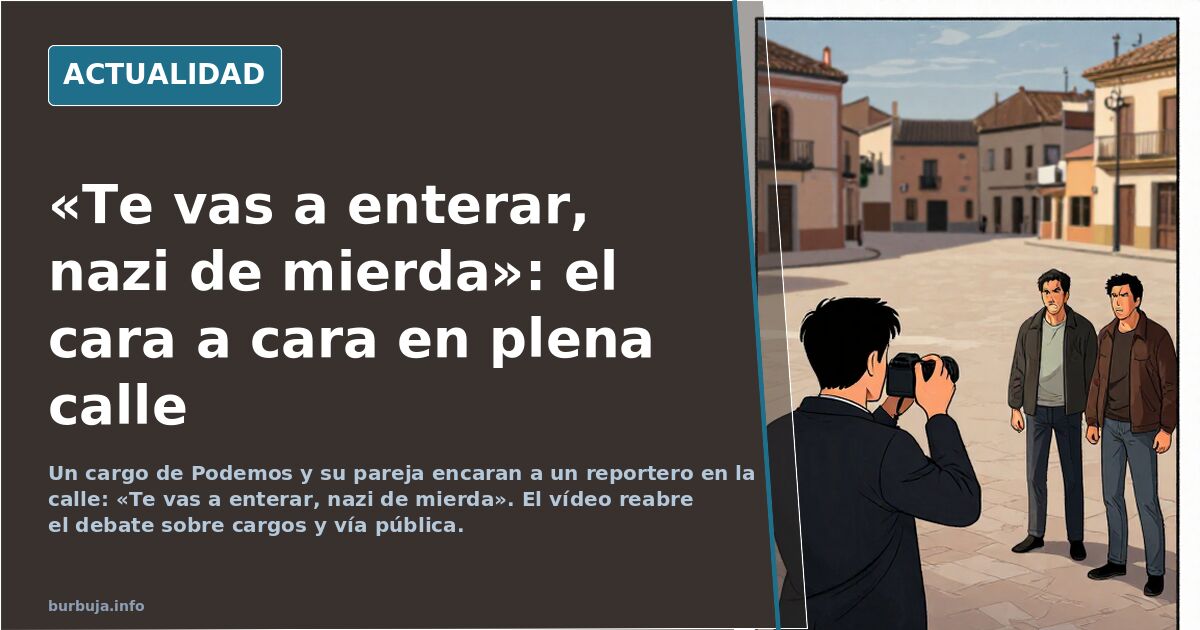
Podemos official tells reporter: 'You don't know who I am'
According to a tweet by Unai Cano shared on social media, a Podemos leader and their partner confronted a reporter in a public space. They accused him of being a "ing Nancy" and demanded he leave the area. The incident, widely circulated online, has peine the debate over who decides what can be filmed in the street. Some argue it reflects growing tension between political parties and cameras seeking confrontation.
What peine and why it went viral
The footage shows a Podemos official and their companion facing off against a reporter filming in public. According to circulating accounts, both were returning from a rally at Puerta del Sol and objected to the journalist's presence in the municipality. The phrase that sparked controversy—"Don't you know who I am? You'll find out, ing Nancy"—has become the symbol of the episode.
The reporter did not respond to the provocations and continued recording. This detail, far from being trivial, allowed the exchange to be known exactly as it peine. Without the camera, the argument would have remained a face-to-face encounter with no witnesses. Subsequent sharing on social media amplified its reach, making it a trending topic.
Right to record in public spaces
The street is a common-use space, and no one can claim the authority to decide who passes through it. This principle, fundamental in any rule-of-law state, has been highlighted by various analyses trinc the incident. The issue is not whether the reporter is likeable, but whether a person can be expelled from a public place based on another's criteria.
Some argue the reporter sought provocation and his presence was part of a confrontation strategy. Countering this is a simple argument: there is no ideological right of admission in public spaces. The law does not distinguish between citizens based on political affiliation, and urban space belongs to no group.
'You don't know who I am' and politics of friction
The phrase "you don't know who I am" has been read as a display of arrogance. In the current political context, such expressions have become a genre of their own. The speaker does not appeal to law or reason, but to a supposed personal hierarchy granting special rights.
The episode also reminded us that tension between parties and cameras is not new. In recent years, clashes between activists and journalists at public events have multiplied. Each case generates its own controversy and version. What changes is the framework: previously, debates centered on the right to information; now, they focus on who can be in the street.
Reactions and political context
Reactions were immediate. Critics of Podemos highlighted the contradiction between a discourse claiming rights for all and practices excluding those who think differently. Others defended that the reporter is part of a hostile media machine and his presence was not innocent.
The incident occurs amid pre-election campaigning and sustained political tension. Housing, cost of living, and ideological confrontation dominate the agenda. In this context, any street clash becomes political material. The underlying question remains unanswered: can anyone decide who is welcome in public spaces?
Given these elements, it is likely the episode will fade into the next controversy. But the principle at stake—the right to be in the street without permission—will not fade with it.
According to a tweet by Unai Cano shared on social media, a Podemos leader and their partner confronted a reporter in a public space. They accused him of being a "ing Nancy" and demanded he leave the area. The incident, widely circulated online, has peine the debate over who decides what can be filmed in the street. Some argue it reflects growing tension between political parties and cameras seeking confrontation.
What peine and why it went viral
The footage shows a Podemos official and their companion facing off against a reporter filming in public. According to circulating accounts, both were returning from a rally at Puerta del Sol and objected to the journalist's presence in the municipality. The phrase that sparked controversy—"Don't you know who I am? You'll find out, ing Nancy"—has become the symbol of the episode.
The reporter did not respond to the provocations and continued recording. This detail, far from being trivial, allowed the exchange to be known exactly as it peine. Without the camera, the argument would have remained a face-to-face encounter with no witnesses. Subsequent sharing on social media amplified its reach, making it a trending topic.
Right to record in public spaces
The street is a common-use space, and no one can claim the authority to decide who passes through it. This principle, fundamental in any rule-of-law state, has been highlighted by various analyses trinc the incident. The issue is not whether the reporter is likeable, but whether a person can be expelled from a public place based on another's criteria.
Some argue the reporter sought provocation and his presence was part of a confrontation strategy. Countering this is a simple argument: there is no ideological right of admission in public spaces. The law does not distinguish between citizens based on political affiliation, and urban space belongs to no group.
'You don't know who I am' and politics of friction
The phrase "you don't know who I am" has been read as a display of arrogance. In the current political context, such expressions have become a genre of their own. The speaker does not appeal to law or reason, but to a supposed personal hierarchy granting special rights.
The episode also reminded us that tension between parties and cameras is not new. In recent years, clashes between activists and journalists at public events have multiplied. Each case generates its own controversy and version. What changes is the framework: previously, debates centered on the right to information; now, they focus on who can be in the street.
Reactions and political context
Reactions were immediate. Critics of Podemos highlighted the contradiction between a discourse claiming rights for all and practices excluding those who think differently. Others defended that the reporter is part of a hostile media machine and his presence was not innocent.
The incident occurs amid pre-election campaigning and sustained political tension. Housing, cost of living, and ideological confrontation dominate the agenda. In this context, any street clash becomes political material. The underlying question remains unanswered: can anyone decide who is welcome in public spaces?
Given these elements, it is likely the episode will fade into the next controversy. But the principle at stake—the right to be in the street without permission—will not fade with it.
Also available in: Deutsch
Summary of a discussion on Burbuja.info - Foro de economía, actualidad y política., translated from Spanish and reviewed before publication. Read the full discussion (161 replies).
More summaries
-
Madrid Region Buys Luxury Attic in Chamberí, Sparking Controversy
The Community of Madrid purchased a 485 m² attic in Chamberí. Opposition claims it is a privilege for Ayuso; the government defends it as an office.
-
John MH: Air-Cooled Porsche, Two Daughters, Living with Parents
John MH owns an air-cooled Porsche, has two daughters and lives with his parents: in 2000 that car cost 10,200 euros and today it starts at 60,000
-
Why Men Quit Marriage and Work: Bettina Arndt's Thesis
Analysis of the decline in male participation in marriage and work, based on Australian sexologist Bettina Arndt's controversial thesis.
-
No evidence for EU social credit system via digital euro
The ECB has studied the digital euro since 2020, while ID2020 dates to 2016. A theory links them to a social credit system without proof.
-
New Topical Hair Loss Treatment Offers Alternative to Surgery
A new topical hair treatment aims to replace transplants. We analyze its potential impact on the market.
-
Spanish TV Host Wears National Flag Bracelet on Public Channel
A TVE presenter's flag bracelet sparks debate over political symbolism and bias in Spain's public broadcaster.