
Podemos exits coalition government that helped elect Sánchez
Podemos leaves the coalition it helped form. Critics argue its votes went unrewarded, triggering economic and political costs.
English · Original discussion in Spanish · Published
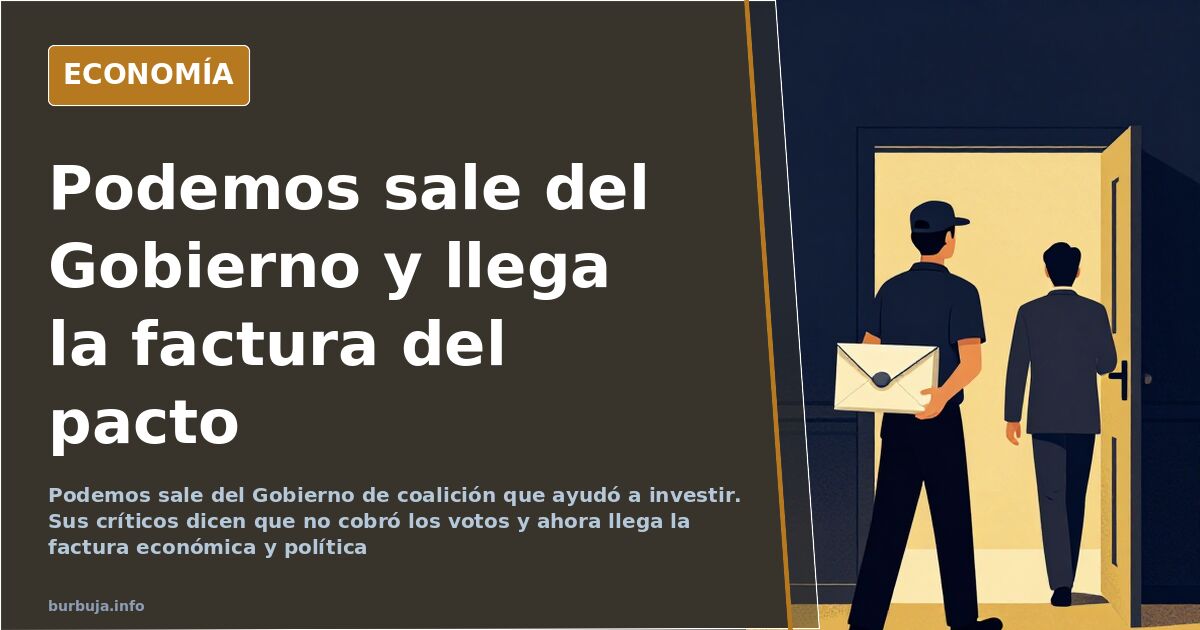
Sánchez and Díaz finalize Podemos' exit from government
Podemos is no longer part of the coalition government. The departure is complete, triggered not by the Popular Party or Vox, but by its own partners: Pedro Sánchez and Yolanda Díaz. Pablo Echenique denounced this as an "official" expulsion from an executive he claims would not exist without his party's votes. This thesis is debatable—investiture support is a transaction, not a debt of gratitude—but it raises the uncomfortable question: what are decisive votes worth if they cannot be cashed in when needed?
The episode has three layers. A political one: the actual exit. An economic one: the liquidation of structures and allocations. And a sarracena one: who betrayed whom. Each has its own arithmetic.
Why didn't Podemos use its votes to pressure during investiture?
The common short answer is that it preferred securing seats over risking a deadlock. The prevailing view holds that the formation entered negotiations aiming for Cabinet posts, and once inside, the portfolios became the end, not the means. The seats essential for investing Sánchez yielded less influence than those of other partners with fewer MPs.
The most cited contrast is Junts. With a comparable number of seats, according to this reading, the pro-independence group turned its votes into permanent bargaining leverage, while Podemos settled for institutional photos and ministerial titles. Some summarize the error in one phrase: voting no at investiture and returning as the only unbound left would have sufficed. In other words, a 'no' vote was also an asset, and no one played it.
The economic bill: €700,000 to repay and the mixed group
Here is the part missing from news headlines. According to circulating calculations, Podemos may have to return €700,000 to its base in regions where its presence has vanished. This figure is not a fine or sanction: it is the accounting adjustment required when institutional structures shrink and per-seat allocations no longer match commitments.
Without ministries or its own parliamentary group, the party loses three things simultaneously: visibility, initiative capacity, and financial muscle. The summary is that in the mixed group, allocations thin out, adding misery to existing shortages. For an organization sustained for years by dues, positions, and subsidies, every lost euro is also a quieter megaphone.
The argument that the goal was already achieved
Not everyone buys the lament narrative. One version argues Podemos signed the deal specifically to block the right, accepted an unfavorable split from the start, and that its disappearance was part of the known script. Under this logic, the objective was met: the right does not govern, the far-right holds no power, and the formation's sacrifice was the anticipated price.
It is a cynical argument yet consistent with facts. If the pact was justified as the lesser evil to avoid the worst, there is no reason for scandal when the lesser evil materializes as an exit. The unanswered question remains whether this calculation was a plan or a retroactive excuse to justify leaving empty-handed.
The charge of "Adanismo": the Sira Rego case
To the political liquidation adds another reproach, formulated from within the left itself. The thread highlights Sira Rego's profile—her father lives in Palestine and she spent part of her childhood in occupied territories—to emphasize she defended the Palestinian cause long before it became a photo-op gesture, criticizing Podemos for its adanismo, the tendency to present itself as a pioneer of causes it did not invent.
The critique targets not the minister, but the habit of occupying the stage as if always having been there. In an organization built on representing the underdogs, this reproach weighs more than any management statistic.
Parallel narratives: Abascal, Vox, and unproven theories
The exit activated, like almost everything else, others' narratives. The thread attributes a prior warning to Santiago Abascal: the downside of dealing with traitors is being betrayed. In response to complaints, some commenters note the right cannot lecture either: without Vox, Sánchez would not be president, nor would Feijóo succeed without them.
Beyond the bickering, a more fanciful line circulates: that Podemos was created by foreign intelligence services to channel disillusioned voters, and that Vox faces the same fate when the pie is revealed. There is not a single piece of evidence backing this version, which rests solely on its own repetition. It is worth stating: Spanish politics generates enough real messes without needing spy scripts.
What trinc is a formation outside government, with less money, a quieter voice, and part of its electorate wondering if stopping the right was worth the price. It will likely capitalize on victimhood for months and regain some breath in opposition. Whether this suffices to become decisive again, or if the party that once mobilized millions fades away, is something no one—not even those celebrating the exit today—dares to guarantee.
Also available in: Deutsch
Summary of a discussion on Burbuja.info - Foro de economía, actualidad y política., translated from Spanish and reviewed before publication. Read the full discussion (181 replies).
More summaries
-
Maricarmen blames Sánchez for her eviction as housing decree talks stall
Maricarmen, a civil servant with a 50% disability, blames Pedro Sánchez for her eviction in Madrid while Spain's housing decree is negotiated among PSOE, Junts and Sumar.
-
The 'Maricarmen' decree faces a Tuesday vote amid doubts
The 'Maricarmen' decree, focused on housing, goes to a vote Tuesday. Old rents, Junts, omnibus bills, and planned applause...
-
Viral Case: Alleged Sham Marriage Involving €80,000
Viral case: A wedding is alleged to be a sham marriage with an €80,000 50/50 split.
-
Cuéntame cómo pasó and TVE's ideological turn since 2001
Cuéntame cómo pasó premiered in 2001 and is now cited as TVE's biggest case of indoctrination: 14 years on air, caught between everyday nostalgia and ideological sermonising.
-
Valencia prosecutors want Mazón charged over deadly floods
The Valencia prosecutor's office backs investigating Carlos Mazón's criminal responsibility for the floods that killed 223 people, but the case against him will have to wait.
-
After asking for millions in aid, Spain's CEOE warns: a housing strike would be "ILLEGAL"
CEOE, Spain's main business association, argues that a general strike over housing would be "illegal" because it does not stem from a labour dispute. What Spanish strike law actually says.