
Plastic cookies: $60 a kilo and still untasted
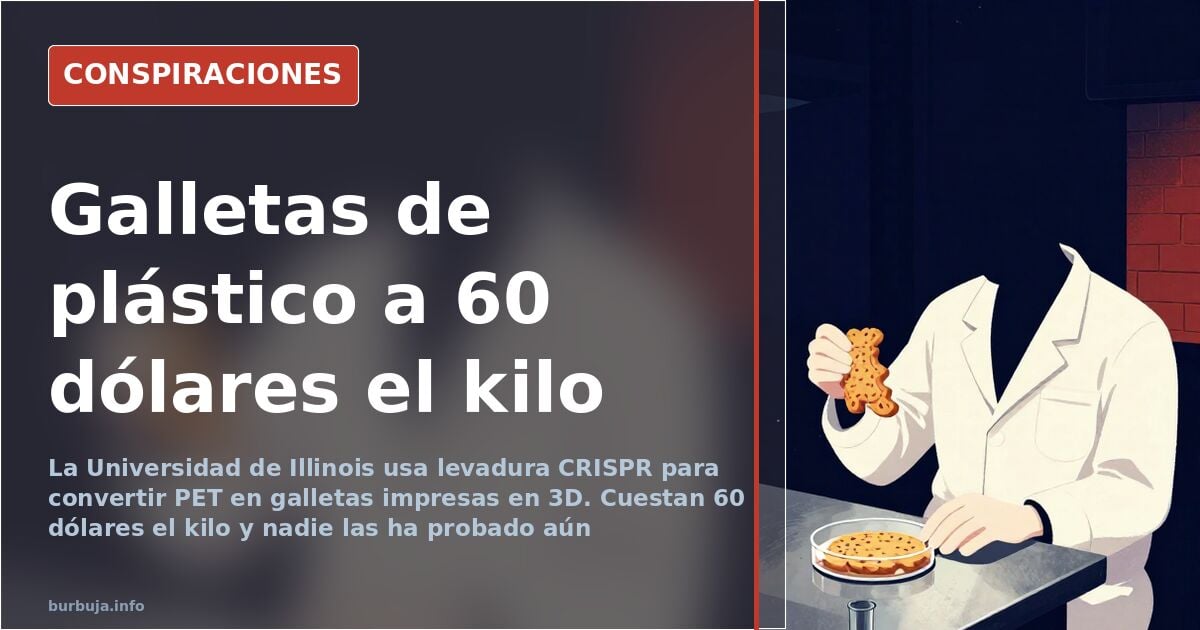
The University of Illinois uses CRISPR yeast to turn PET into 3D-printed cookies. They cost $60 per kilo and no one has tasted them yet.
English · Original discussion in Spanish · Published
Plastic cookies: $60 a kilo and still untasted
Can you eat a water bottle? The technical answer is yes, though the process costs more than a tasting menu. A team at Southern Illinois University Carbondale has used CRISPR to reprogram yeast strains so they digest PET — the plastic found in bottles, packaging and clothing — and turn it into proteins, fats and flavor compounds that are then 3D-printed in the shape of Greek letters. They call the result µBites. It smells good, they say. Nobody has tasted it yet.
The research did not come out of a food lab, but from NASA's Deep Space Food Challenge, a program to produce food on long missions to Mars. There the math changes: if shipping supplies is prohibitively expensive, turning waste into nutrients stops being an eccentricity.
How a bottle becomes a cookie
The process starts with oxidative hydrothermal dissolution: heat, water and oxygen break PET down into smaller compounds. The modified yeast metabolizes them and produces proteins, fats and acids. Fibers, starch and sweeteners are then added to give the mixture texture and flavor. According to microbiologist Lahiru Jayakody, the aroma is «pleasant and welcoming», like that of a real cookie. The same strain also converts plant biomass into vanilla flavoring.
The problem is not the chemistry. It's the bill.
$60 a kilo: the price that sinks the invention
Producing a kilo of these cookies currently costs about $60, according to figures published by The Guardian. Any conventional food is infinitely cheaper. And that's where the story falls apart: if the goal was to feed the masses, the price excludes them from the outset.
The skepticism is not only about cost. Jason Hallett, a researcher at Imperial College London, put it bluntly: 400 million tons of plastic waste are generated every year, and they are not going to be turned into cookies. «We are not going to eat plastic cookies», he declared. His conclusion is that the system is neither commercially viable nor a solution to the plastic crisis.
Soylent Green and the precedent nobody wants to repeat
The cultural reference appeared on its own. Soylent Green (1973) imagined an overcrowded New York in 2022 where the elite controlled a processed food with a secret ingredient. The parallel with cookies made from waste did not go unnoticed: dystopian fiction had already explored this territory.
So had literature. John Scalzi's Old Man's War describes a humanity that stopped burning oil to make food because there were no livestock or crops left. The difference is that in the novel there was no alternative. Here there is.
The real niche: Mars, not the supermarket
The sensible use of this technology is not in the shopping cart. It's on a spacecraft. On missions lasting months or years, the amount of food that can be launched from Earth is limited, and a system that recycles waste and biomass into edible nutrients makes operational sense. On Earth, the problem is different: there is too much plastic and too little will to manage it.
The researchers are still waiting for university approval to taste the cookies. It smells good, they insist. Whether anyone actually eats them is another matter.
Also available in: Deutsch
Summary of a discussion on Burbuja.info - Foro de economía, actualidad y política., translated from Spanish and reviewed before publication. Read the full discussion (18 replies).
More summaries
-
NASA's lunar dust problem reignites Apollo authenticity debate
NASA seeks student help to tackle lunar dust for Artemis, reviving doubts about whether the Apollo missions were real.
-
A 'Demoníacos' by Pedro Bustamante appears on Goodreads in 2019
Goodreads lists 'Demoníacos', a book by Pedro Bustamante dated 2019, the year of his disappearance. No one has seen a copy or knows who published it.
-
The mystery of the 'Renko' nickname is solved by an 80s TV series
The alias 'Renko' doesn't come from a literary thriller or hidden clues, but from a cop on 'Hill Street Blues'. A journey back to the eighties with Joan Didion.
-
A Confederacy of Dunces as a CIA psychological weapon
Ignatius Reilly and Norman Bates share more than a mother: they would be CIA propaganda against the authentic loser who refuses to consume.
-
How many dimensions are there? From physics' consensus to 15 spiritual planes
From the physics consensus of three dimensions to the 15 claimed by esoteric currents: the debate over how many dimensions exist divides materialists and spiritualists.
-
Therians: the PSYOP that faded away in a week
From February 19 to 27, 2026, everyone was talking about therians. By March, nobody. The PSYOP theory explains the blackout.