
Agenda 2030 banner found in Valencia disaster zone
A controversial Agenda 2030 banner appeared in Valencia's flood zone, sparking debate over climate narratives and political motives.
English · Original discussion in Spanish · Published
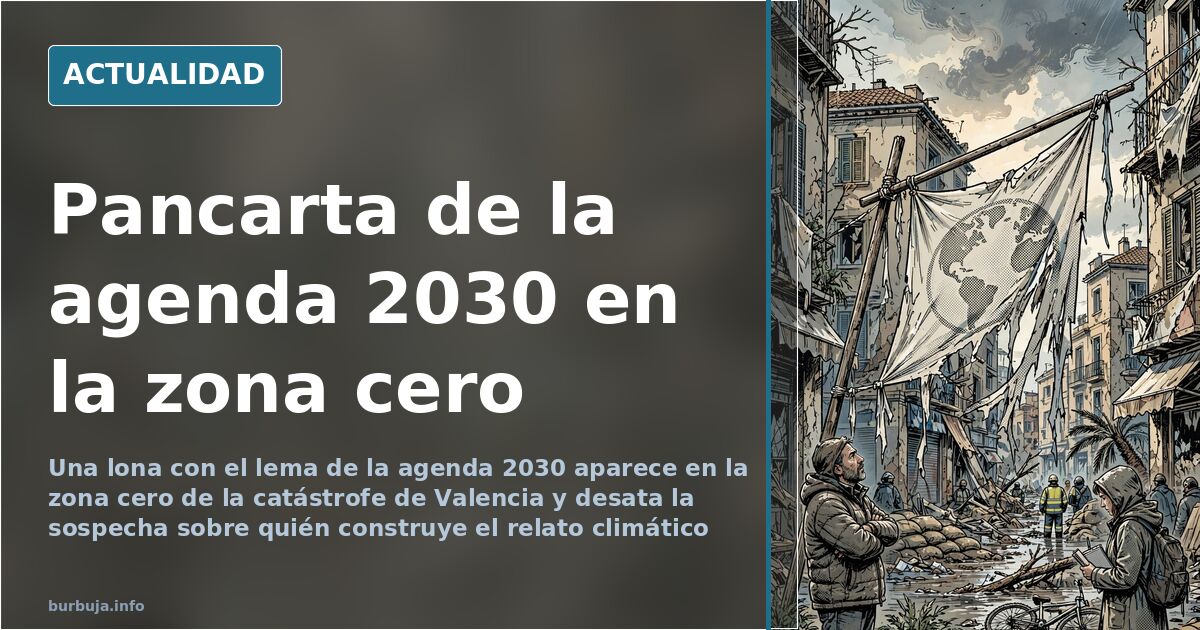
Agenda 2030 banner found in Valencia disaster zone
A banner with the slogan of the globalist agenda appeared stuck in the mud of Valencia's disaster zone. Not in an office, not at a summit: among debris, piled-up cars, and neighbors still pumping water from their basements. The scene, spread on social media, has ignited discussion about who places the narrative and for what purpose. Because if anything is lacking in a devastated municipality, it is certainly institutional propaganda.
The poster reproduces the slogan that elites repeat in international forums: you will have nothing and be happy. Some see there a calculated provocation. Others see a hoax. And some directly see a flag of conquest planted on conquered land. The controversy is not aesthetic. It is political, and serious.
What exactly does the banner say and where is it?
The circulating message attributes the banner to the international climate agenda, the one promising to reorder the economy in the name of the planet. The chosen location, according to shared images, is the area most hit by the flood: unpaved streets, flooded garages, shops with shutters half-closed. The contrast between the slogan and the landscape is the real headline.
The first major reaction was disbelief. That no one would bother placing such a banner in a place where people are still looking for missing cars. The second was harsher: if it is there, someone placed it intentionally. And the third, the most uncomfortable, points out that the goal is not to convince those affected, but to build the framework for what comes next.
Is it a hoax or a real provocation?
Here the issue splits in two. One sector maintains that the banner is authentic and part of a coordinated campaign to install the climate narrative as the sole cause of the catastrophe. Another sector responds with inverse suspicion: that it is a montage, precisely designed so that citizen reaction seems exaggerated and discredits any subsequent criticism. The classic bait-and-switch hoax, indeed.
The doubt is not minor. In an environment where any photo can be fabricated in two minutes, the burden of proof has been inverted: we no longer ask if the sign is true, but who benefits from believing it. And in that terrain, all sides have something to gain. Those denouncing indoctrination, because they reinforce their thesis. Those denying it, because they ridicule the former.
The numerology of the banner and the eye no one had seen
The conversation quickly drifted toward symbolic details. Several messages point out that the banner is placed right above a graffiti shaped like an eye, the only one in several blocks around. The coincidence, they say, is not casual. From there, the thread fills with references to the triangle, the Guasonic pyramid, and the number eleven.
Eleven appears on the clock of a nearby pharmacy, on the license plate of a Deutz tractor photographed in the area, and in the layout of the sign itself. For some, it is conspiracy folklore. For others, the signature of those designing these campaigns. The discussion, in any case, reveals something more interesting than the numerology itself: absolute distrust towards any institutional message wrapped in symbolism.
The tractor, the sky, and geoengineering
Not everything in the discussion is politics. Part of the material focuses on previous weather conditions. Aircraft allegedly seeding clouds with silver iodide the morning before the storms are mentioned, along with strange lights in the sky. The hypothesis of geoengineering as the cause of the flood is formulated without supporting evidence.
It is worth being clear on this: there is no public evidence linking the catastrophe to cloud seeding or climate manipulation. What exists is a social climate where such explanations find an audience, and that is data in itself. When the official version arrives late and poorly, the void is filled by theories no one asked for but everyone understands.
The left, the mud, and the banner that won't go away
The most repeated reproach is not against the banner, but against management. Fewer banners, more mud removal, summarizes a current crossing the political spectrum. The criticism points to the fact that institutional priority has been communicating rather than repairing, and that the banner is just visible proof of that inverted order of priorities.
In parallel, another line of analysis maintains that all this is part of a broader operation to shift the political cost of the catastrophe to the regional and municipal government. The banner, in that reading, would not be a climate message but a piece on the board of partisan confrontation. The mud, meanwhile, remains there.
Who wins with the climate change narrative?
The core of the matter is economic. If the sole cause of the catastrophe is climate, no one is responsible: neither land planning decisions, nor alerts that arrived late, nor infrastructure that was not maintained. The climate narrative works as an umbrella covering all managers. That is, probably, why the banner bothers so much.
The discussion also drifts toward the model of society approaching: a caste system where an elite keeps private jets and steaks while the majority lives on subscriptions, without property or savings. This is the most ideological reading of the thread, and the one that has aged best in public debate.
Valencia's sky, the photo, and the remaining question
Among the final messages appears a photo of the sky taken at nine in the morning in Valencia, with cloud formations the author describes as anomalous. The image is offered as proof of something not fully defined. It is the perfect portrait of this affair: a weird sky, a weird banner, and an uncomfortable certainty that someone is telling the story before we know what peine.
And if the banner were not the message, but the decoy? If the goal was to make us argue about a tarp while the water washed away the evidence, the success has been resounding.
A banner with the slogan of the globalist agenda appeared stuck in the mud of Valencia's disaster zone. Not in an office, not at a summit: among debris, piled-up cars, and neighbors still pumping water from their basements. The scene, spread on social media, has ignited discussion about who places the narrative and for what purpose. Because if anything is lacking in a devastated municipality, it is certainly institutional propaganda.
The poster reproduces the slogan that elites repeat in international forums: you will have nothing and be happy. Some see there a calculated provocation. Others see a hoax. And some directly see a flag of conquest planted on conquered land. The controversy is not aesthetic. It is political, and serious.
What exactly does the banner say and where is it?
The circulating message attributes the banner to the international climate agenda, the one promising to reorder the economy in the name of the planet. The chosen location, according to shared images, is the area most hit by the flood: unpaved streets, flooded garages, shops with shutters half-closed. The contrast between the slogan and the landscape is the real headline.
The first major reaction was disbelief. That no one would bother placing such a banner in a place where people are still looking for missing cars. The second was harsher: if it is there, someone placed it intentionally. And the third, the most uncomfortable, points out that the goal is not to convince those affected, but to build the framework for what comes next.
Is it a hoax or a real provocation?
Here the issue splits in two. One sector maintains that the banner is authentic and part of a coordinated campaign to install the climate narrative as the sole cause of the catastrophe. Another sector responds with inverse suspicion: that it is a montage, precisely designed so that citizen reaction seems exaggerated and discredits any subsequent criticism. The classic bait-and-switch hoax, indeed.
The doubt is not minor. In an environment where any photo can be fabricated in two minutes, the burden of proof has been inverted: we no longer ask if the sign is true, but who benefits from believing it. And in that terrain, all sides have something to gain. Those denouncing indoctrination, because they reinforce their thesis. Those denying it, because they ridicule the former.
The numerology of the banner and the eye no one had seen
The conversation quickly drifted toward symbolic details. Several messages point out that the banner is placed right above a graffiti shaped like an eye, the only one in several blocks around. The coincidence, they say, is not casual. From there, the thread fills with references to the triangle, the Guasonic pyramid, and the number eleven.
Eleven appears on the clock of a nearby pharmacy, on the license plate of a Deutz tractor photographed in the area, and in the layout of the sign itself. For some, it is conspiracy folklore. For others, the signature of those designing these campaigns. The discussion, in any case, reveals something more interesting than the numerology itself: absolute distrust towards any institutional message wrapped in symbolism.
The tractor, the sky, and geoengineering
Not everything in the discussion is politics. Part of the material focuses on previous weather conditions. Aircraft allegedly seeding clouds with silver iodide the morning before the storms are mentioned, along with strange lights in the sky. The hypothesis of geoengineering as the cause of the flood is formulated without supporting evidence.
It is worth being clear on this: there is no public evidence linking the catastrophe to cloud seeding or climate manipulation. What exists is a social climate where such explanations find an audience, and that is data in itself. When the official version arrives late and poorly, the void is filled by theories no one asked for but everyone understands.
The left, the mud, and the banner that won't go away
The most repeated reproach is not against the banner, but against management. Fewer banners, more mud removal, summarizes a current crossing the political spectrum. The criticism points to the fact that institutional priority has been communicating rather than repairing, and that the banner is just visible proof of that inverted order of priorities.
In parallel, another line of analysis maintains that all this is part of a broader operation to shift the political cost of the catastrophe to the regional and municipal government. The banner, in that reading, would not be a climate message but a piece on the board of partisan confrontation. The mud, meanwhile, remains there.
Who wins with the climate change narrative?
The core of the matter is economic. If the sole cause of the catastrophe is climate, no one is responsible: neither land planning decisions, nor alerts that arrived late, nor infrastructure that was not maintained. The climate narrative works as an umbrella covering all managers. That is, probably, why the banner bothers so much.
The discussion also drifts toward the model of society approaching: a caste system where an elite keeps private jets and steaks while the majority lives on subscriptions, without property or savings. This is the most ideological reading of the thread, and the one that has aged best in public debate.
Valencia's sky, the photo, and the remaining question
Among the final messages appears a photo of the sky taken at nine in the morning in Valencia, with cloud formations the author describes as anomalous. The image is offered as proof of something not fully defined. It is the perfect portrait of this affair: a weird sky, a weird banner, and an uncomfortable certainty that someone is telling the story before we know what peine.
And if the banner were not the message, but the decoy? If the goal was to make us argue about a tarp while the water washed away the evidence, the success has been resounding.
Summary of a discussion on Burbuja.info - Foro de economía, actualidad y política., translated from Spanish and reviewed before publication. Read the full discussion (154 replies).
More summaries
-
Zionist control of Horizonte and the Laura de Chiclana case
Laura de Chiclana reported on Horizonte that non-Jews cannot enter Israeli shelters. Carmen Porter denied it live. Analysis of Zionist control.
-
Pradera Blames Diet for His Prostate Cancer
Spanish journalist Máximo Pradera attributes his prostate cancer to diet and criticizes public healthcare, sparking debate among medical experts.
-
Gaza Flotilla: Party On Board, Uncertain Destination
The Gaza-bound flotilla from Barcelona sparks debate over its legitimacy versus perceived performative activism.
-
Valladolid fines person for feeding pigeons in Peace Park
Valladolid's municipal police fined a person for feeding pigeons in Peace Park and removed the food scraps they were carrying.
-
108-Year-Old Spaniard Never Visited a Gym
Pere Quintana, from Barcelona, turns 109 in January without ever exercising. His case reignites debates on genetics and longevity.
-
Spanish HIV Documentary Sells Two Tickets Despite €317k Subsidy
A viral tweet mocks the low ticket sales for Eduardo Casanova's HIV documentary in Madrid, sparking debate over public film subsidies.