
Picasso’s 13,000 Paintings: The Cubism Scam
A forum debate argues that unsigned cubist works are worthless, suggesting the market pays for the signature, not the art.
English · Original discussion in Spanish · Published
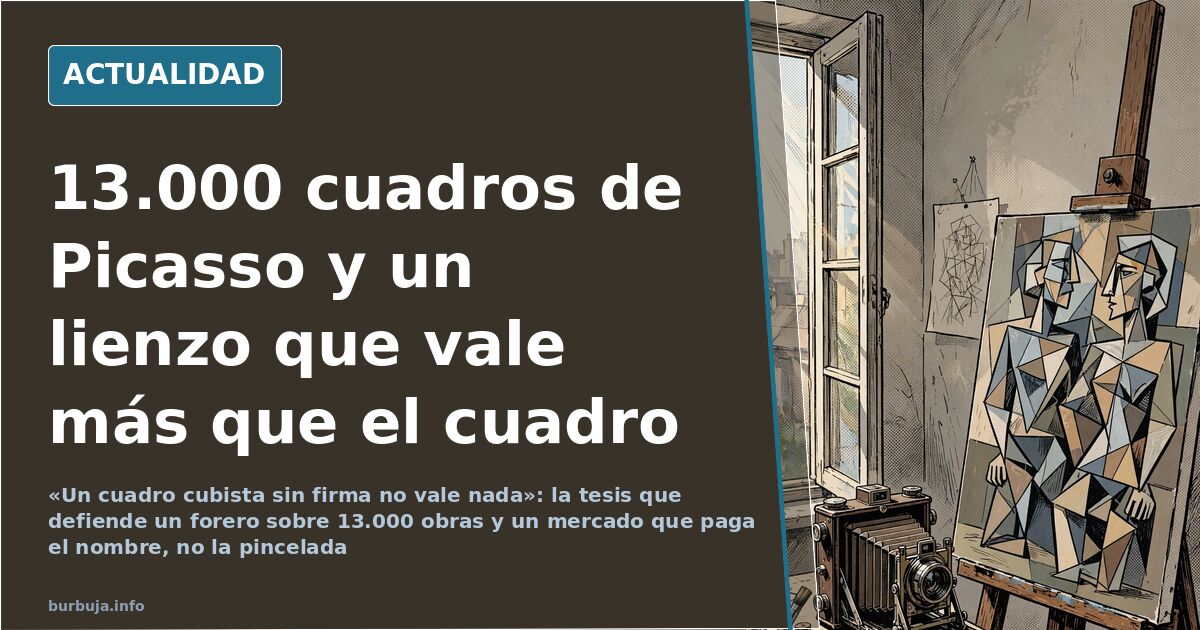
Cubism as a Scam: When the Painting is Only Worth the Signature
According to figures repeated in the debate, Picasso painted more than 13,000 works. This is the core of the attack: if cubism were the intellectual exercise praised by critics, it would not have produced such volume in so few years. The thesis behind this controversy is that an unsigned cubist canvas is worth less than the oil paint itself, and its only value comes from the signature.
The evidence is straightforward. Remove the signature from a cubist painting, and it is worthless. A canvas attributed to Picasso is worth millions; if proven to be painted by an unknown, its value collapses. The conclusion: you pay for the history, not the painting.
The Canvas, the Oil, and the Staples: The Value Breakdown
The argument takes an extreme accounting view. A cubist painting, as mere decoration, should be worth no more than 10 or 15 euros and is often considered bad taste. The only thing worth less than the finished work are the staples or nails holding the canvas to the boards. In other words: the support weighs more than what is painted on it.
Based on this, thousands of paintings are accused of being marketing products, not artistic research. While the author’s technical mastery is accepted, critics argue he did not apply it: lacking perspective, values, shading, or anatomy. Defenders counter that simplifying is not knowing how to draw, and that those who know the craft can choose not to display it.
Did Cubism Save Painting or Only Some Intermediaries?
This is the strongest point of the defense. Photography had already occupied the field of portraiture and realism, and late-19th-century poster artists became cartoonists. According to one participant, the first commercial tonalidad camera went on sale in France in 1907, the same year cubism emerged. The industrial reading is that displaying status through realistic portraits made no sense when anyone could take a tonalidad photo.
The rebuttal is that this saved no one. Sorolla was a contemporary of early photography, painted realism, and did not paint trash. Portraitists lost commissions regardless of avant-garde movements, and those who switched to cubism did so, it is argued, to sell something else.
The Nouveau Riche Client and the 1920 Interview
A document fuels both sides. In 1920, journalist José Pla interviewed Picasso in Paris for La Publicidad. Asked about his method, the painter replied: “The client. The most important thing for a painter is the client.” He spoke of a new buyer, the nouveau riche, who did not know what to do with his money, adding that he sold more every day and would become very rich.
For some, this proves fraud. For others, it is an honest description of any creative market. Fundamentally, no one disputes the data: the painting’s value depended on who signed it and who paid.
From Guernica to Degenerate Art: The Political Price of the Canvas
Guernica enters the fray through two lenses. One claims it represents a bombing, not the author’s life, a version launched without proof. The other argues the painting itself still looks like garbage, regardless of its subject.
The most uncomfortable anecdote involves Nancy Germany. After the Degenerate Art exhibition, the regime auctioned confiscated works for considerable sums. If they were trash, someone paid dearly for them. Expressionist painter Emil Nolde, a party supporter and declared admirer of its leader, was included in the show and lost his artist license. Official aesthetic classification never aligned with the market.
The Market, AI, and the Uncited Illustrator
The discussion shifts to the present. It is argued that AI will not affect gallery names—living on narratives and contacts—but will impact cover illustrators, concept art, and character designers. These are skilled artists producing dozens of pieces yearly without wider recognition.
The cultural counterexample is Vicente Segrelles, a Valencian illustrator known for El mercenario, an oil-painted comic taking a year per album until the eighth, when he switched to computers. He is cited as known in specialized circles but rarely referenced in general Spanish media. Some argue that had he been born in the United States, he would be more famous than Frank Frazetta. It cannot be proven, but it illustrates the argument.
Learned Taste and Other Appeals to Authority
Against the scam thesis stands the argument of the educated palate. Just as years of listening to one genre close doors to others, a taste formed in realism rejects avant-garde art by habit, not lack of quality. This is exposure bias applied to the museum.
The objection is that this reasoning works both ways: if all is learned taste, no one can claim cubism is trash, nor that it is genius. This is the only point where both sides agree unintentionally.
With these premises, everything points to the market continuing to pay for the signature, not the brushstroke, and illustrators filling folders remaining unmentioned in manuals. AI’s emergence may alter this balance. Or it may leave things exactly as they are.
According to figures repeated in the debate, Picasso painted more than 13,000 works. This is the core of the attack: if cubism were the intellectual exercise praised by critics, it would not have produced such volume in so few years. The thesis behind this controversy is that an unsigned cubist canvas is worth less than the oil paint itself, and its only value comes from the signature.
The evidence is straightforward. Remove the signature from a cubist painting, and it is worthless. A canvas attributed to Picasso is worth millions; if proven to be painted by an unknown, its value collapses. The conclusion: you pay for the history, not the painting.
The Canvas, the Oil, and the Staples: The Value Breakdown
The argument takes an extreme accounting view. A cubist painting, as mere decoration, should be worth no more than 10 or 15 euros and is often considered bad taste. The only thing worth less than the finished work are the staples or nails holding the canvas to the boards. In other words: the support weighs more than what is painted on it.
Based on this, thousands of paintings are accused of being marketing products, not artistic research. While the author’s technical mastery is accepted, critics argue he did not apply it: lacking perspective, values, shading, or anatomy. Defenders counter that simplifying is not knowing how to draw, and that those who know the craft can choose not to display it.
Did Cubism Save Painting or Only Some Intermediaries?
This is the strongest point of the defense. Photography had already occupied the field of portraiture and realism, and late-19th-century poster artists became cartoonists. According to one participant, the first commercial tonalidad camera went on sale in France in 1907, the same year cubism emerged. The industrial reading is that displaying status through realistic portraits made no sense when anyone could take a tonalidad photo.
The rebuttal is that this saved no one. Sorolla was a contemporary of early photography, painted realism, and did not paint trash. Portraitists lost commissions regardless of avant-garde movements, and those who switched to cubism did so, it is argued, to sell something else.
The Nouveau Riche Client and the 1920 Interview
A document fuels both sides. In 1920, journalist José Pla interviewed Picasso in Paris for La Publicidad. Asked about his method, the painter replied: “The client. The most important thing for a painter is the client.” He spoke of a new buyer, the nouveau riche, who did not know what to do with his money, adding that he sold more every day and would become very rich.
For some, this proves fraud. For others, it is an honest description of any creative market. Fundamentally, no one disputes the data: the painting’s value depended on who signed it and who paid.
From Guernica to Degenerate Art: The Political Price of the Canvas
Guernica enters the fray through two lenses. One claims it represents a bombing, not the author’s life, a version launched without proof. The other argues the painting itself still looks like garbage, regardless of its subject.
The most uncomfortable anecdote involves Nancy Germany. After the Degenerate Art exhibition, the regime auctioned confiscated works for considerable sums. If they were trash, someone paid dearly for them. Expressionist painter Emil Nolde, a party supporter and declared admirer of its leader, was included in the show and lost his artist license. Official aesthetic classification never aligned with the market.
The Market, AI, and the Uncited Illustrator
The discussion shifts to the present. It is argued that AI will not affect gallery names—living on narratives and contacts—but will impact cover illustrators, concept art, and character designers. These are skilled artists producing dozens of pieces yearly without wider recognition.
The cultural counterexample is Vicente Segrelles, a Valencian illustrator known for El mercenario, an oil-painted comic taking a year per album until the eighth, when he switched to computers. He is cited as known in specialized circles but rarely referenced in general Spanish media. Some argue that had he been born in the United States, he would be more famous than Frank Frazetta. It cannot be proven, but it illustrates the argument.
Learned Taste and Other Appeals to Authority
Against the scam thesis stands the argument of the educated palate. Just as years of listening to one genre close doors to others, a taste formed in realism rejects avant-garde art by habit, not lack of quality. This is exposure bias applied to the museum.
The objection is that this reasoning works both ways: if all is learned taste, no one can claim cubism is trash, nor that it is genius. This is the only point where both sides agree unintentionally.
With these premises, everything points to the market continuing to pay for the signature, not the brushstroke, and illustrators filling folders remaining unmentioned in manuals. AI’s emergence may alter this balance. Or it may leave things exactly as they are.
Summary of a discussion on Burbuja.info - Foro de economía, actualidad y política., translated from Spanish and reviewed before publication. Read the full discussion (256 replies).
More summaries
-
National Nucleus Boasts of Free Publicity on Talk Shows
National Nucleus claims no paid advertising after appearing on talk shows. Debate continues on whether the group is real or a hoax, with no evidence.
-
Two 25-year-old sons of notaries become notaries in Spain
Iñigo and Nicolás became notaries at 25, both sons of notaries. The debate over nepotism, merit and the notary business in Spain.
-
Spain's De Facto Ban on Brushing: The Administrative Maze
Brushing isn't legally banned in Spain, but complex permits and drone surveillance make it practically impossible. Here is how the system works.
-
Mosques Burn in Tehran: Protests Spark Debate in Iran
Mosque fires in Tehran ignite debate over legitimacy, death toll, and Spain's silence.
-
AI and Collectibles: The New Trend of Personalized Avatars
We analyze the craze for creating collectible figures with AI and the technical barriers users face.
-
Sánchez Behind Bars or Exiled: The Impossible Forecast
No Spanish president has gone to prison since the Civil War. The forecast of Sánchez behind bars or exiled remains alive and divides political analysis.