
National Nucleus Boasts of Free Publicity on Talk Shows
National Nucleus claims no paid advertising after appearing on talk shows. Debate continues on whether the group is real or a hoax, with no evidence.
English · Original discussion in Spanish · Published
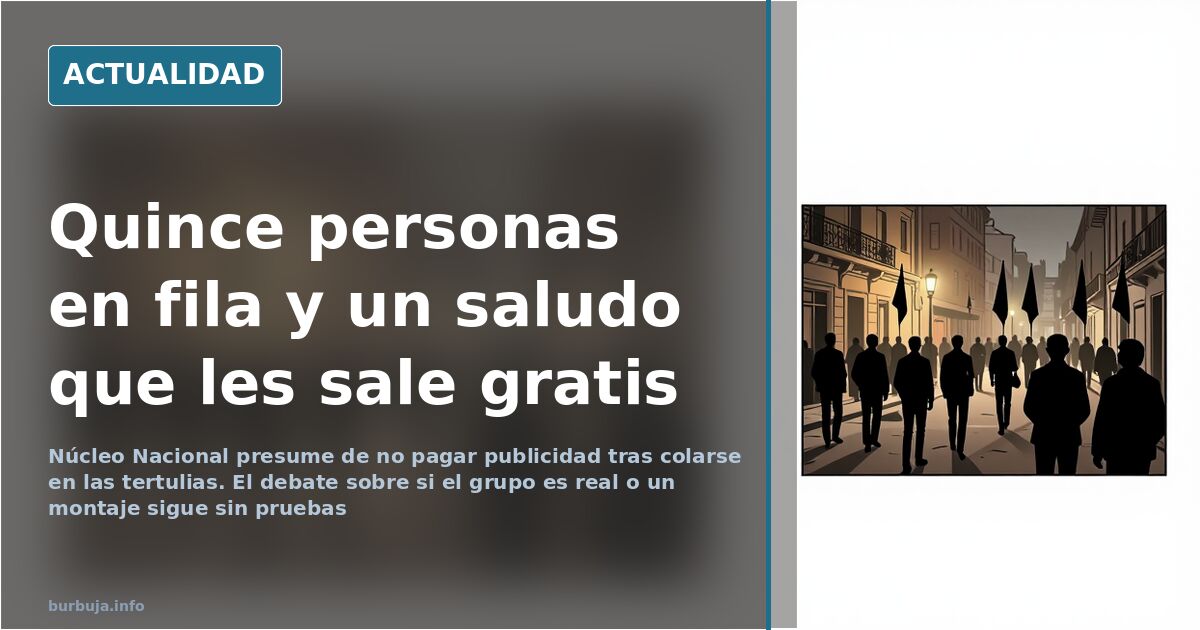
National Nucleus and the Unclaimed Aesthetic Circus
A ten-second video with fifteen people in a line, arms raised, and a call for November 8th. With this material, a far-right group has achieved what takes others years: appearing on all the talk shows without paying a euro for advertising. The group itself celebrates this unashamedly, calling the coverage it receives "zine" (a play on cinema). They imply the coverage serves as advertising. And this is where the uncomfortable question arises: if the scandal feeds them, who benefits from keeping it alive?
What is National Nucleus and What Did They Do
The group presents itself with an aesthetic that directly references the 1930s: hoods, black flags, nighttime flares, and extended arm salutes. In circulating clips, a woman appears as the visible face before a line of men, and the group announces gatherings for the weekend of November 8th and 9th under slogans like "Don't stop until you conquer."
The staging is not accidental. A good part of the discussion revolves precisely around why this imagery, as recognizable as it is controversial, is chosen instead of a more discreet format. Those who defend the group argue that the martiality and interwar aesthetic are more appealing to the public than political correctness admits. Those who criticize it respond that this fidelity to the past is precisely what makes them an easy scarecrow to ridicule.
Authentic Group or Orchestrated Hoax?
Here the analysis splits in two. One current holds that it all smells of fabrication: that if the group were real and dangerous, its members would already be identified, with their details and faces exposed by opposing groups. The absence of such a targeting campaign is seen, from that position, as an indication that there is no genuine militancy behind it.
A second, colder analysis sees not a hoax but opportunism: people acting on their own and taking advantage of a gap left by others. Between these two hypotheses circulates the suspicion, never proven, of an organization created by intelligence services – the classic theory of a staged event manufacturing a custom enemy. The only certainty, as of this discussion, is that no one has provided proof, and both versions remain standing.
Television as a Free Megaphone
The media coverage soon became an issue in itself. The group disseminated a program segment to mock the fact that they were dedicating minutes to it and joked about offering a spot to a TVE editor if they were fired. For a segment of the public, public and private channels have become the far-right's best communication agency: broadcasting the videos functions as an involuntary showcase.
It's the old "boogeyman" mechanism. The more the image of the hooded figure is broadcast, the more the sense of threat spreads, and the more benefit is given to those who want precisely that. The repetition of the scene, some argue, ends up integrating it into the landscape.
The Background: VOX and the Gap to Their Right
None of these performances can be understood without the electoral map. VOX appears in the discussion described as a party domesticated by the system – aligned with Brussels, NATO, and employers – and therefore incapable of covering the flank that these groups try to occupy with noise and aesthetics. The question hovering is whether that gap is real or imaginary.
The calculation is long-term. Some see in these scenes the embryo of an alternative that will one day compete for space. Others reduce it to posturing without substance: lots of photos, little structure, and zero program. What does seem clear is that the noise gives them visibility they don't have in votes.
The Aesthetic Some Consider a Hindrance
The most repeated criticism is anachronism. Reproducing the uniform, the salute, and the parade does not project power: it projects a costume. The image that repels ordinary people, another forum user argues, is not the interwar paraphernalia, but that of the thug disguised as a fighter. And that register, they say, is what truly generates rejection.
Against this, the group's defense appeals to a supposed "healthy masculinity" and the need for tough people for whatever comes. The counterargument is devastatingly simple: those who seek real power do not dress up, they act without being seen. Appearance is only cultivated when there is nothing yet to offer.
With the publicity they give each other and the publicity others give them, the group should grow. For now, it only gets minutes on television. It remains to be seen how many of those minutes translate into something other than a new controversy.
Forum Voices
A ten-second video with fifteen people in a line, arms raised, and a call for November 8th. With this material, a far-right group has achieved what takes others years: appearing on all the talk shows without paying a euro for advertising. The group itself celebrates this unashamedly, calling the coverage it receives "zine" (a play on cinema). They imply the coverage serves as advertising. And this is where the uncomfortable question arises: if the scandal feeds them, who benefits from keeping it alive?
What is National Nucleus and What Did They Do
The group presents itself with an aesthetic that directly references the 1930s: hoods, black flags, nighttime flares, and extended arm salutes. In circulating clips, a woman appears as the visible face before a line of men, and the group announces gatherings for the weekend of November 8th and 9th under slogans like "Don't stop until you conquer."
The staging is not accidental. A good part of the discussion revolves precisely around why this imagery, as recognizable as it is controversial, is chosen instead of a more discreet format. Those who defend the group argue that the martiality and interwar aesthetic are more appealing to the public than political correctness admits. Those who criticize it respond that this fidelity to the past is precisely what makes them an easy scarecrow to ridicule.
Authentic Group or Orchestrated Hoax?
Here the analysis splits in two. One current holds that it all smells of fabrication: that if the group were real and dangerous, its members would already be identified, with their details and faces exposed by opposing groups. The absence of such a targeting campaign is seen, from that position, as an indication that there is no genuine militancy behind it.
A second, colder analysis sees not a hoax but opportunism: people acting on their own and taking advantage of a gap left by others. Between these two hypotheses circulates the suspicion, never proven, of an organization created by intelligence services – the classic theory of a staged event manufacturing a custom enemy. The only certainty, as of this discussion, is that no one has provided proof, and both versions remain standing.
Television as a Free Megaphone
The media coverage soon became an issue in itself. The group disseminated a program segment to mock the fact that they were dedicating minutes to it and joked about offering a spot to a TVE editor if they were fired. For a segment of the public, public and private channels have become the far-right's best communication agency: broadcasting the videos functions as an involuntary showcase.
It's the old "boogeyman" mechanism. The more the image of the hooded figure is broadcast, the more the sense of threat spreads, and the more benefit is given to those who want precisely that. The repetition of the scene, some argue, ends up integrating it into the landscape.
The Background: VOX and the Gap to Their Right
None of these performances can be understood without the electoral map. VOX appears in the discussion described as a party domesticated by the system – aligned with Brussels, NATO, and employers – and therefore incapable of covering the flank that these groups try to occupy with noise and aesthetics. The question hovering is whether that gap is real or imaginary.
The calculation is long-term. Some see in these scenes the embryo of an alternative that will one day compete for space. Others reduce it to posturing without substance: lots of photos, little structure, and zero program. What does seem clear is that the noise gives them visibility they don't have in votes.
The Aesthetic Some Consider a Hindrance
The most repeated criticism is anachronism. Reproducing the uniform, the salute, and the parade does not project power: it projects a costume. The image that repels ordinary people, another forum user argues, is not the interwar paraphernalia, but that of the thug disguised as a fighter. And that register, they say, is what truly generates rejection.
Against this, the group's defense appeals to a supposed "healthy masculinity" and the need for tough people for whatever comes. The counterargument is devastatingly simple: those who seek real power do not dress up, they act without being seen. Appearance is only cultivated when there is nothing yet to offer.
With the publicity they give each other and the publicity others give them, the group should grow. For now, it only gets minutes on television. It remains to be seen how many of those minutes translate into something other than a new controversy.
Forum Voices
— On the theory of artificial fabrication
— Criticism of the interwar aesthetic
— Coverage as an involuntary megaphone
Summary of a discussion on Burbuja.info - Foro de economía, actualidad y política., translated from Spanish and reviewed before publication. Read the full discussion (292 replies).
More summaries
-
Pedro Varela joins Núcleo Nacional in Valencia
Núcleo Nacional announces Pedro Varela as speaker for their Valencia conference on September 26, requiring a €10 donation to attend.
-
The reproach to the far right: rallies yes, children no
The internal reproach to the far right pits the rally as a political gesture against birth rate as a long-term strategy for its project
-
Juan Soto Ivars Divorces Amidst Professional Success
Journalist and writer Juan Soto Ivars is separating from his wife with two young children just as his career takes off, marked by bestsellers and national television.
-
Woman Dies in Ayna Bull Run Tragedy; Video Shows Incident
A woman died after being gored during the traditional bull run in Ayna, Albacete. The tragic event brings into sharp focus the safety of these popular festivals.
-
Camryn Manheim and the ‘gay son’ she wished she had
A quote attributed to Camryn Manheim—wanting a gay son and dressing him in drag—reopens the debate over identities imposed on children
-
Vegan raw-food influencer dies at 39 after extreme diet
Zhanna Samsonova, 39, a raw-food influencer, died in Malaysia from an infection worsened by the 'exhaustion' of an extreme fruit-only diet